Entry #203
August 11, 2025 — 12:15 AM
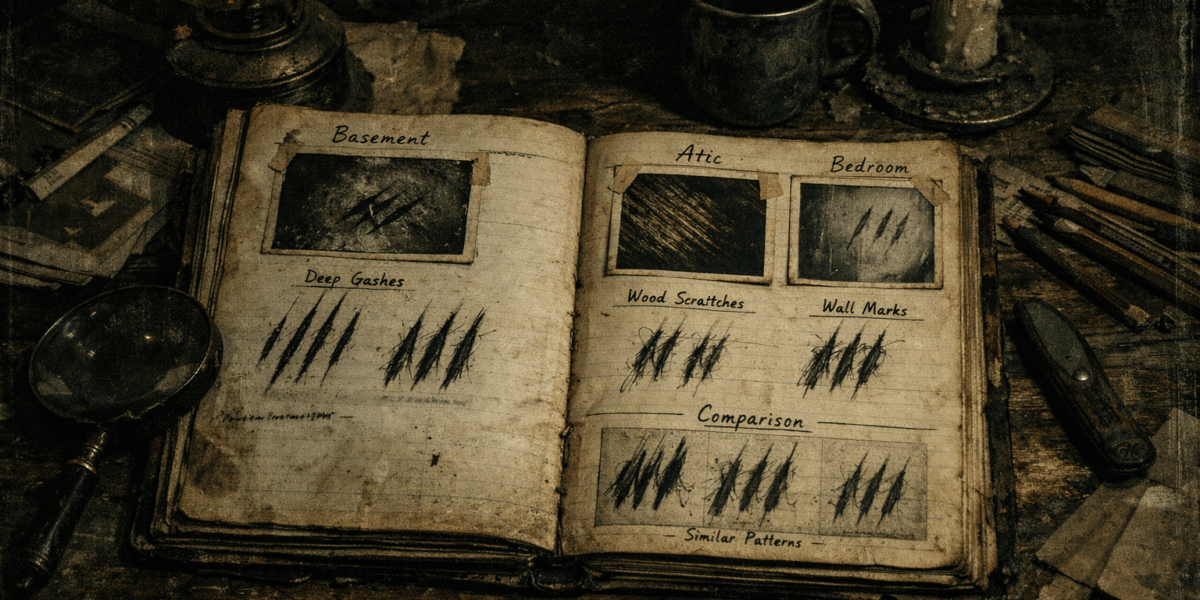
The table is covered in rubbings and scraps. Graphite on tissue, charcoal on freezer paper, painter’s tape marked with Sharpie. I sorted them into five stacks: cellar, route, chamber, upper level, oldest core. The lamp turns the paper edges yellow and makes the pencil shines look wet. When I move a sheet, the fine grit from the sanding I did earlier whispers under it.
Cellar first: deep, confident cuts, usually in old growth sills and the rough undersides of stair treads. The recurrent unit there is a pair of verticals with a shallow V incised between them, sometimes with a tiny nick at the right foot. Tool work, not knife play. Grain bruised, darkened by time. Where the air was coolest this afternoon, I found them high on the joists, where you wouldn’t lean a shoulder.
Route next: the path between kitchen and back hall, the run along the main stair, the inside of door casings. These show a single long stroke crossed low, like a flag without the flag. More variation here, some done in graphite over shellac, others chiseled into raw wood inside hinge mortises. Always on the side you face when moving toward the back of the house. In “Built to Keep” I thought they might be directional. They are, but they also coexist with other shapes in a way direction alone doesn’t explain.
Chamber: the sealed room we opened in “Where Hands Returned.” On the door lintel and inside, near knee height, I keep finding the double tallies bracketed on the left by a short, shallow curve. Same hand as the cellar cuts in depth and steadiness, but laid over newer paint layers. Old thought repeated in a fresher surface.
Upper level: softer pine, more scribal. Here the marks shift into graphite dots under or beside the longer strokes. Dot on the right when the route-cross is present; dot on the left when the chamber-bracket appears. In one closet, the dot is all there is, three in a triangle, ghosted by sanding dust.
Oldest core: the studs around the central chimney mass and the back of the original stair carriage. These are the most stripped-down—single chisel bites, no crosses, no dots, just scarce hash marks so deeply oxidized you have to catch them at an angle to see the shine go dull. On the underside of the second tread I pried loose, I found the word BLACKWOOD carved in thin, practiced letters, then nailed back over. The name isn’t a flourish; it uses the same knife as the bracket’s curve. I typed it into the county search; nothing turns up but a broken scan of a land transfer index from the 1890s with a smudged BLA— that could be anything. No births, no deaths. I don’t know if it’s a maker, an owner, or a witness.
Mapping across stacks, certain units keep each other’s company. The cellar pair-with-V almost always shows up within six feet of a route-cross, but never with the chamber’s bracket unless there’s also a dot. The dot favors the upper level, but when it appears downstairs it is always pencil over varnish, never cut first. That looks like sequence to me: a base mark, then an addition, then an annotation once surfaces were finished. Later marks descending from older ones, not just pointing the way but labeling a condition.
I taped the rubbings together on the wall until they made a low-resolution plan of the house. What falls out is not a compass but a ledger. The co-occurrences feel like columns: one set for transit, one for status, one for event. I can’t read the words, but I can see where the same combinations repeat and where they do not. The chamber’s bracket never lives alone. The cellar’s pair-with-V never takes a left-hand dot. The upper dots cluster near where I sanded back to bare wood in “Against the Grain,” as if whoever made them returned and revised the record after finishing work.
It’s provisional. I could be forcing symmetry out of noise. Still, each family of cuts shows preference and aversion, like breeds sorted in pens. Repetition distributed through a house feels less like damage than administration.
— Thomas Hale