Entry #204
August 14, 2025 — 1:00 AM
I cut the work lights an hour ago and told myself to sleep. Instead I went back to the oldest run, the narrow route between the chimney stack and the back stair where the framing shows its first decisions. The air there is cooler by a few degrees, dry with ash memory. Even in summer the brick gives off a mineral chill you can feel in your teeth. Dust tastes like plaster and old paper.
I brought only a small lamp and a hand level. I’d opened a pocket between studs earlier to see if I could thread conduit without chewing more than necessary. The lath on the far side is hair-thin and shed a fine, horsehair filament when I touched it. Nails are square, hammered flat. The original joinery is stubborn and slow. The house keeps what it can.
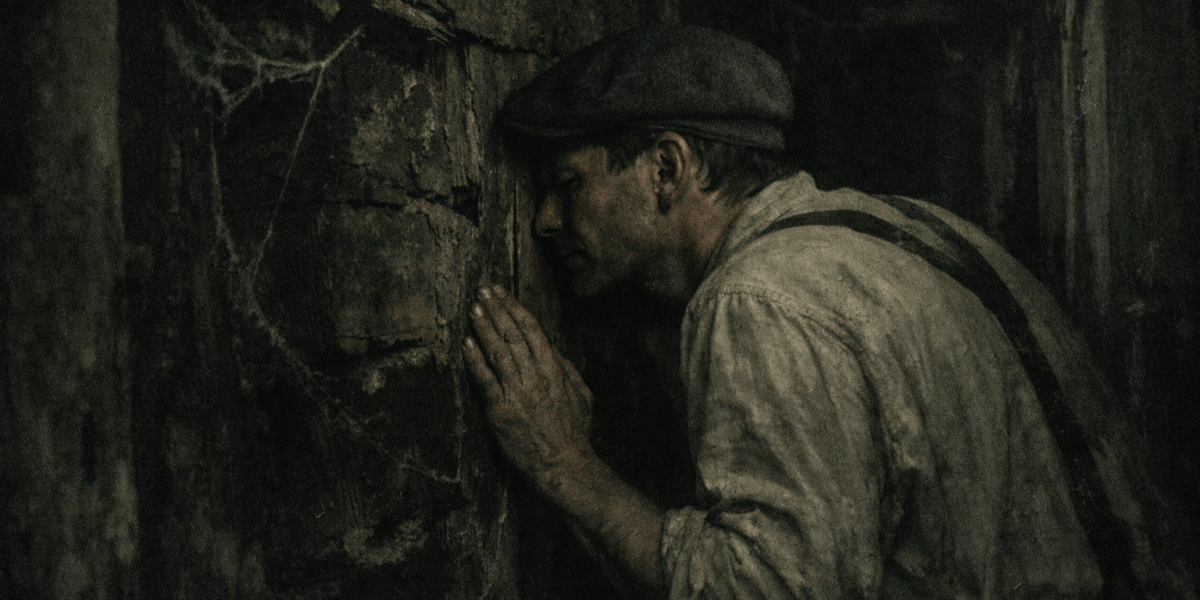
Standing with my shoulder to the chimney, I heard a cadence in the wall. Not words—the edges were gone—but a rise and fall as clean as any pattern. It came in on a low swell, lagged, and dropped away in the same place each time, followed by a dry scuff, then quiet. It didn’t feel like it was aimed anywhere. It didn’t meet me. It was simply there, like a contour left when the thing itself has weathered out.
I stopped the lamp with my palm and held still. The refrigerator hummed under everything, but it wasn’t that. No wind through the flue tonight; the damper was sealed until I redo the throat. Plumbing was asleep. I pressed the flat of my hand against the stud. The sound was truer through the wood than in the air. Ear to the grain, it felt pinned to one face of the stud, the way a knot pins light. Four soft beats of shape, a breath-length, the faint rasp—then again. It would break, start over, and land on that same pause, like a record without its needle, tracing grooves with nothing sharp enough to make it speak.
Part of me cataloged causes. Expansion in a hot day’s cooling. A squirrel. Old plaster settling on lath. But the rhythm was too human to be mechanical and too regular to be animal. It didn’t vary when I knocked. It didn’t answer anything. It only continued. The house, which has preserved rooms like pockets and names in paint under paint, might be keeping this too. The way pine holds pitch long after the tree is gone. The way a ledger holds debt you think you’ve settled because you forgot you wrote it down.
There’s a short section of skirting in that route that never fit right. I eased it off earlier to look for wiring runs and set it on the stair. Behind it, on the back of the stringer, someone had carved a word all the way through the first summer of the wood: BLACKWOOD. The letters were cut deep with a chisel point; you could feel the small ridges where the steel lifted out at the end of each stroke. Soot has slicked the high spots, like a hand over years.
I took a photo and tried a quick search on my phone on the stair, ash grit sticking to my knees. Blackwood with the town name, the county, this road, surrounding townships. A few trees. A stone supplier three counties over. Nothing that links to this place. The deed will say something when I pull the older volumes at the office, but the public registries I can reach from a screen gave me no one who lived, married, or died here with that name. The absence wasn’t useful, only plain.
I shut the lamp again and stood with my ear against the carved stringer. The cadence found me through the wood. It wasn’t stronger for my listening. It didn’t turn to me. It ran its curve, let the breath fall, and left the rasp where it always left it. I listened until my knees ached and the chill from the brick moved into my jaw. What reached me in that space did not behave like presence. It behaved like retention. Some sounds no longer seemed alive, only retained.
— Thomas Hale