Entry #123
May 24, 2025 — 1:00 AM
Overcast this afternoon—the kind of flat light that makes surfaces honest. I set aside plastering and spent the hours with a screwdriver and a rag, opening what opens.
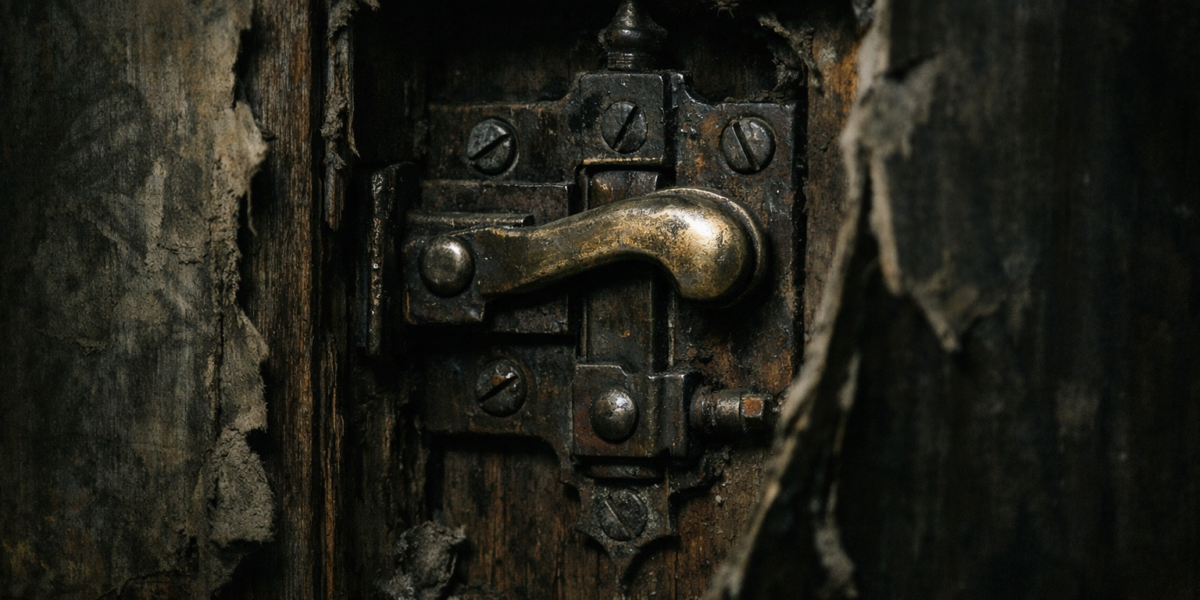
The small hinge inside the hall panel (the one revealed when I pulled the baseboard last month) has no reason to move smoothly after decades. Yet the knuckles showed a crescent of bright where the pin turns. Not fresh, not oiled—just burnished. The leaves are dark gray, but the line of contact gleams like a knife’s edge. The screws are mismatched; two brass, one steel, one slotted so thin my driver slipped twice and clicked off the face. Someone cared enough to replace them as they stripped. Someone kept that door working because they needed it to work.
On the east landing, a sliding board low to the wainscot rides in a captured groove. The upper lip is rough with paint drips, but the lower track is slicked smooth as if a river ran there. I pushed it open a hand’s width and felt the old habit in it—the initial resistance, the learned angle, the small drop as it clears a knot it has cleared a thousand times. Dust lives on the ledge, but in the groove itself there’s a dark polish from long goings and comings. The underside carries the ghost of a thumb: oil-darkened wood where fingers hooked and tugged. Not one tug. Many.
In the second-floor corridor, the peephole cap from Entry #120 has a latch with a bevel worn onto the tongue. Strike plates don’t bevel themselves. The jamb directly opposite shows a shallow arc chewed into the paint—paint layers scalloped back to bare wood in a repeat of the same movement, the same line of travel, tight as compass work. I found another of those arcs behind the linen press, as if something hinged across there often enough to etch its own diagram into the wall.
In the crawl under the stairs, a bolt secures a panel from inside. The bolt’s head is ridged, but the ridge tops are rounded off from thumbs. When I worked it, the spring gave a practiced note. Not rusty complaint. A memory of closing. Beside it, a faint scratch almost lost in the grain: E.B. Or B.E. The gouges are shallow and careless, not presentation. A name flicked in while waiting for a handhold to free.
I am trained to read wear, to tell habit from accident. This house keeps its notes in metal and oak. Latches with bright mouths. Hinges bright on the turn. Boards sliding where only boards should know to slide. Grooves with more traffic than any vermin could explain. The hidden parts are not novelties. They are fixtures. The architecture has secret habits built into it.
I stood in the dim and counted: open here, slide there, lift, bolt, look. Not a story, just a sequence that once lived in a body. Routines are grooves cut into time as much as wood. They don’t happen a few nights and then stop. They live and live until the parts know them.
The day stayed gray, and by evening the rooms cooled. Metal kept its chill even under cloth. I wiped my fingerprints from the brass because my hands are not part of their history. I don’t know who did these things or why. I only know the persistence of touch. Mechanisms do not smooth themselves through neglect.
— Thomas Hale