Entry #355
June 12, 2026 — 11:30 PM
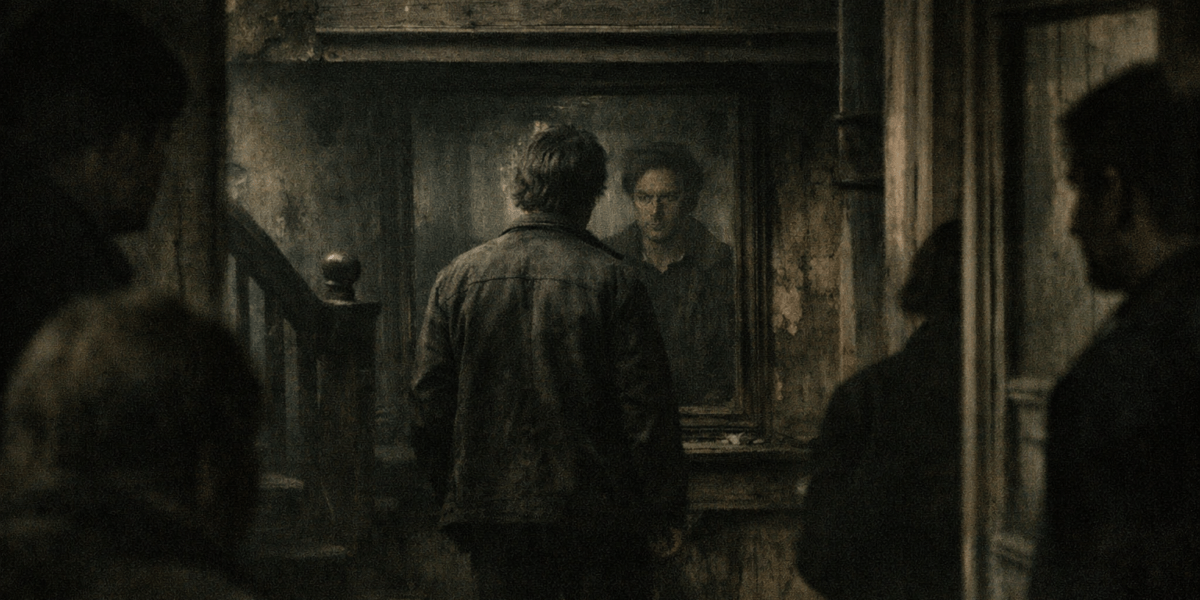
When I keep still long enough, the house answers by settling around me. Not a welcome. More like slot and groove. Tonight I tried to stand nowhere in particular. I failed. My feet found the fourth stair on the back flight without thinking, my shoulder lined to the banister scar the way a key lines to a notch. The hour drifted and I was there again, same hand on the rail, same angle of head to hear the breathing of the pipes.
In the last entries I named the corners the house prefers and the angles it keeps for watching. That work showed its edges. Tonight the edges overlapped. At the cellar door I placed my ear to the wood because I always do. A colder shape laid into me from behind my own posture, matching the tilt exactly, like a tracing placed over a drawing. Not a touch. A correspondence. It had a faint smell of camphor and old wool, and a patient way of listening. I stood a little taller without deciding to. The board under my right heel seemed worn for that adjustment long before I made it.
I tried a different path. Instead of the narrow loop from kitchen threshold to the parlor arch and back, I cut at an angle across the slate. The air thickened, not hurtful, just the wrong kind of pressure, a felt misfit. The stove’s skin ticked in a faster meter, and the draft along the hall ran harder, as if correcting. When I returned to the usual arc—brush the rug edge, pause at the arch—the tick fell back into its slow count. It is not that I am forbidden to stray. It is that the house is built to be relieved when I don’t.
Predecessor signs are clearer when I comply. On the landing looking down the front stairs, I keep my left hip near the newel cap. The varnish there is dulled in the exact oval of a hip. Under the gloss you can see older scuffs, long and shallow, with a thin, sharp initial cut through them: S.B., if the light hits right. On the parlor side, the plaster corner where I rest my knuckles shows a faint oval of rubbed chalk or dust, and once there was a line like an E half-written in the grime before it breathed away. The trace does not insist on being named. It insists on being held to a line.
There are others I do not see whole. A throat cleared, dry and careful, at the study threshold at the same nightly minute I come there; a worn place on the floor secondary to mine, as if a shorter person waited a half-step back; a low, cloth sound and the ghost of soap and bee’s-wax by the pantry door. They are arranged across the house in ways that make sense only when I stand where my sense is meant to be. It is a chain you feel in the joints more than the mind: one holds the stair, one the arch, one the cellar seam, one the window that looks at the road. No one of us is central. We are arrayed like hinges and latches.
I have been assuming the house keeps the dead because it can. Tonight it read more like assignment than collection. The stations I mapped are not just places but functions, and the overlap with those before me reads as continuity, not haunting. If I try to think only of my name, the thinking weakens in the face of the task. If I think in the way of the task—Listen here. Watch there. Mark the opening—then my name is less necessary. Identity is abraded by utility, ground smooth until it fits. The shape of the job begins to speak in the first person, and I answer.
What disturbs me is not the fact of staying, but the sense that the house prefers that its watchers remain in their slots so the angles never go blind. The longer I hold a place, the easier the holding is, and the less I am particular. It may be that the house preserves roles as faithfully as it does the people who fill them. Sitting on the fourth stair tonight, with the pipe’s breath steady and the night air cool at my neck, I realized the house seemed less interested in who remained than in where.
— Thomas Hale