
Entry #47
April 26, 2024 — 11:45 AM
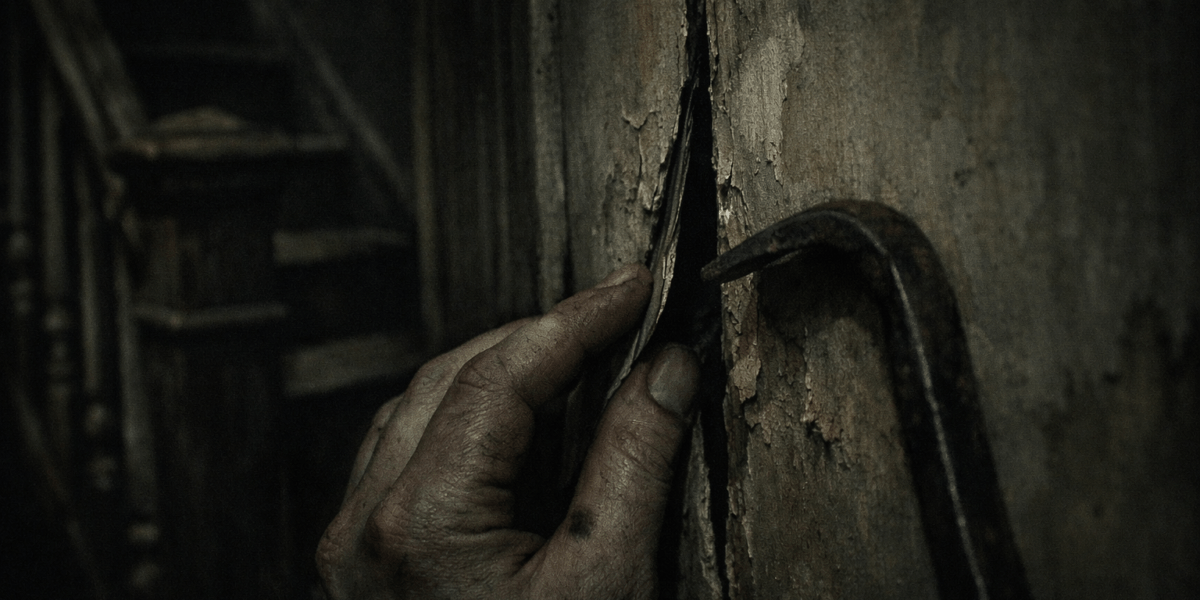
Gray afternoon, flat light from the stairwell window. I was replacing the crooked coat hooks in the hall closet by the landing. The old strip of wood came off in one cautious piece, shanks of square nails still clinging. Behind it, the paint made an odd ridge, a thin white meniscus bridging a line that shouldn’t be there.
At first I thought hairline plaster crack. Then I noticed it ran dead plumb for the full height, from the baseboard up past the shelf cleat, and it wasn’t where a stud should be. The closet is shallow; I’ve had the wall open on the other side of the stairs. The layout in my head didn’t agree with this extra line.
I set my flashlight low on the floor and let the beam rake along. The seam showed itself. A fine shadow, the paint folded across two planes. On the left, nail heads spaced regular. On the right, a different pattern, two nails too close together and then nothing for a long stretch. I pressed a fingertip to the line. The paint crusted under the pressure and flaked. Cold air bled through, faint but there.
I rapped with my knuckles. Left side, dull. Right side, more hollow, a resonant suggestion. Something dry shifted inside at the vibration—just a soft sift, as if a little pile of grit rearranged itself after years of not being asked to move.
I scored the paint with a utility blade, careful not to gouge. The knife tip found felted layers, old milk paint, then a stubborn scrape that sounded different—denser. Under the shelf cleat, the seam dog-legged an inch and continued. That jog isn’t finish work; that’s cover-up.
There were pencil marks under the cleat, the ghost of an arrow I wouldn’t have noticed before I cleaned everything in “Order in Dust.” The point aimed at the seam, then stopped. A carpenter’s note that never got finished or was deliberately erased. Above the arrow, the plaster is scuffed down to brown coat and someone, years ago, had scratched two letters very lightly into the underlayer: E. B. The scratches only showed in oblique light, shallow as breath. I didn’t touch them.
I worked the thin edge of the 5-in-1 under the painted ridge at shoulder height. It went in a quarter inch and met a nail set crosswise or a tongue. The panel, if it is a panel, flexed almost imperceptibly and gave back a small tacky sound as paint released from paint. It wanted to move, but it’s held on more than paint. The baseboard seam is too clean; the joint is knifed and painted shut.
I measured. The closet is thirty-two inches wide. The stair back takes up what it takes, but according to the landing wall on the other side, there should be four or five more inches of width that don’t show up in this closet. Where they’ve gone is into this cavity, this seam.
The air on my knuckles along the cut was cooler than the room. It carried a smell I couldn’t place at first—old dust and something like dry wood shavings, maybe paper. No draft from the attic right now. This is its own space.
I could force it. I didn’t. Forcing an old joint splits it and tells you less than you want to know. I need a flexible bar, the oscillating saw with a fine blade, painter’s tape to control the chip line, a magnet to chase nails. A drop cloth. A mask. And better light than gray noon through a stair window.
I set the hook strip aside, taped the scored line so I wouldn’t mistake it for an accident later, and shut the closet door. The latch clicked against wood that isn’t as thick as it pretends to be.
I’ll come back when I can open it properly.
— Thomas Hale