Entry #266
January 17, 2026 — 12:15 AM
This afternoon the cold held steady in the rooms, the kind that sits in the plaster and comes back through your gloves. I pulled the dining-room baseboard to chase a leak and found pencil on the raw wall where no one was meant to see: small arrows, numbers in a run that should have gone to seven and stopped at five. The last two were sanded to a smear, as if a thumb rubbed them flat in a hurry. The baseboard itself had a strike mark chiseled short so it would never seat true without a fight. Not accident. Interference.
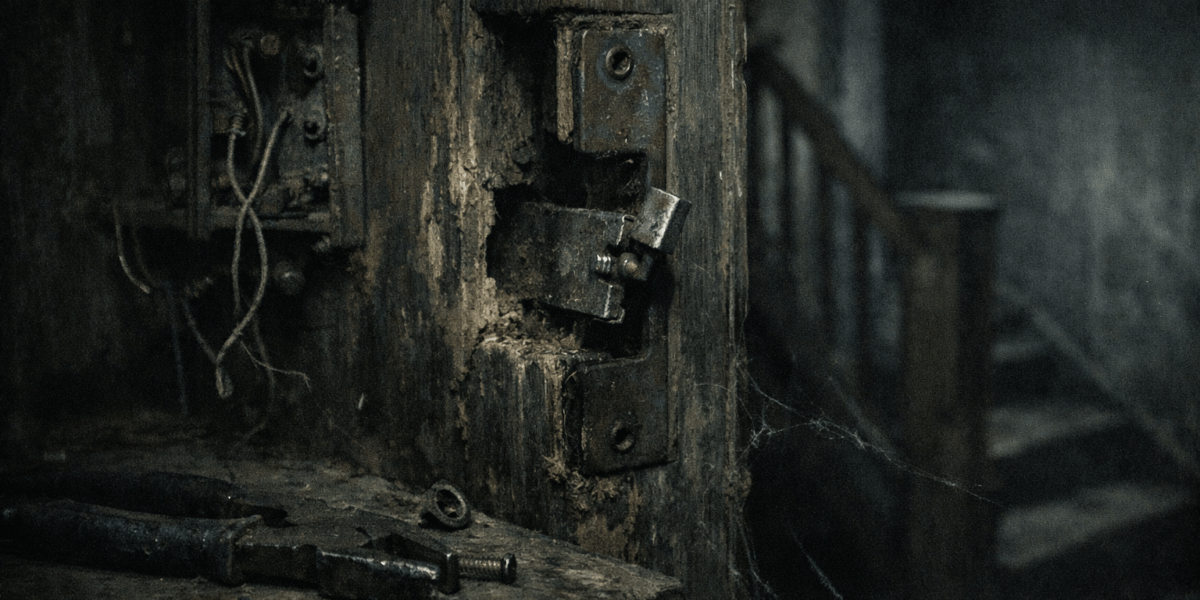
It repeats. The parlor door: hinge mortises filled with slivers of cedar on one side, so the door never hangs exactly plumb, so it snags and refuses a clean close. The strike plate has been set a fraction high, a bright shim hammered behind it and then painted to disappear. If a sequence here depends on a latch catching and a latch releasing, someone tried to cut it on the hinge of that action.
Under the front stair I found a mismatched tread—white oak where the rest are red. On its underside, in the dust shade where saw never reached again, faint tally strokes: five grouped, a gap, two, and then the ghost of a wiped eighth. Next to it, “S.B.” and, further along the carriage, a careful “E.B.” in a different hand. Between them: 6/14. No year, but the deed in my folder shows Samuel and Eleanor Blackwood signed on June 14, 1891. The carpentry says they were here with a knife and pencil, marking what the stair did to a day—or what the day did to the stair. Whether they were the first to keep account of the house, or the first the house forced into being counted, I can’t say yet. The initials sit there like a witness that doesn’t elaborate.
On the mantel’s underside, a neat line of notches runs left to right. One is planed shallow, almost gone. In the hearth, one tile is rotated a quarter turn. In the pantry, the bell pull has been shortened by a hasty splice so it will never fall to the same resting point. The dumbwaiter track wears a nail set proud in one rail to jar the carriage. A clock niche upstairs has two extra screw holes, as if a pendulum leader was swapped for a shorter one to alter the beat. All of these are breaks at the same kind of point: not structure, but practice. Points where the body does something without thinking—shut, step, pull, place, time.
I don’t mistake any of this for carelessness. Whoever did it understood that vulnerability lives in procedure. They tried to snip the thread mid-stitch. And yet I can see why it wasn’t enough. Habits repair what tools undo. Someone will come along and file the proud nail flat because it scratches. A door that won’t close right gets planed true by a conscientious uncle. A tile out of square itches a new owner until they set it straight. Even when left, the hand finds its old route: feet relearn the same rise, the bell wants the same pull, a borrowed clock gets adjusted “correctly” out of irritation. The system gathers itself from those small obediences. It doesn’t need force when it has repetition.
Past resistance is everywhere if you bother to look for the skipped numbers and the wrong wood at the right step. It’s more persuasive than any story because it requires no interpretation. It simply exists in the joins and the margins, in fixes that refuse to be fixed. Failed resistance is often the most honest archive a place can keep.
— Thomas Hale