
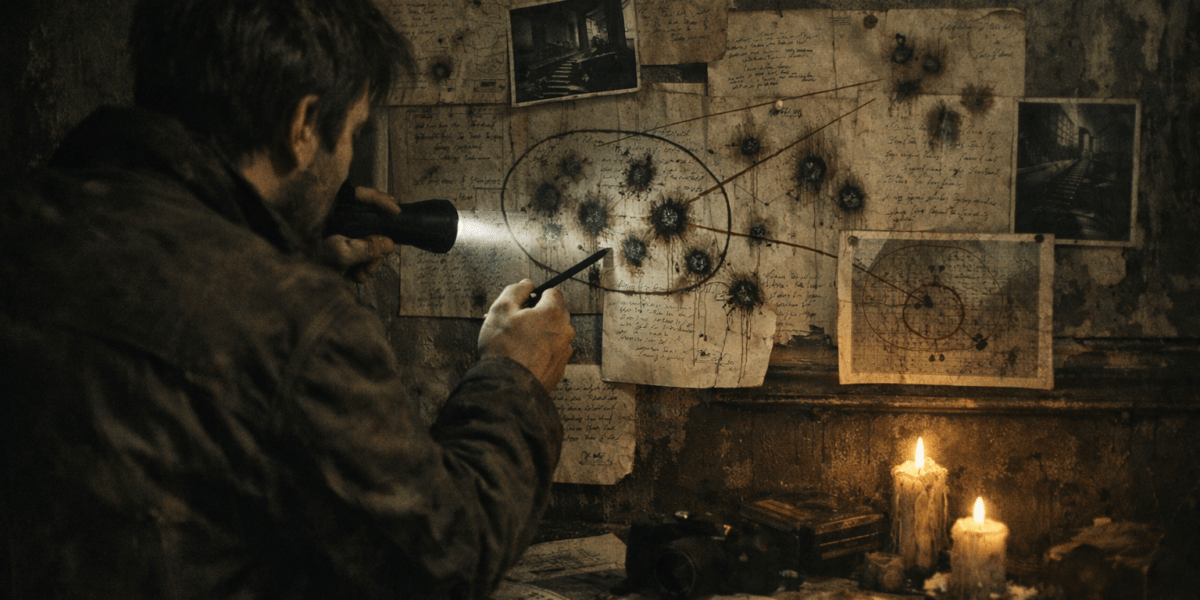
Entry #357
June 17, 2026 — 1:00 AM
This afternoon I moved between five places and did little more than stand, look, and come back again. I called them stations to myself: the parlor window with the bowed lower sash, the newel at the stair bend, the pantry threshold with its glossy foot-wear, the cellar door’s latch line, and the attic dormer where the seam in the glass makes a second horizon. I tried to treat each like a watch post. Nothing dramatic. Just return, hold, take note.
At the parlor window a pale block of light lay on the rug like a folded sheet. Dust rose and sank along the sunshaft. A waxy, old-linen smell held in the fibers. When I came back the third time, the dust seemed to fall slower, as if the room were reluctant to forget the last arrangement. My outline stayed at the glass a breath longer, the impression of my attention paling from the pane like warmth from a touched doorknob.
The newel is rounded smooth and slightly flat on top. Under the varnish there are faint cuts, clustered, no rhyme at first glance—short verticals scored by something narrow. I matched my hand to the worn place and counted to thirty, returned an hour later and did the same. The second time the air at the bend felt thicker, like a held note. There are shallow marks on the inside face, almost regular, five and a cross, five and a cross. Tallying of days is a guess, but the rhythm is there. Below those, lower down where a smaller hand might reach, someone carved a careful E and an overcut B. The edges are bald with age.
The pantry threshold gives to the foot and remembers the heel. On the backside of the door I found pencil lines half-vanished by grease bloom: dates rubbed to smudges, a vertical series of notches checking height or time. On the jamb, near knee level, a knife point made a habit of starting in the same divot. In the cellar hall the plaster still smells faintly of damp lime when the air cools; if I stand with my shoulder near the latch and keep my head turned, something like a throat-clearing comes by, not sound exactly, more a careful settling into a posture that has been taken many times. In the attic, someone tried a fuller name on a beam and stopped—E. Black— then let the knife wander off into the soft grain. Elsewhere I’ve seen S by itself, repeated where a hand would rest. They recur at stations. Watching marks. Practiced letters.
I tried an experiment with the journal. I wrote only when I stood at a station. A page for the parlor, a page for the stair bend, and so on. When the pencil moved while my eyes held the scene, the hold on me lengthened. The room kept up the moment like a wall takes fresh paint better where it has already been painted once. Coming back grew easier. I did not have to force the shape of myself into place. The page seemed to carry a corner of the house with it, and returning the page to the place returned me as well.
I don’t have a rule to offer. Only a suspicion: stations, repeated marks, and the act of noticing—especially writing—press the witness deeper into the grain. Use wears a path, and the path does not close at night. The house preserves through use. The house seemed to remember most intensely where memory had already been practiced.
— Thomas Hale