Entry #311
March 16, 2026 — 12:15 AM
This afternoon was bright on paper and pale in hand. I watched the yard through the parlor window first. The glass held that faint delay again—my hand rose to test the smudge and the hand that belonged to me arrived a breath late, as if the window needed time to decide what I had done. Outside, the grass lay pressed and colorless from winter. The feeder moved once, no bird in sight, a single tick against the hanger wire.
There should have been more to hear. The road two houses over, the delivery trucks. Instead I got a thin drone, like a box fan in a far room. Even the wind hadn’t found its way into the pines along the fence; their needles stayed arranged, a drawing of weather rather than weather itself.
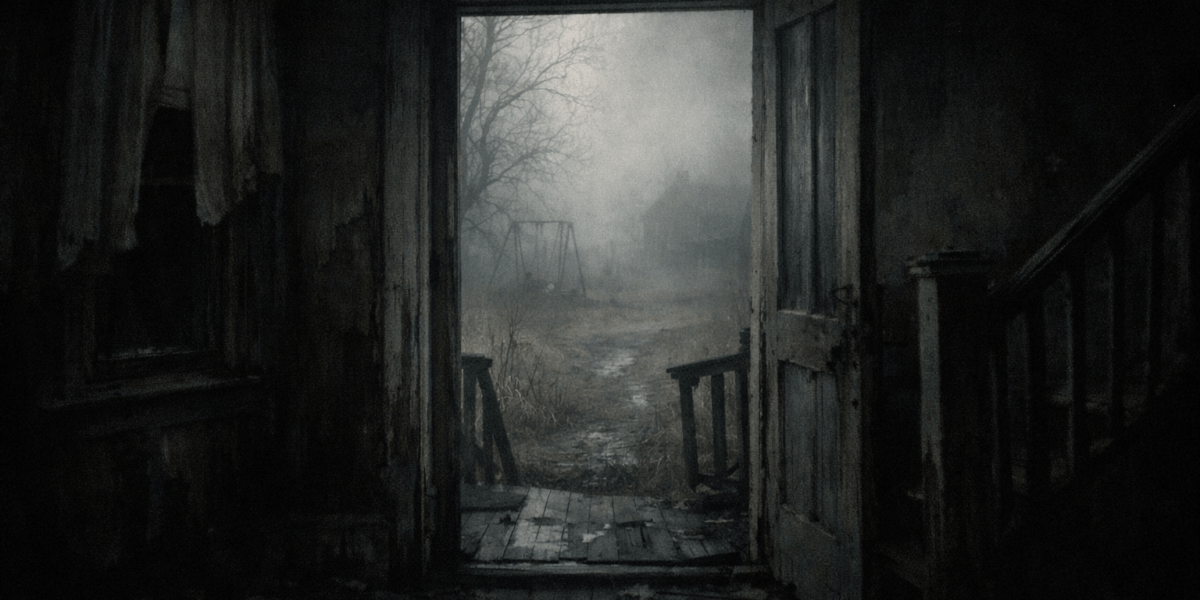
I opened the front door for the hinge report and the smell. The hinge gave what it always gives: a stretched, metallic vowel. Inside smelled of dry wood, old paper, and the iron tang that rides up from the cellar at certain hours. The air beyond the door had almost no smell at all, only a faint wetness, like cooled porcelain.
I stood on the porch and read the post again. I’d cleaned it last week, but the shallow cuts showed clearer today where the paint had given up around them: S & E in a child’s careful hand, then below, a stray B that seems newer, or maybe just deeper. I traced it with a fingernail and it gave back a grit of chalky paint. The post itself felt more here than the yard did.
The boards were holding sun but not warmth. My shadow fell across the steps with such exactness I checked twice for someone behind me. When I put weight onto the first step, the wood answered with a familiar bow and the small knock where a loose nail complains. On the path, the gravel found my shoe, but their edges barely registered. A step should make a specific sound—stone against rubber, a chuff of grit. What I heard was an approximation, as if someone had layered it in later, at low volume.
The gate latch was cold in the way of metal that hasn’t been touched all day. The thought was to go to the mailbox and bring back anything tangible: envelopes, the coupon sheaves that pretend to be addressed to me. I held the latch and looked out. The street had gone flat. Not truly—cars moved through the gap at the hedge—but distance had compressed. The far fence and the near fence read the same. The sky had good color but no depth to fall into. Wind agitated the birch catkins across the way and my sleeves lifted in answer, yet my skin registered no push or chill.
A radio somewhere ran a song I knew. It came as if from inside a tin model of the neighborhood, not the neighborhood itself. I waited for a truck to announce itself at the curve—there’s a timing to it here I’ve learned—and when it came it lacked the bass that gets into your ribs and makes the window glass scold. The house behind me, by contrast, kept its usual densities: the stair that ticks as it cools, the low hum from the refrigerator that sounds like it has a memory.
I might have been tired. I might have been between storms. The glass might have persuaded me of something that wasn’t happening. None of those settled. I let the latch fall back, its tongue finding the post with a dry click. I stood there long enough to make it awkward with myself, then I went back in and the door closed with its full weight, and the smell of the interior met me as if I had been away a week.
The yard no longer felt like a destination, only a view.
— Thomas Hale