
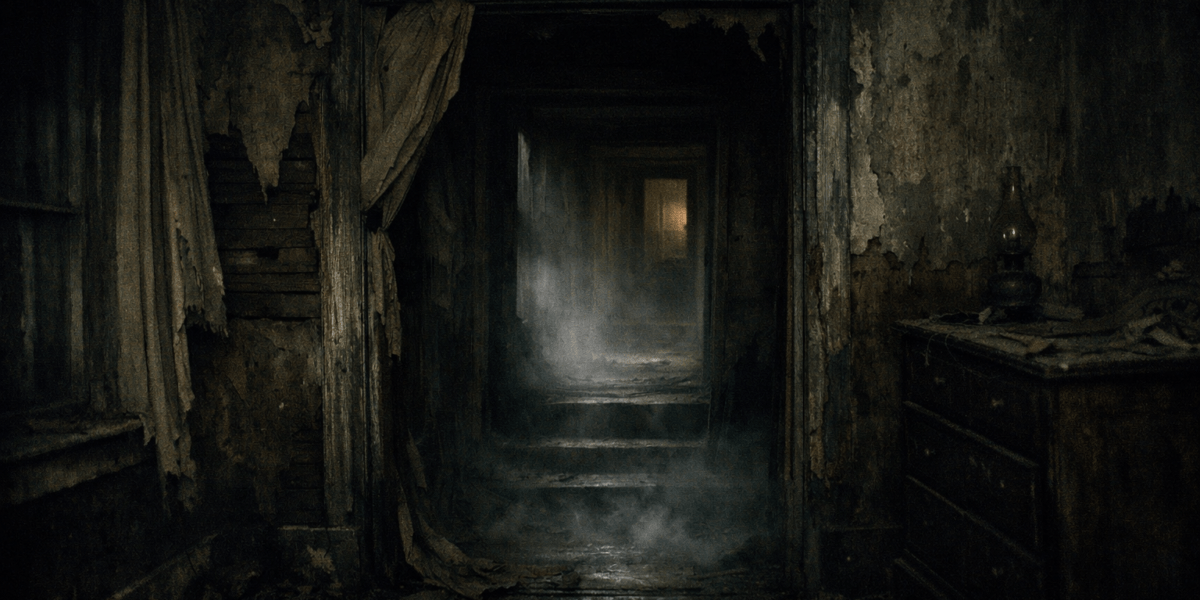
Entry #315
March 22, 2026 — 11:30 PM
This afternoon the house let me through places that used to take work. The brass knobs were dry under my hand, but most of the time my hand wasn’t required. Latches clicked on their own a hair before I reached them, a small dry sound like a throat clearing. Hinges did not complain. The odor was the usual compound—old varnish, cold iron, dust warmed by a thin strip of sun—but the air moved around me as if it had learned my shape.
The linen-closet panel on the landing—the one that needed a pry-bar and curses the first month—breathed outward at my step and stopped at exactly the space I would take if I still took up space the same way. I put my palm to the interior face. Paint ridge under my fingertips, the soft stubble where a scraper skipped. On the raw edge where it had been trimmed, someone had started to scratch letters and then painted over them. I could pick only the high points with my nail: maybe an E, a blunt hill that could be a B, or just the vestige of a knot. The wood remembered more than it showed.
Downstairs, the crooked run from front room to kitchen was shorter. The long left that always felt longer than it could be, today it didn’t. The angle in the hall flattened. What used to be a nudge at the hip from the wainscot didn’t happen. The runner didn’t catch my shoe because my shoe didn’t exactly exist in the way it used to, and because the runner lay itself smoother by a quarter inch as I approached. Dust motes shifted their spiral to widen in front of me and knit after I passed, like a current closing.
I stood in the southeast bedroom where I never stayed long. Before, there was a low push at the threshold that made my shoulders come up. Today there was no pressure. I stepped in and the window gave off a square of dull light onto the floorboards. The boards did not answer my weight. I don’t warm the air now, and the glass did not fog at my breath, but the room still altered. The smell of old soap and a sweet rot in the plaster came forward. A fly that I have not seen in days ticked against the sash twice and then was quiet. The door did not try to close me out or in. It waited at a comfortable angle like something taught to heel.
The ease is not kindness. It feels like a solved equation. Since I died, whatever gates the place keeps use a different arithmetic on me. I don’t trip the obvious alarms—the heat, the weight, the damp mark of a hand—and that aligns me with the house’s other logic. It is not passive. It adjusts. I hear it do so: the small lift of a deadbolt when I pause the same length of time I paused yesterday; the change in the pitch of the return vent when I stand over it and listen; the stair that takes half a beat to settle under my foot and then doesn’t settle at all the next time, because it has learned the cadence I bring.
I tested by turning back along the long way, putting deliberate wrong angles into my path. Still, doors opened in front of that decision, not against it. I distrust this ease. There is a difference between being welcomed and being absorbed, but I can’t tell, in the moment of an opened door, where that difference begins. An opening can be an intake if you step at the wrong time. Welcome and entrapment are often separated only by timing.
— Thomas Hale