Entry #321
March 30, 2026 — 12:15 AM
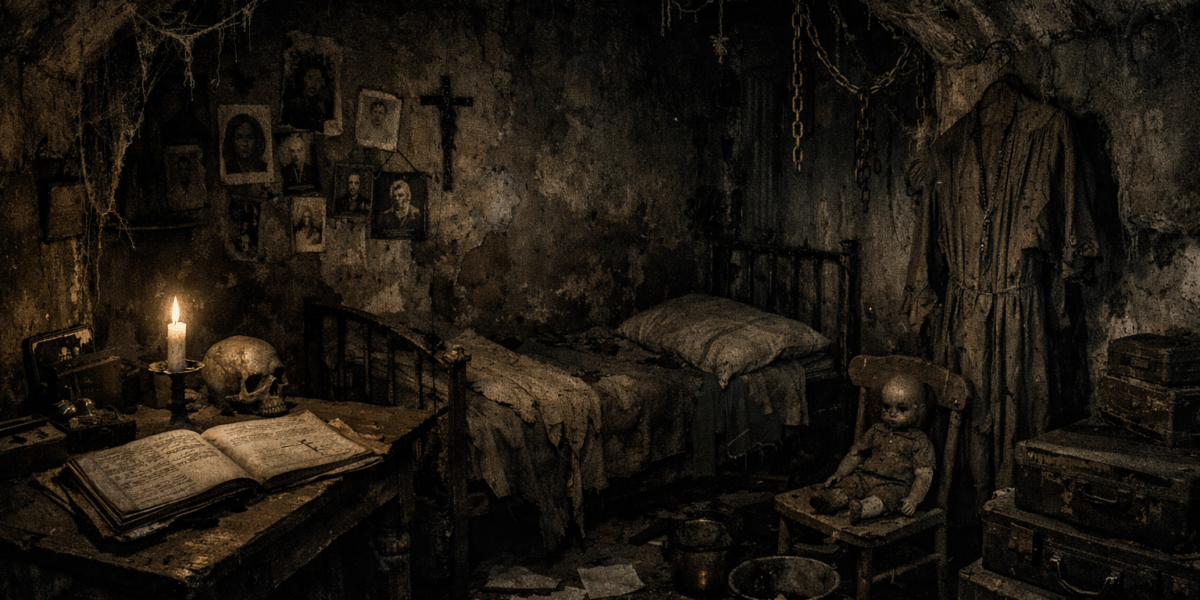
I went back into the narrow place behind the lath, the chamber I keep not telling anyone about. It felt colder than the hallway by a degree that mattered to my hands more than to any thermometer I ever owned. Dust drew its chalk rope across my knuckles. There is iron in the smell here, and a sweetness like old paste.
I did not bring a light. The room answered with its own weak fluorescences: paint that had been scuffed enough to remember daylight, mica grains in the plaster catching the little that bled from the seam under the door. I do not fog the air anymore, so I watched the surface without a veil between us. It made the finer scratches show up.
There are more marks than I admitted the first time. Some are pencil—faint graphite eaten thin by the lime. Some are soot rubbed from a hand that had been near a flue. Some are nail-scratches that bristled my fingertip. They layer. Different slants, different pressures. A left-hander who worried the tail of every T into a fishhook. Someone who made their letters like a carpenter makes notches—square and shallow. A third hand, small, printing careful blocks as if for a window card.
I had taken them for idle hiding-place graffiti. Names in a fort. Now that my own chest stays level no matter how long I hold still, the notes read differently. One line, thin as cobweb wire: “No steam on the glass tonight.” Another, in the block hand: “Count by the quiets, not the clocks.” Next to a set of strokes—twenty, then a line across, then another set. There are interruptions where the lath breaks, and the tally restarts on the opposite side as if somebody kept time with their fingers and did not want to lose the thread.
In one corner, down low near the sole plate where dust lakes collect, the left-hand writer had carved letters with a pocketknife. The edges have oxidized to the same brown as the old nailheads. S. and E., joined with a small notch like a knot where the ampersand should be. Then a long B that starts strong and dies out midway. I had seen that sigil elsewhere as ornament. Here it sits like a signature where nobody living would bother to sign.
Across from it, a much later pencil line arrows toward the notch and notes: “Still here.” The graphite has smeared. A thumbprint overlaps it—no oil, only a darkness pressed in by habit. Farther along, written sideways to stay inside a stud bay: “After-work is all work.” I touched that one. The powder came off on my finger. It was not new, but it answered.
I do not hear voices. I do not feel a crowd. It is quieter than any church. Still, the room has the behavior of a ledger: entries made by hands that had no need of a clock or a lung, registering durations and agreements the house seems to have required. I can feel how somebody, then somebody else, then another somebody again, positioned their body where mine is now and learned to read the walls by what would and would not take a mark. We make our notes where living eyes will not go, and the house keeps them. It keeps us near the keeping.
This is not a single accident or a single era. The signs arrive, pause, resume, in layers as regular as paint. The nails rust. The graphite fades to the lightest gray. The cuts stay. The house had long practice in outlasting those who thought they had merely lived in it.
— Thomas Hale