
Entry #325
April 4, 2026 — 11:30 PM
Afternoon light had come in low and colorless through the frosted bathroom window, the kind that disintegrates things into blur and grain. I went in to test the latch again. It swells in damp and complains; it’s a sound I know, a wood-throat catching. The tile held a mild chill even though the radiators were clanking elsewhere. All ordinary.
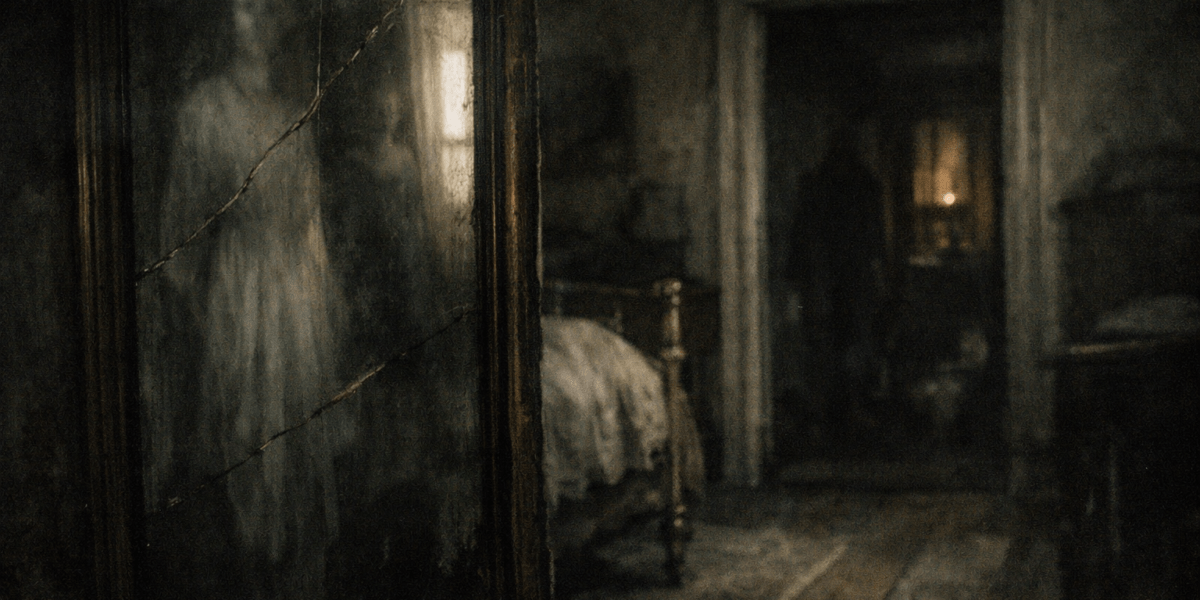
The mirror over the sink has silver rash along the margins, a slow rot. I have used it to map myself in this house, to make sure the lines of me still returned. Today the glass was true to the room but wrong to me. Standing in the doorway, I lifted my hand. The doorway in the reflection didn’t catch my hand at the same angle. The baseboard seam behind me—where the wainscot meets the corner—missed its mate in the glass by the width of a thumbnail.
I stood where the tile creaks, centered on the threshold. I did not move. Breath is a habit I have not quite laid down; when I let it stop pretending through me, the house quieted by a degree I only notice now. In that pause, the mirror settled. The seam in reflection slid into a second place and showed a shallow notch I had never seen, a raised vein of paint the exact color of the wall. I turned my head too fast and lost it; the notch wrote itself back into flatness. I re-aligned by the sound of the radiator’s last cough and stared until the mirror gave me the offset again.
There was a joint in the wainscot, disguised under coats of enamel. Not new, not recent—just a quieted fact. I put my hand there and didn’t push. I let my palm warm the paint. The latch answered with a faint inward slack, a small movement I would have missed any other day when I still assumed effort was the currency here. The panel breathed and opened a fraction. I could not have forced it. I could only agree to its timing.
Behind it, stairs: steep, tight, edged with dust that had settled in diagonal drifts. They smelled of lye and something like old wool singed. The air was cooler by a notch, not cold, just further away from rooms that expect guests. I went down three steps and stood on the fourth, where the rise gives a half-landing. The banister rasped under my fingers like paper. There were marks on the riser, low, where only knuckles or shoes would reach. A pin-scratched B, and beside it the beginning of a second stroke that could decide itself into anything if given time.
The improved access was specific. If I moved as I used to—clearing my throat, putting weight early on the heel—the panel drew itself inert and the mirror fell back into common obedience. If I let the afternoon carry the small sounds and matched myself to them, something held open. The house was not more kind. It was more legible, and only along certain lines.
It disturbed me. The steps angled me somewhere I didn’t reach. Even turning back, I felt the cupboard door watch the room for me, as if I had left a shape behind to occupy the opening I’d made. Up in the bathroom mirror, the offset seam lingered a breath longer each time, like a practiced response.
This aligns too neatly with the ledger I started—who is kept, who is made useful. I do not think the house misfiled me. I think it waited until I was filed.
The house had begun to answer in forms I had not previously been equipped to hear.
— Thomas Hale