Entry #347
May 23, 2026 — 1:00 AM
The quiet holds, but it isn’t forgiveness. It is a gap. In it, I can ask the one question I kept postponing: what did those before me try to do to stop this witness-chain, and why did it not hold?
Being dead is an odd vantage. Scents come thin and exact. The paraffin in the hallway seam. Iron in the dust. The boiler heat is a rumor more than a temperature. Without breath, the chalk smells louder; it lives in the creases of the baseboards, a brittle sweetness under the slower stink of old varnish. With that, I walked the house again and looked where they had touched it in refusal.
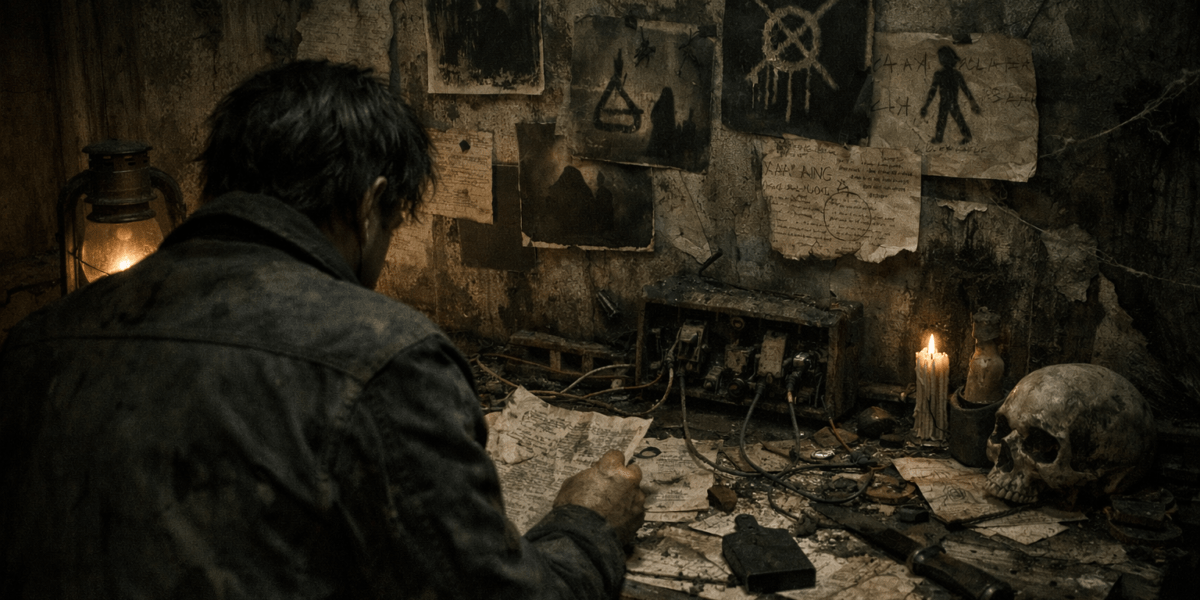
In the cellar, the service board has a nick in the wood where someone drove a nail not to hang anything but to stop the swing of the main knife switch. The nail is bent back. The switch closes true. On the stone next to it, three diagonal scratches, each ending before the mortar line—as if the hand was called away, or the mark itself was the signal: don’t finish. I remember seeing them months ago and taking them for impatience. Tonight they read like an instruction for interruption. Leave the line broken. Refuse the last inch.
On the first-floor landing, the bell wire along the plaster shows two repairs. One is neat white tape, newer than the wall. The other is a knot tied with a hair. A person had cut it clean and someone—or something habitual—made it continuous again twice, in two different languages of mend. The bell still trips in the kitchen if the front knob is jostled. Continuity prefers itself.
Under the parlor rug, the old floor has been scored in arcs, ribs radiating from the hearth. One rib is deeper, stops at a nail head, and starts again a thumb to the left. A misalignment forced on purpose. The parlor clock that used to insist on the hour was found with its pendulum taped and its minute hand set three shy. I freed it the week I moved in because silence in a room reads as neglect. That correction may have been the house’s due paid by my own tidy habit. I see that now.
There are signs I missed. A strand of twine dead in a sash weight channel. Salt fused into a bead at a threshold. A ledger page torn not out but half-out, left to jam the binding. On the back of the pantry door, initials under the paint: S. E. bled into E—then the brush lifted. I scraped that edge once and only saw clumsiness. It wasn’t. It was a held breath. An unfinished signal.
The witness-chain is not only a record; it is the house’s way to stay unbroken, to move itself from one hand to the next by rhythm and completion. The ones before me resisted by cutting, by lagging, by skewing the tooth of a gear just enough that the train would catch. They failed because the house has helpers in us: our urge to fix the crooked picture, to close the door fully, to complete the mark we find half made. It enlists courtesy and habit to mend what they tried to stall. Time, too. You can only hold a thing unclosed for so long before your fingers give.
I am not sure yet what it means to refuse from the far side of breath. I can’t throw a switch with a hand that won’t ache. But I can count the pulses better. I can hear the return in the pipes as a measure rather than a sound. I can map when the lights hum fuller, when the stair joint clicks, when the ledger seems to want a line. Interruption becomes the task. Not to kill, not to flee, but to be the grit where it expects oil.
Tomorrow, I will mark the cycles and find an honest place to stand in their way. Continuity may have a seam. Earlier witnesses found it with their nails and knots. I will try to continue their refusal, cleaner and longer. Understanding a mechanism offers no mercy unless one can also find where it jams.
— Thomas Hale