Entry #351
June 2, 2026 — 12:15 AM
I have stopped testing the borders of my condition. Enough. The fact stands: I do not warm, I do not tire, my breath is a memory my mouth keeps making by habit. The question now is not what I am, but what the house means to do with me.
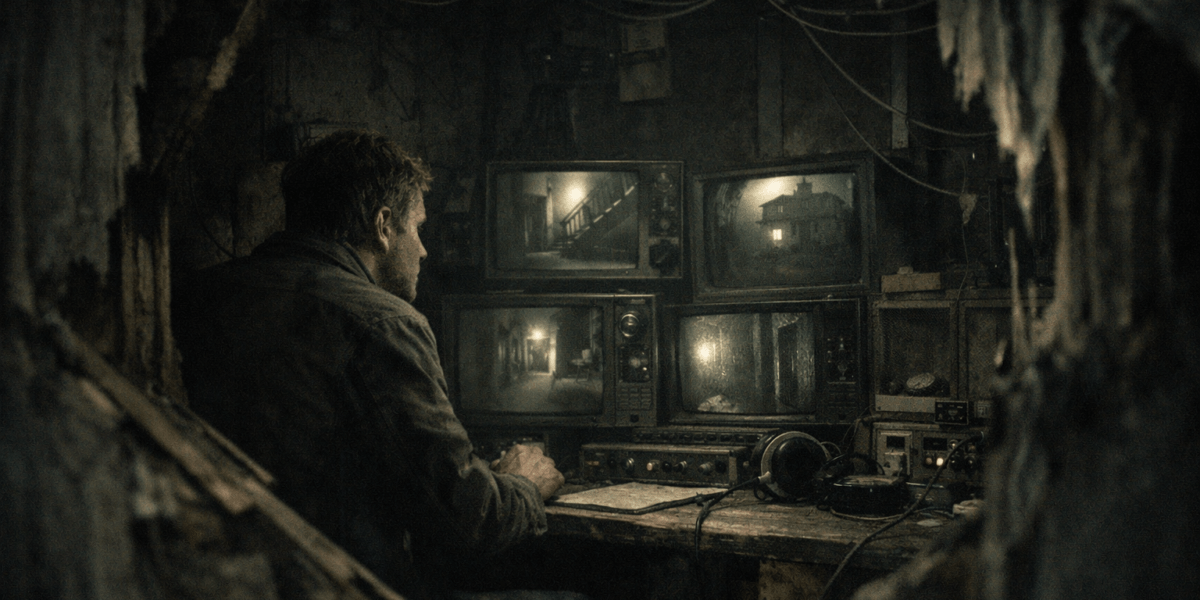
I went back to the stations, not as shrines but as fixtures. The stair landing first—the cut in the baluster that gives a narrow sightline down to the chain on the front door. When I held that slit in view, the chain stirred as if teased by a draft that did not touch my face. I stepped two feet left and it went quiet. I put myself back into the notch the old varnish has polished, and the links whispered again. Use, not mystery: my presence there sets a part in motion. Not grandly. A hum beginning somewhere in the metal, then settling. The map of scuffs at my shoes agreed: others have stood in that exact wedge of light until the boards learned their feet.
The parlor grate next. I knelt, though the kneecaps mean nothing now, and put my ear over the iron lattice. No pulse there to make a drum of bone, but still a feeling came—a low running, like rain heard through a pipe, regular enough to count with. When I shifted, it blurred. When I centered, it clarified, ticks spacing themselves as if my skull were a dial it preferred to read. The breath of the grate was cold, metallic, with a salted edge like a key pulled from the tongue. The edge of the opening bears a shallow set of letters I had missed before, worked into the soot-dark by something sharp: E.B. Smoothed by time. I did not try to embellish them. I only noted how they sit at the exact place your hand lands when you lean in too far.
In the pantry I set my eye to the seam between door and jamb—no light from within, only the faintest paler stripe, enough to draw a line across cornea. That line cut the kitchen doorway at an angle that catches the old mirror in the far hall. The glass returned a slivered hallway and once, a shoulder that was not mine crossing the return. A brown sleeve, plain cut. It moved like someone doing a thing for the hundredth time. I held still. Nothing else came, but the seam held me as a vise holds a chisel. A tool doing what it was made for, even if it does not understand the cut.
Upstairs, the little window on the half-landing has a crescent worn into the paint on the sill where a thumb would rest to hold it at a precise crack. I set it so, and the room took on a draft that pulled sound down the stairwell. Voices do not carry to me in their old way; their edges are all wrong, as if heard through wet paper. But placed there, I picked up syllables shaped by rooms, not mouths. A name like a struck match, brief and phosphorous: Black— and gone. The underside of the rail, where the hand curls, has another scratch: S. It felt cooler than the wood around it, as if the cut itself kept the memory of a blade.
The house moves me in small pressures. Temperatures lift by a degree at one mark on the floor, fall at another. The hinge on the back door stutters unless I watch it through the pantry seam; then it slides. The clock in the hall loses a second each time I leave the landing before the tick completes. Not coercion exactly. Alignment. We are held to our places like lenses in a lantern. The picture does not project otherwise.
I am not trying to master it. I am not fit for mastery. I am taking notes on function. What angle opens the draft. What footfall brings the pipe’s count into steadiness. Where the scratches gather, and whose are newest over whose. In this work I have company, though not in the living sense. There are habits nested in these stations—postures that do not belong to me and yet fit the body I have left in outline. A tilt of the head I find myself using. A way of leaning that tightens the sightline. They have been here before me, occupying the same inches. They are not gone. They are instructions shaped like people.
Death has not removed me from the house’s pattern; it has only placed me deeper inside it.
— Thomas Hale