
Entry #353
June 7, 2026 — 2:30 AM
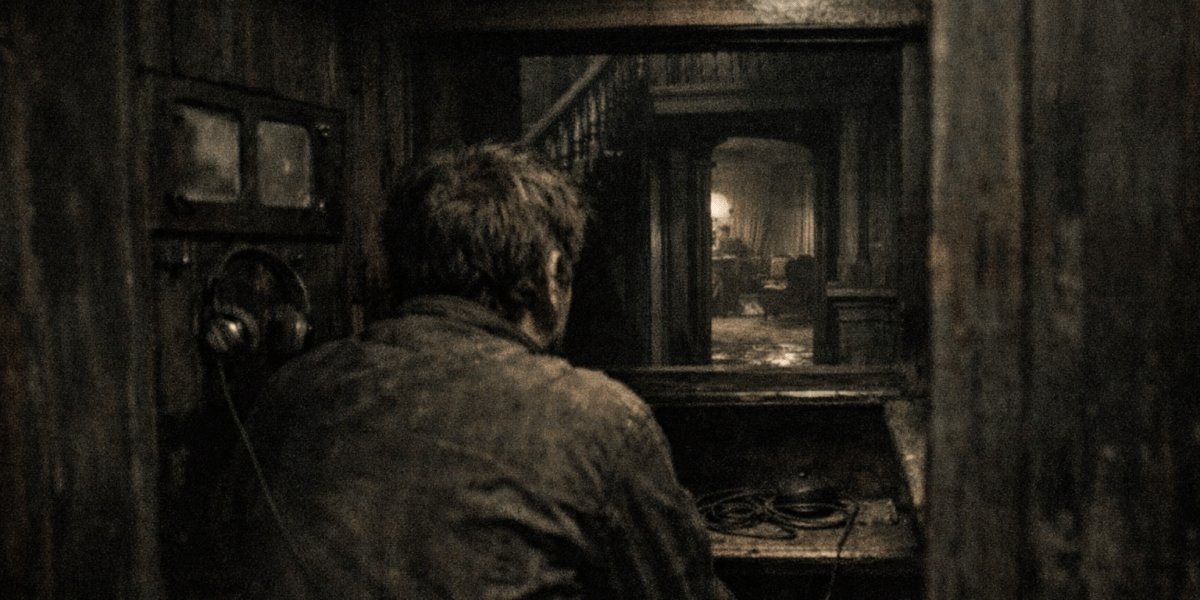
I stayed in one of the stations longer than comfort or prudence. Narrow void behind the parlor wall, entered through a loose length of baseboard that only gives if you pull from the bottom and lean to the right. The space takes a body into a shape: right knee on the worn knot in the subfloor, left foot turned, temple set against a smooth oval rubbed down by other skulls. The oval lines the eye to a drilled hole through the lath, no larger than a seed.
The air in there sits colder than the room it serves. Dry, old-sack cold, flour and mouse and a thin vein of paraffin. Horsehair catches on the skin like cobweb, though I do not leave prints now. The wood is glossy in the places that solve you—brow, cheek, the notch where a thumb finds hold. A second notch in the stud below is for the other hand; you discover it by needing it. That is the first instruction.
Through the hole: a sliver of the parlor, composed as if someone had once argued over the frame. Not the full hearth, only the left corner of the mantel, the doorjamb, the arm of a chair. No window. The sightline excludes the clock entirely but includes the top quarter of the door where a hat would pass. If you keep still the grain of the mantel resolves into nicks that match the teeth of a thin saw. If you move, the nicks go soft.
Sound changes by the inch. Ear to the hole and you get s, f, sh, a skin of consonant; ear to the seam in the floorboard behind your knee and you get the low moving air of the stair. Two channels that never quite meet. After a while the wall begins to answer itself: the heating lines tick in a path, the house breathes behind plaster. At some hour I could not name—time shed its seams when the clock was cut from the picture—I heard a quiet series of numbers in a woman’s mouth, just breaths and shapes of them, like someone counting stitches. I did not hear the numbers, but I knew the rhythm. The draft smelled briefly of soap sharper than anything I own.
Scratched into the stud at temple height: E—B, the crossbar of the E too heavy, the B made in two motions, top loop small. Lower, a single S struck harder than the rest, knife point skidding. I found a bead of wax in a gap and crushed it, and the scent that came out did not belong to this year. I stayed because of those marks, and because I wanted to see if the station would teach me something other than patience.
It did. Not by any grand sign. By subtraction. The longer I kept my eye, the more the house outside the frame went unsure. I could not hold the backs of the stairs in my head, but I could tell you the discoloration on the nail above the jamb, the way breath fogged an edge of glass when someone passed—a fellow witness, unseen, or a remnant of one. When I looked away to remember the upstairs landing, the details I had gathered unraveled. When I held my post, they stayed. Watching fixed them. Looking made them true.
The view also planted questions. It made me wonder about hands and hats, not faces. It made me listen for the door’s latch, not the voices behind it. It set my attention to the left side of the room, which is where the soot thins and the paint goes new—a decision I would not have made from a chair. The station did the choosing before I knew I had agreed.
I came out when my knees had no opinion left. The parlor had not changed, but my hours had. The corridor felt papered over. The place I had watched felt solid as cut wood. The more I move through these lines, the more I see they are not only cover. They are the house’s way of keeping. The station did not merely conceal a witness; it instructed one.
— Thomas Hale