Entry #362
June 29, 2026 — 1:00 AM
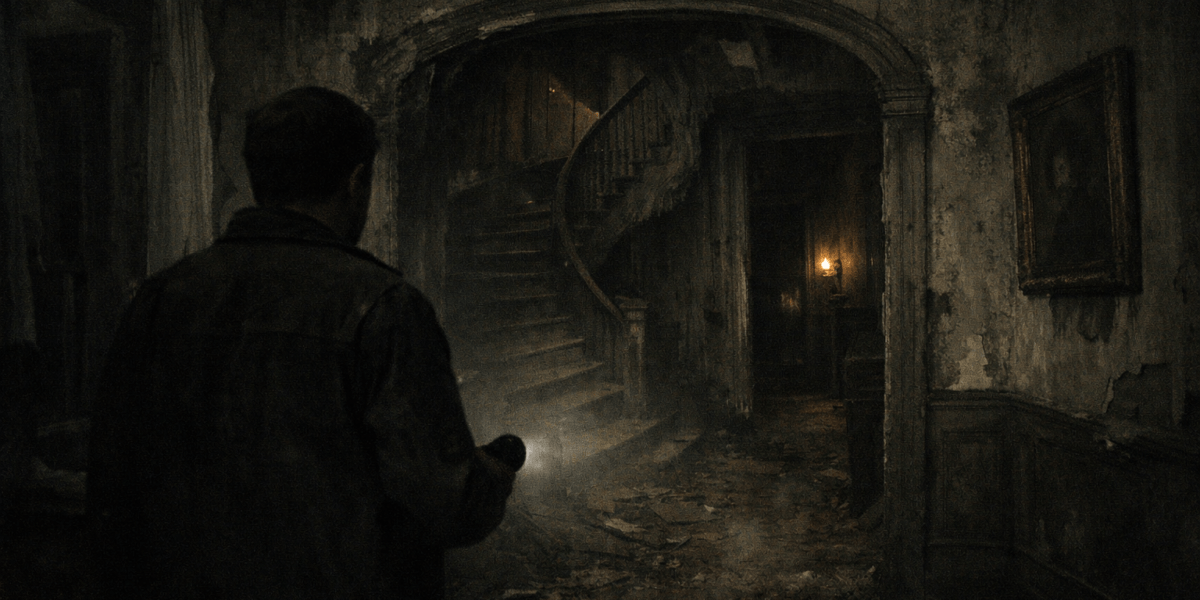
Afternoon, clear light. I picked one of the stations I’ve learned to expect—the landing window on the east stair where the sun slices low and I’m meant to let my hand rest on the rail and look out. I didn’t stop. I took the turn hard and kept moving down, past the varnish sheen and the fine grit along the tread nosings.
The first correction was sound. The iron in the front parlor began a dry tap, three counts, a pause, then three again. It shifted position each time I changed course, not in distance but in bearing: always just left-forward, like a metronome moved by an unseen hand to keep itself in my periphery. When I slowed, so did the interval. When I quickened, it tested a faster tempo. I turned a full circle in the back hall and the tap orbited with me, keeping its offset from the landing I’d refused.
Next came recurrence. The baseboard scuff shaped like a comma appeared at the foot of two different doors I know are not the same door. A snag in the stair runner reappeared two turns later, thread poking up like a cat’s whisker. The same spider-gray lint at the seam between plaster and frame. I tried for the kitchen by the long way and arrived into another length of hall with the same window-well stain: oval, tea-colored, a slight tide line where someone set a wet plant long ago. No walls moved. Scale and order held, but the route folded me into resemblance until resemblance did the work of return.
I stopped in the back hall to watch it operate. The air there always feels cooler against the skin I don’t have, a pressure on the idea of skin; the smell is old paper and iron. I put my palm where my palm is supposed to go: the banister curve polished to a low shine by years of weight. Under the rail, on the flat where you wouldn’t touch unless you were searching, shallow cuts: E—B. Not neat. Someone opened the paint with a blade, then the paint closed over and kept the ghost of it. Whoever did it stood in the same place for long enough to need a mark. The station is not only mine.
I tested timing. From pantry door to landing window is ordinarily fourteen steps for me now; refusing the stop made it twenty-six no matter how I measured it. The parlor clock held its quarter-hour; the strike paused in its throat until I lined my view to that glass pane and then the chime let go, not louder, just released. On the kitchen threshold (another assigned pause) I refused again. The ceiling fan bearing took on a low rub, as if paper were catching, until I reversed and put my shoulder to the jamb and looked into the dark square beyond. The rub ceased mid-cycle, like a switch settled true.
It’s not a tantrum. It’s a governor returning an engine to speed, a control loop finding its setpoint. The pressure is gentle until it isn’t necessary; soft repetitions become harder symmetries if you ignore them. I kept my breath out of the habit of it and watched for drift, counted intervals, traced what it wants with my refusals. The chain that holds the Others Before me is maintained here not by threat but by repetition, by a procedure that favors the most similar next event until the next event is me.
It responded to refusal the way a mechanism responds to misalignment.
— Thomas Hale