Entry #364
July 4, 2026 — 3:45 AM
The noise outside has burned itself out. The air still holds a dull sulfur thread, pulled thin through the screens. July swells the wood. The upstairs door sticks unless you lift as you pull. It always has, but tonight I watched three different versions of that same hand remember it at once.
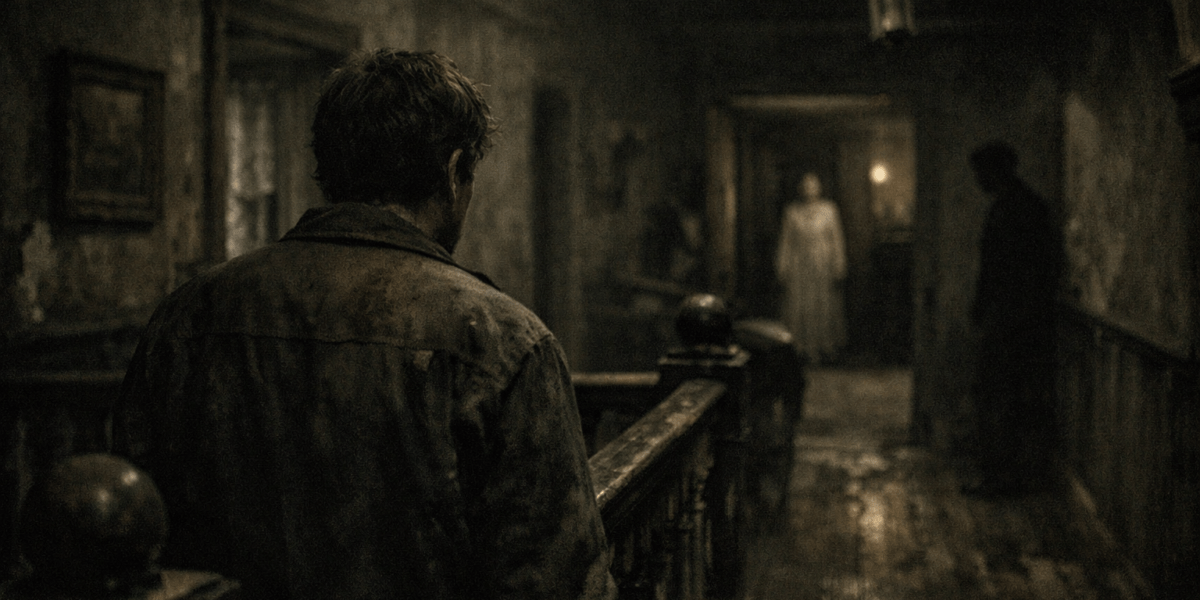
Not memory the way we mean it. Muscle memory without muscle. The hall showed me a small procession: a woman in a dress with sleeves cut back from work, a boy with a split thumb, a man with his cuff frayed—each moving along the same stations I mapped two nights ago. They did not turn to me. They did not turn to each other. They touched the same places: the pin on the kitchen window that keeps the sash from slamming in the night breeze, the second stair with the soft edge where you set your weight to keep the tread from speaking. Their fingers found the dents without looking. It was all procedure, and none of it had to be taught on purpose.
On the inside of the pantry door, where I scraped a pencil line to gauge swelling, there is an older scoring: S & E B, shallow and neat. I had seen the letters separate before, but in the dark grain tonight I saw them as a joined habit, cut by someone who wanted a mark to sit low and private. A smell of leaf tobacco left in the hinge-joint. A hairpin caught behind the wainscot, knotted with lint. I do not think they are here like a portrait on a wall. It is closer to a worn place where a body once leaned long enough to teach the wood the shape. They are kept by the house the way we are kept—through acts that happen again because it feels worse not to do them.
In “Stations” I wrote what returns. In “Against the Groove” I wrote what not to do. In “Procedure” I laid out a way back. I thought I was building handholds. I still think I was. But tonight I understood that each note, each marking of time, is also an instruction set that can outlive the need that made it. The witness-chain feeds itself through imitation. You come here late, you find the kettle sitting on the back burner because the scorch ring says it belongs there, and you put it there again. You unlatch the cellar door and leave it to rest on its heel because the hinge wants it, and the next one will feel that want too. Even the one who swears they will not participate—that refusal is an echo of someone’s earlier refusal, and it fits the house just as neatly.
I have been proud of noticing things. That is my only trade. I see now how observation is also leverage, and leverage can turn you in place. I do not feel guilt burning me clean—I do not burn—and I will not write a confession here. But the problem is not only survival anymore. It is what we owe the ones who might step into the worn route after us. If I write a shortcut, I may also be laying a rail. If I perform the safe act again, I may be making it indispensable for someone who doesn’t want this at all.
I don’t think the answer is to stop breathing in this ledger. That would be another kind of instruction. But I can choose to record with an eye to subtraction. I can sand down where I can, blur the chalk, leave a door fully closed once in a while, break a timetable. Not to be contrary for its own sake, but to dent the groove so it does not run so smooth. That is a practical choice, and it has become a moral one.
Inheritance in the house may have depended less on intention than on repetition.
— Thomas Hale