Entry #12
September 3, 2023 — 8:30 AM
I meant to spend yesterday afternoon sorting the last of the hardware bins and ripping shims. I ended up at the cellar door instead, standing with a tape hooked to my pocket and drywall dust in the seam of my palm. The door sits off the kitchen, low and heavier than it looks. Four coats of paint at least—cream over gray over a bluish guess. The latch plate is a little crooked, as if someone drove the screws in a hurry with a dull bit. When I eased it open, it gave me back a smell I haven’t had in a long time: wet stone and old earth, a thread of iron like a penny in the mouth.
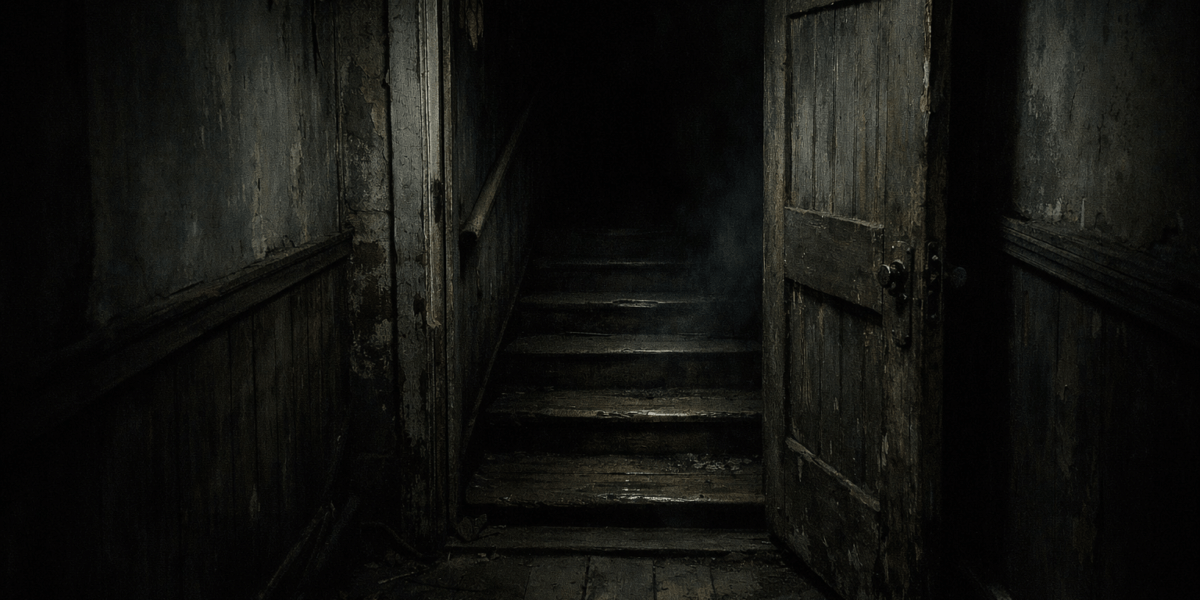
The air down there is cooler by several degrees. It lays on the ankles first. I thumbed the switch inside; nothing. The pull-chain hanging from the joist had been snapped off long ago—a frayed end with a ghost of nickel plating. I used my phone light and kept it chest-high, the way you do when you’re trying not to blind yourself in your own beam. The cone didn’t carry far. Dust hung in it, slow and indifferent.
The steps are narrow and pitched a little to the left, pine worn to a shallow smile in the middle. The first tread and the third have been replaced at some point with a brighter wood, their edges too crisp, screw heads modern and proud. Someone tried to paint them to match but missed the tone by a good inch—old white versus new white. On the right, a handrail that’s more decorative than helpful, rounded and greasy with a century of hands. Under its paint, shallow cuts. Two letters scratched into the wood at shoulder height, or maybe an illusion of grain. Looked like E and B. Could be anything.
At the bottom, the light found rock. Fieldstone and lime, the old kind. The coating is flaking in scallops, and there’s white bloom in the seams where the mortar sweats—the crystalline salt that forms when water keeps a slow argument with stone. A dark vein of damp runs down where the foundation meets the floor. I stood on the second step and listened. There was a faint ticking somewhere, irregular, as if a drip had farther to fall than it wanted.
On the left wall, halfway down, there’s a repair that isn’t pretty. Three short boards laid over a section of stone, face-nailed with cut nails and ring-shanks mixed together. The boards are older than the topcoat on them; the paint took differently, wrinkled where it should have leveled. The middle board cups away from the wall enough to show a black seam behind it. Not a gap you can follow with your eyes—just a shadow that didn’t change when I moved my light. Someone patched something there a long time ago, and someone else painted over the patch even longer after they should have measured it first.
I didn’t go farther. Not because of any one thing. The smell of rot has a few names and I could pick most of them out—mildew, old lumber, the faint sour of something that stayed damp too long. Mold means masks and filters and a real plan, not a quick peek with a phone and a half-charged headlamp I haven’t unpacked. The floor down there looked like compacted dirt or very tired concrete. Either way, it wanted boots I wasn’t wearing.
I closed the door soft and stood with my hand on the edge until the latch clicked the way it wants to click. I’ll bring proper light, respirators, bleach, plastic sheeting, maybe a dehumidifier just to start the conversation. It isn’t small work. The cellar matters, that much is obvious, even through a narrow crack of view.
Some jobs are easier to postpone when the house seems to agree.
— Thomas Hale