
Entry #57
June 19, 2024 — 10:00 AM
I moved slow this morning. Before coffee cooled, I cleared the drop cloths and set the work light outside the opening. No point heating the cavity or stirring air. The hidden space is the problem part now, so I treated it like any other problem on a job: establish baselines, mark references, stop guessing.
I vacuumed the sill and the top of the baseboard inside the gap, then tapped the vac bin to shake a little fine dust back out. I swept a finger-width trail across the floor of the void, from stud to stud, like a pencil line you can smudge. If anything crosses, it will interrupt the ridge. I set that down in the notebook first so I wouldn’t trust memory later.
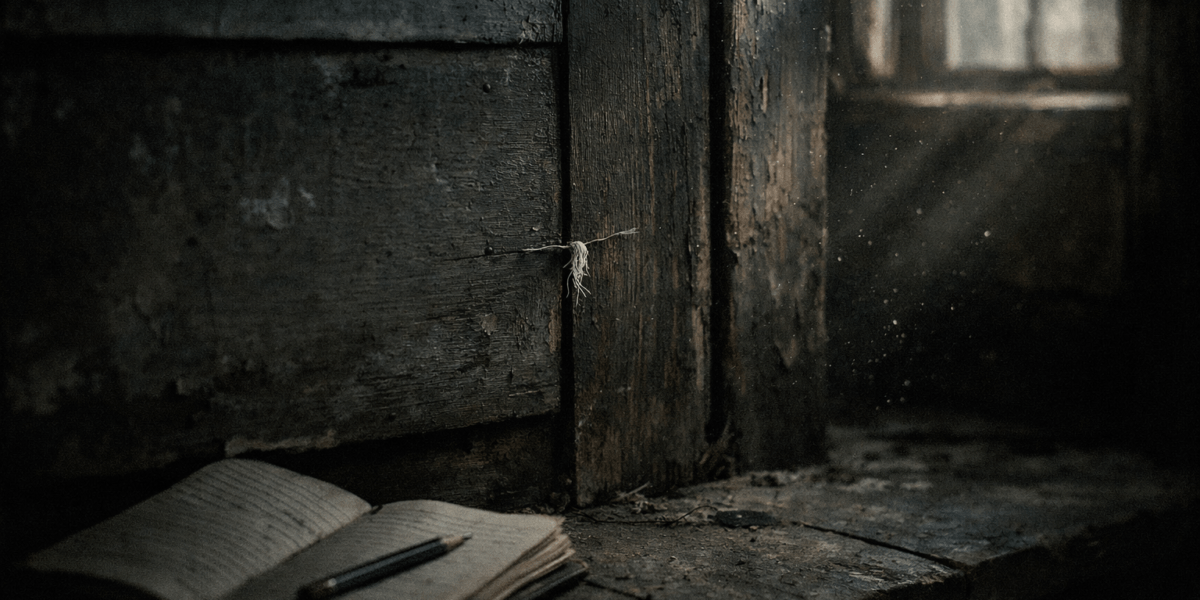
Thread next. I pushed two small brads into opposing studs just inside the opening, about waist height. I tied off white sewing thread between them, snug and straight, then added a flag of blue tape in the middle so I can see if it sags or swings. The brads bite into old wood with that dry creak; the dust they raised smelled like paper gone sweet at the edges. A faint draft moved along my wrists. Could be the stack effect from the chimney chase. Could be nothing.
I used a carpenter pencil to make crosshatch marks anywhere two things meet: one on the edge of the molding outside, one exactly opposite on the cut panel. I did the same at the baseboard miter where it returns around the opening, and at the top plate where the plaster meets lath. If anything shifts, the lines won’t line up anymore. Simple.
I placed small objects because they are honest witnesses. A nickel on its edge inside the void, centered over a knot I circled in pencil. A short carpenter’s level laid on the floorboards along the dust ridge, bull’s-eye bubble between two marks I drew on the vial. A piece of chalk on its side at the far stud, pulled flush against a nail head. All of it stupid if nothing happens, but useful if something does.
Wrote it all down as I went, so there’s no arguing with what I thought I saw later:
10:12 AM — Dust ridge across void floor from east stud to west stud. Ridge height ~1/8 inch.
10:15 AM — Thread between brads at 36 1/4 inches off finished floor. Blue tape flag centered. No movement.
10:18 AM — Cross marks: casing to panel at midline; baseboard return to panel; top plate to lath. All aligned.
10:20 AM — Nickel set on edge over knot (third board in from opening). Chalk piece flush to nail head at west stud. Level bubble centered between pencil ticks.
10:23 AM — Panel gap measured at 3/8 inch at center, 5/16 inch at top. Noted chill along wrist, likely draft.
I considered setting the phone to record, then didn’t. Heat from the light, batteries dying, my own reflection making me jump at playback — too many variables. Physical tells are cleaner. If a raccoon shoulders through, I’ll see the ridge broken and the nickel gone. If the house relaxes and the panel slips, the pencil crosses will betray it. If air moves, the tape flag will gossip.
On the upper stud, where I pushed the brad, there’s a scratch that looks like a letter. Maybe an E, maybe just a slip of a hand at some point in 189-something when the lath went up. I traced around it with pencil so I know I’m not inventing it later. That’s noted too.
I closed the panel back to the exact gap I measured and set the latch. Work light off. I’ll leave it and go pull trim in the hallway so I’m not hovering. This is ordinary: you mark a floor before you float it, you chalk a line before you cut, you test for movement before you blame a ghost or a bad framer.
I felt a little foolish arranging a stage for nothing, but not foolish enough to skip it.
— Thomas Hale