
Entry #93
December 17, 2024 — 3:00 PM
The light was already slipping toward evening even though the clock disagreed. The rooms were colder than the hallway; the plaster held the chill. I spent the afternoon prying off the last of the decorative trim in the back half of the house. Nails came up in a slow give-and-sigh. Glue from some prior fix gave off a sweet, stale smell when it let go, like old paste opened after years.
I keep trying to talk about the house in practical terms—sag in the joists, poor ventilation, the usual shortcuts—but today I kept walking into spaces that felt not merely strange, but misused or burdened. Not a feeling I trust on its own, so I took notes. There are choices in the hardware and scars in the wood that don’t match normal living.
The small room off the kitchen—someone called it a pantry in an old listing—has two sets of hinge ghost-marks, one on the frame and one on the door itself, as if the door had been flipped to swing the other way at some point. The latch plate was moved too, but there’s a second, older strike mortised into the jamb higher up. Holes clustered around the latch look like attempts to align it again and again. On the inside face of the door, down low, the paint is scored in thin arcs where something hard met it repeatedly. The toe-kick along the shelving is grooved deeper than the rest of the floor, a half-moon of wear from standing pressed there longer than cooking requires. Someone stood there enough to etch their patience into the pine.
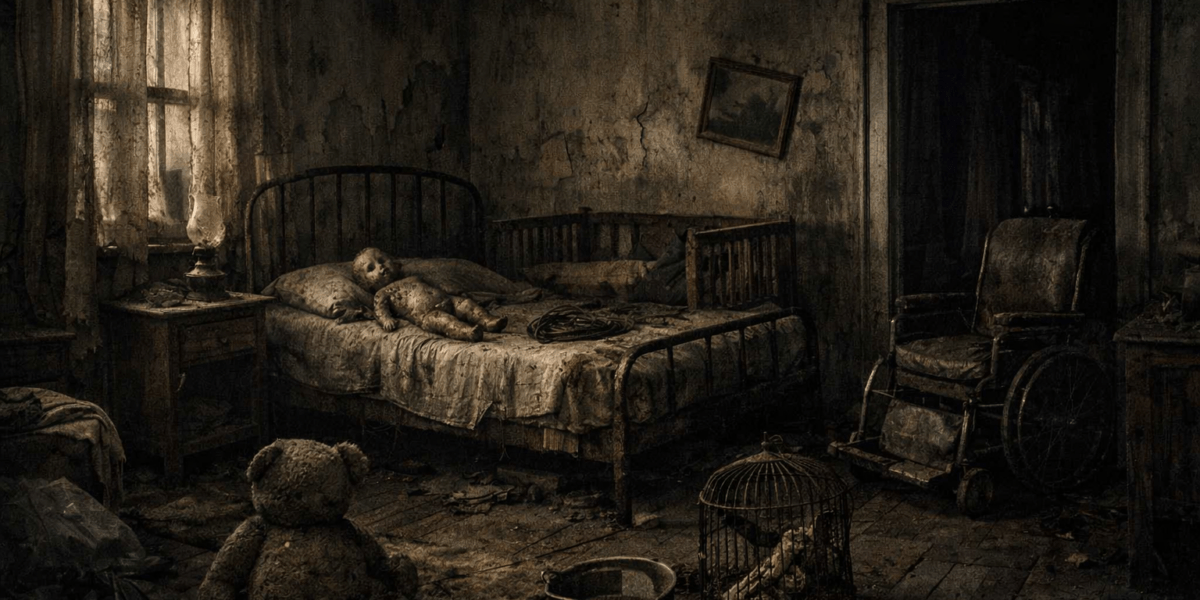
Upstairs in the back bedroom, the window has been painted shut so many times the sash line is nearly soft. A hook-and-eye is fixed to the casing at shoulder height, but its mate is on the outer face of the door, not inside. The cheap hook is newer than the screws in the hinges. Inside the closet, there’s no rod; instead, a line of small screw eyes runs just under the upper molding, too weak to bear much weight. The floor in that closet is clean except for a single ring set into the plank near the wall, like the sort of hardware you’d use to feed a cord through, not to anchor anything heavy. The surrounding boards are rubbed, but not by shoes. Rounded scuffs, elliptical, as if by something that moved but didn’t go far.
In the parlor, while pulling down quarter round, I found an old vent cover that goes nowhere: lath behind, no duct. When I held it to the light, there was a slit cut into the plaster just behind the grille pattern, a long thin opening that doesn’t match the rest of the framing. It’s not large enough to pass anything through. It would carry sound. The wall carries a faint glossy rectangle where a piece of furniture sat for a long time—always the same place, always the same distance from that false vent.
Under the kitchen sill someone scratched E.B. into the beadboard a long time ago. The letters are shallow and tidied over with paint, as if the mark embarrassed someone later. I don’t assign meaning to initials or to paint strokes, but these are not neutral surfaces. They were altered to control light, sight, movement. The weight in these rooms comes from decisions. If there’s any haunting here, it’s welded to acts someone chose and then built around.
Some rooms feel lived in, and others feel kept.
— Thomas Hale