Entry #137
August 6, 2025 — 9:45 PM
Midday light came flat and bright along the stairwell and into the small room, enough to show the hairline I marked yesterday. The paint had skinned over a join that didn’t belong to any sane layout. I taped a catch sheet, scored along the seam with the utility knife, and eased the putty knife in. The wall felt warmer than the room at first, then gave a little; a springy resistance, wood flexing. When it let go, it let go quick. The strip was only seven inches high and thirty long, a shallow valance over darker wood.
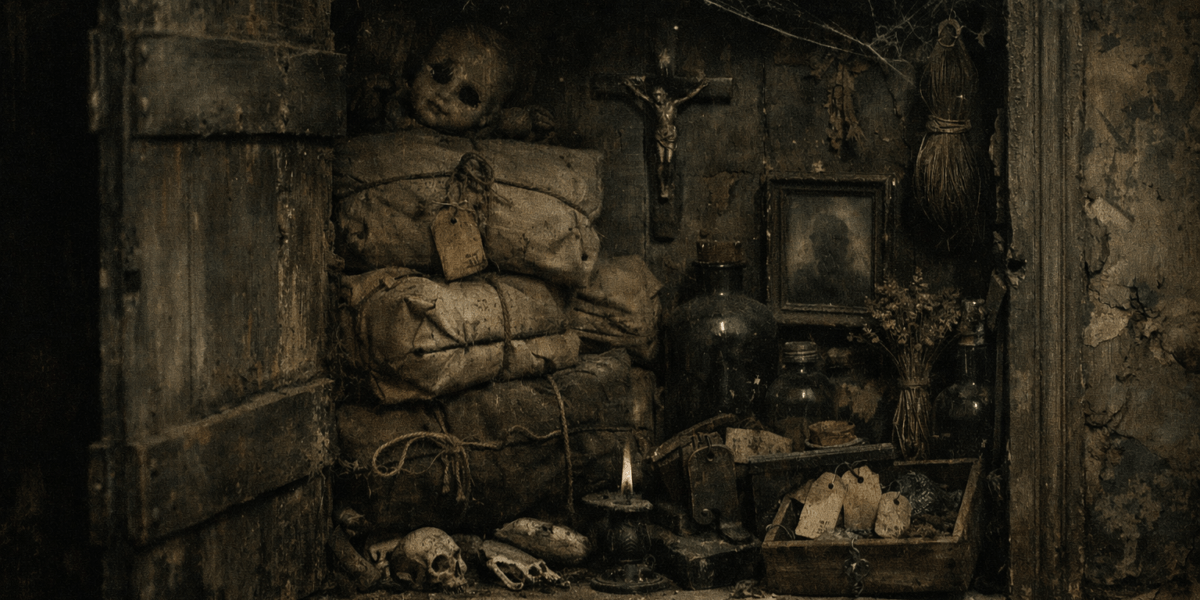
Behind it: not void, but a recess built like a piece of furniture. Dadoed sides. Bead along the lip. Someone planed this smooth enough to take wax. There was the smell of gypsum dust from my cut, and under that something else: soap, starch, a trace of lavender that has no legitimate reason to last this long. The air that came out was still and old and not empty.
I set the panel on the floor and ran the painter’s light in. A shelf, barely a hand deep, ran left into the stud bay. On it sat what at first looked like trash bundled for the dump. Then my eyes adjusted to the fact of order. A muslin roll tied with cotton tape. Two small jars, glass thick at the base, corks sealed with paper disks and twine. A flat tin with a dip worn into the lid where thumbs had pressed it. A narrow wooden tray with six compartments, each labeled in a faded hand: hooks, eyes, buttons, pins, chalk, wax. The labels were little slips, cut down from something with printed borders.
I took the roll first. The tape came free like it had been tied to be untied. Inside: an apron, white once, edges hemmed well, the ties thicker from repair where they join the waistband. The neckband had thread worn smooth where it would have crossed the collarbone. A corner carried chain-stitched initials, E.B., neat and small, the kind taught for marking linens. I ran a knuckle across it and felt the raised work through the cloth. No one does this for themselves unless they expect to keep washing it.
The jars chimed soft against the wood when I moved them. One held what looked like borax, crystalline, clumped. The other, a salve the color of old straw, beeswax and something else—fat? resin?—with three fine grooves across, the kind that heavy thread leaves when it’s drawn over the cake to tame the fibers. The tin, once open, offered thimbles nested like cups, bone buttons strung on thread, a little square of yellowed wax wrapped in paper scored again and again. The chalk had ghosted pale onto the tray: marks like half-moons, pressure points from use.
At the back lay a paper scrap flattened under a shard of mirror. It was torn from a larger page, frayed where it failed. Five words in pencil: Tuesday — boil linen. S to— and the tear takes the rest. The graphite had polished with the rubbing of something sliding in and out; the way lists kept in drawers get soft at the edges. The mirror shard was ugly with silver rot, but it had been laid with care, face down, so it wouldn’t cut a hand groping in dimness.
On the shelf’s underside, where a thumb would naturally go to prize it out, the varnish was blackened and smooth. A small nail was driven there not as fastener but as stop, bent over to act as a spring. This was not a stunt. It was a station. Someone kept this place, tended it, returned to it often enough to make it comfortable. The way the tape lay, knotted, said the hands were practiced. The way the jars were set two fingers apart said the hand that set them could find them by habit.
On the apron’s hem, in hard light at a raking angle, I caught letters pricked with the point of a needle, not stitched, just perforated: E. Black— and the dash where the name fell away into a fold or a moment interrupted. The pricks had darkened, not with ink, but with the slow oil of fingers. I put it back how I found it. I closed the panel and felt it take and hold with the same spring.
I worked alone at noon and wrote it now at night. The room is different for having shown me this. Architecture can conceal activity, but objects preserve the shape of the hands that used them.
— Thomas Hale