
Entry #147
September 26, 2025 — 10:15 PM
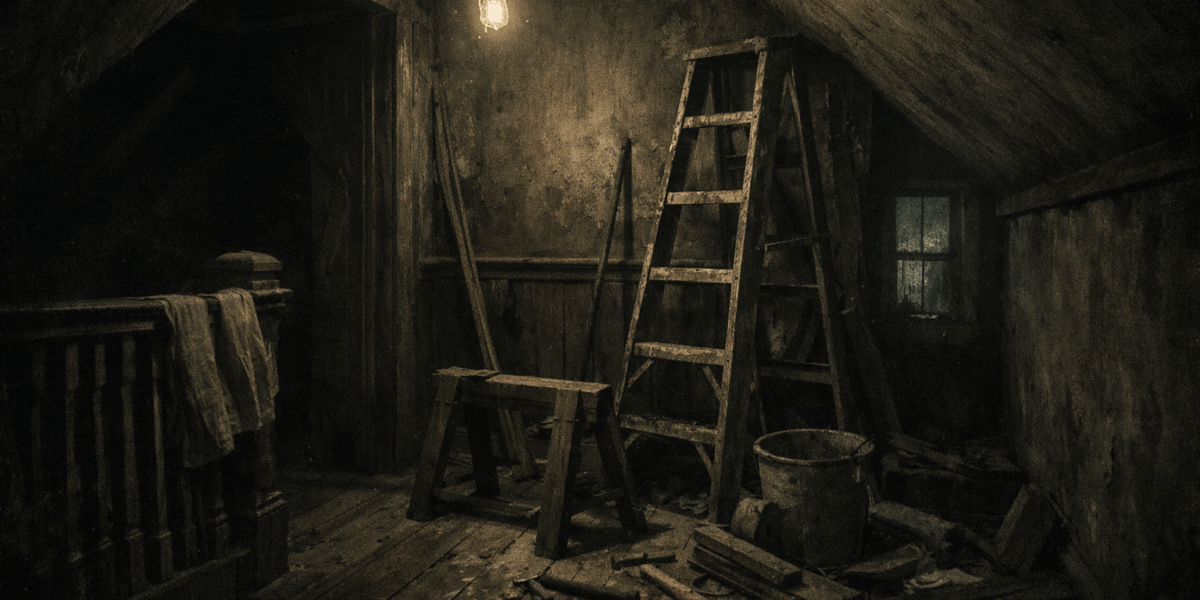
I spent the afternoon at the top of the main stairs, staging for exterior work on the west face. The hatch to the attic sits above the landing like a square eyelid, edges fused by paint and dust. I set a drop cloth over the treads, brought up the ladder, tape, and a short pry bar. The house held the noon heat in its upper pockets. The rail was cool where the paint had worn down to wood. I could feel the grain with my palm, ridged like old rope.
Since opening parts of the walls below, the landing is not just a place that turns a staircase. It is part of a column. The voids I traced downstairs feel routed straight through here—flue, chase, and the hollow newel post—so that when the west wind came across the siding, the rail hummed under my hand. Not noise, exactly. More a long, thin note you only get when something is both taut and joined in too many places.
Prepping for the roof work meant freeing the hatch so I can get a harness line set and find rafter tails from inside. I scored the seam with a knife and worked the bar into the corner. Paint cracked, dry and granular. Dust sifted down, carrying the attic smell: warm tar, mouse, old paper. When the lid finally lifted, the warm air above my head had a different weight, as if it had been kept too long without being stirred.
I kept three points of contact and reached up with the flashlight. The beam caught the underside of the sheathing, the cross-collars, brittle wiring loops, a length of twine stiff with age that someone had tied to a nail and forgotten. The light also picked out a shallow scratch on the upper face of the nearest collar tie: S.B. Two letters, careful enough to be deliberate, not a carpenter’s quick mark. The cuts were gray at the edges, like they’d been there since before the last coat of dust settled.
Standing on the landing, I took measurements from the hatch frame to the exterior wall, then from the collar tie to the rafter where the roof ladder will sit. The tape made a particular rasp against the wood that answered itself from deeper in the eaves. That back-and-forth sound rode the same channels as the rail’s note. The vertical lines are clearer now: the flue from the kitchen rises past this point to the ridge; the cavity beside the chimney stacks to the attic knee space; gaps I cut below feed their shape into angles up here I never saw before. Top, bottom, and the space between are talking to each other.
There was another sound I didn’t know here before I opened walls: a faint ticking in the riser of the top stair when I leaned to reach the far measurement. Not settling from my weight. Faster than that, and irregular, like something small lost in a hollow place finding where to stop. When I eased back, it quit.
I could have written off the initials as a worker’s mark, except they aren’t in a place you see when you’re building. They face the hatch, where you’d only notice them if you were on the ladder, head bent into that inch of air nobody stands in unless they’re reaching up. I traced the cuts with a finger. The wood there felt cooler than the board around it.
Tomorrow I’ll fit the brackets on the west wall and set the first ladder up past this hatch. The roof is work I understand. Still, the higher I went today, the more the paths I’d cut below seemed to pull the rooms tight. Height did not make the house feel more open, only less reachable.
— Thomas Hale