
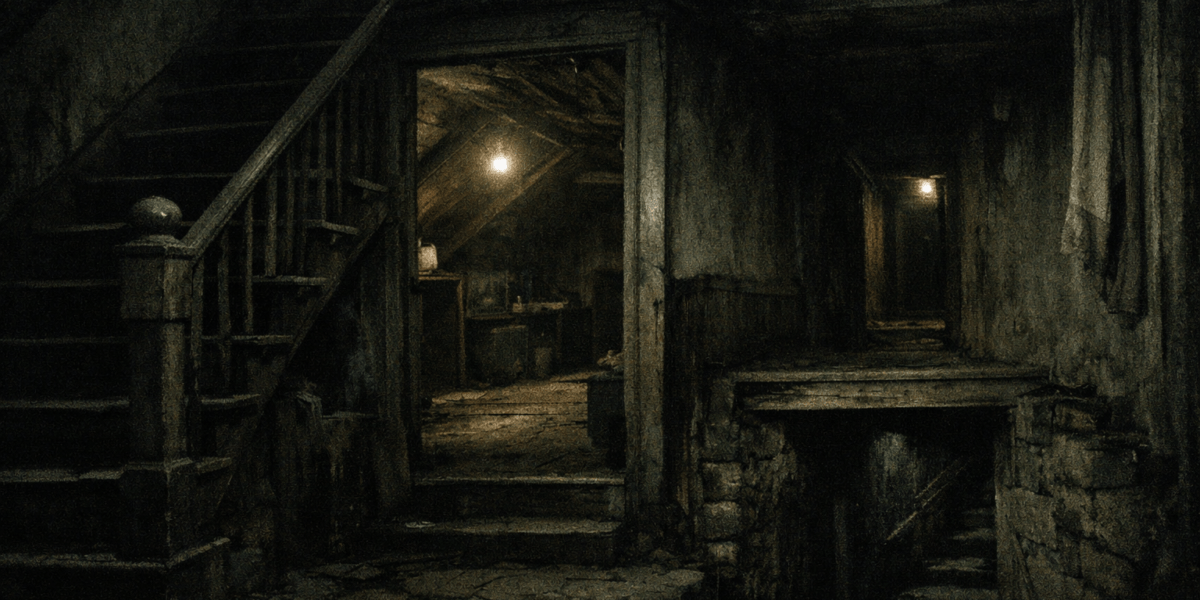
Entry #148
October 1, 2025 — 11:30 PM
I started at dusk with a simple task: pull a new run for the detectors from the attic down the main stack. Ladder planted under the hall scuttle, belt heavy, coil of twine on my wrist. The hall kept an evening cool that stayed while the rest of the house collected the day’s heat. Dust was already moving when I pushed the hatch—small weather, stirred just by lifting a square of wood.
Up there, along the joists, the boards were grayed and salt-dry. My headlamp laid a clean oval through spider struts and lath ends. The chimney’s brick shoulder carried a faint warmth, slow and even. I heard a metered sound—metal somewhere giving, then settling—soft, spaced out, like it had a measure it preferred. Not a mystery sound. Houses do that. But I heard it again when I slid the fish tape past a brace, and again from the strap that held the chimney collar. Three places, same interval. When I counted under my breath, my toes answered before the next tick; the joist under my knee had its own tiny register.
I tied the twine to the tape and sent it down the partition. It didn’t just drop. It arced, caught a draft I could not feel with my face but felt against the hairs on my wrist. I marked the top plate with my carpenter’s pencil—a single X—and next to it, where the lath met the beam, I saw two blunt letters scratched down to pale wood: S.B. The cuts were shallow and old. There was no date.
Back down the ladder, I kept the twine between two fingers, moving with it. On the stair, the air tightened by half. The landing I’ve been working narrowed some more by smell—old plaster and the kind of cold that comes up from an empty throat. Step four answered that same measured sound. My palm on the newel found it cooler than it should have been, as if a shadow had gone down before me and borrowed the warmth.
At the hidden route—the panel cut into the hall wainscot behind the bookshelf—I slid my hand along the seam and lifted it free. Plaster rasped. The cavity gave off linen and chalk. The twine had found this opening without resistance, coasting along the back of the chimney to touch my knuckles just when the upstairs tick came due. In the slot, I could feel the stair risers hum softly, the way a duct transmits a neighbor’s radio through metal. I traced the studs and found that they line straight to the pantry chase, and the pantry chase lines, neatly, to the floor registers in the parlor. It isn’t that the house has channels; the house is the channel.
I took the line on, elbowed through, then down to the kitchen. The pantry was a degree warmer. My light caught the brass of the lower hinge; stamped into it, tiny and clean, E.B. It had been under paint-skin for who knows how long. I scraped a thumbnail along its edge and the letters went bright. When I tapped the hinge to test it, the stair tick answered in its measure, and the little creak from the parlor floor—a tight, high note by the hearth—came exactly after, as if pulled through a string diagram I could almost sketch. When I walked, the cabinet face eased open by a hair, the register grille breathed a paper scrap against its slats, and the electric stapler’s punch in my hand came back through the wall an arm ahead of me.
By the time I fastened the run and tucked the slack, the house had redrawn itself. Riser to stud to flue to brace to hinge to grate. I could go up or down, but it was the same path translated, the same pulse counted in different materials. My work and the place and what moves inside it refuse to separate now. The distances feel as though they have been replaced by connections.
The house had become difficult to enter room by room because it no longer behaved that way.
— Thomas Hale