Entry #158
November 14, 2025 — 12:15 AM
The lamp is clamped to a sawhorse and throws a hard cone over my notes and a strip of the dining room floor. I am working through measurements for casing profiles, cross-checking orders, marking what I can salvage. The rest of the house is shut, heat off for the night. Breath is just visible at the edge of the light if I lean in.
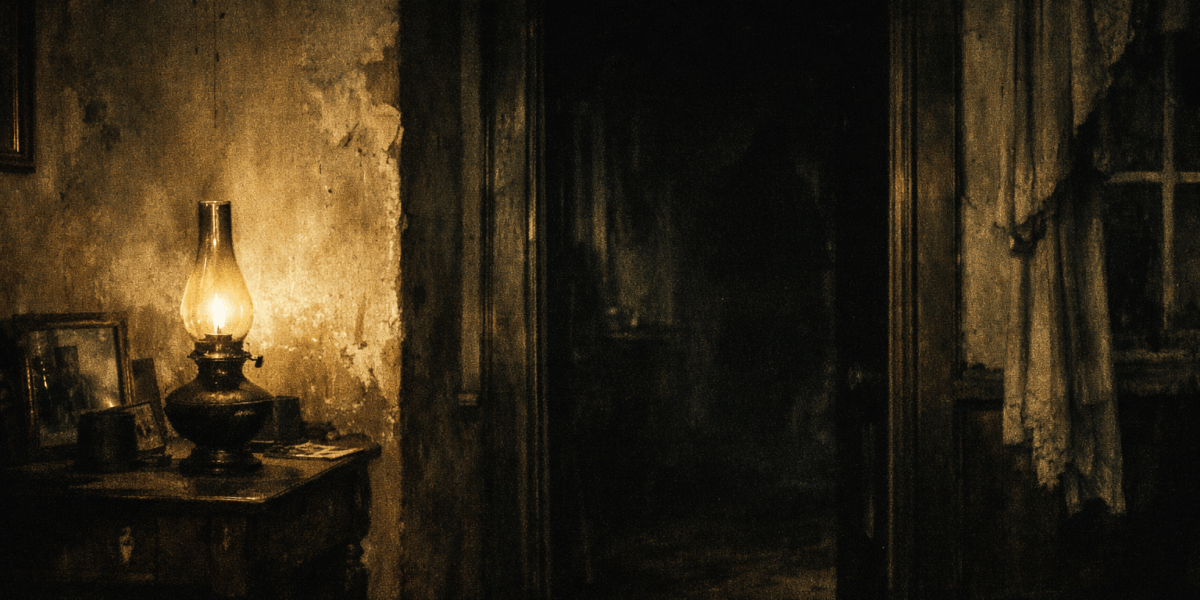
The first time I felt it tonight, it set up in the hallway doorway to my right. Not a sound, just the ordinary dark arranging itself with more purpose than it needed. It held like someone uncertain about stepping in. I turned my head and saw nothing but the rectangle, its paint blanched, the plaster cuts rough where I opened the wall last week. Dust hung and shifted without a draft. I kept working.
It returned as I was writing a number, the pencil catching a splinter in the paper. Again in the same spot, a small insistence at the edge of sight. I stood, let the pencil roll, and walked to the jamb. The casing is original—narrow, knife-plane marks still faint. Near knee height, on the inside face, two letters scratch shallow: S.B. The lines are clumsy, as if done with a dull nail. I pressed a fingernail over them and felt the burrs. I looked down the length of the hall, listened to the settled quiet of a house cleared of people. Nothing.
I sat again. The sense shifted behind me, in the kitchen opening, precisely where I was not looking. It’s the same each time: not panic, just a body-memory that expects a shape where a room thins into a frame. I turned slowly, more annoyed than anything, scanning the counters I haven’t pulled yet, the thin shine of old varnish, the blue tape flags on the cabinet doors. In the sink, a drip found a pan and made one small metallic click every minute or so. No footprints in the sift of plaster along the baseboard. No change.
Back to the table. The lamp hums when it warms. Lead rubs on paper. The pressure doesn’t lift. It keeps to the periphery like a cautious dog, waiting at each opening, choosing the one furthest from where my face is aimed. I pivoted the sawhorse to split the difference, so I could see both doorways at once. The feeling moved to the arch into the foyer, just outside my new angle. I shifted the lamp instead. My shadow went long and then collapsed against the hall and made the emptiness look different without changing it. I got up again, checked again. Nothing. Floor cool under the socks. Wood dry against my palm where I touched the jamb. A faint resin smell when I pressed my thumb into a knot.
It has been like this for an hour. Between checks, the room holds in a way I can feel in my teeth, a tiny weight I can’t knock loose by naming sources—thermal contraction, the open chimney drawing, the way old lumber talks to itself. Work helps, but stillness does not cancel it; the stillness compacts it. I suppose this is what changes: not visits, not a passing draft, but a residency at the borders of things—doorways, the line just behind a shoulder, the staged dark one room away—persistent enough that the same empty view, repeated this many times, begins to go thin. Emptiness can become difficult to credit after enough repetition.
— Thomas Hale