
Entry #164
December 9, 2025 — 9:45 PM
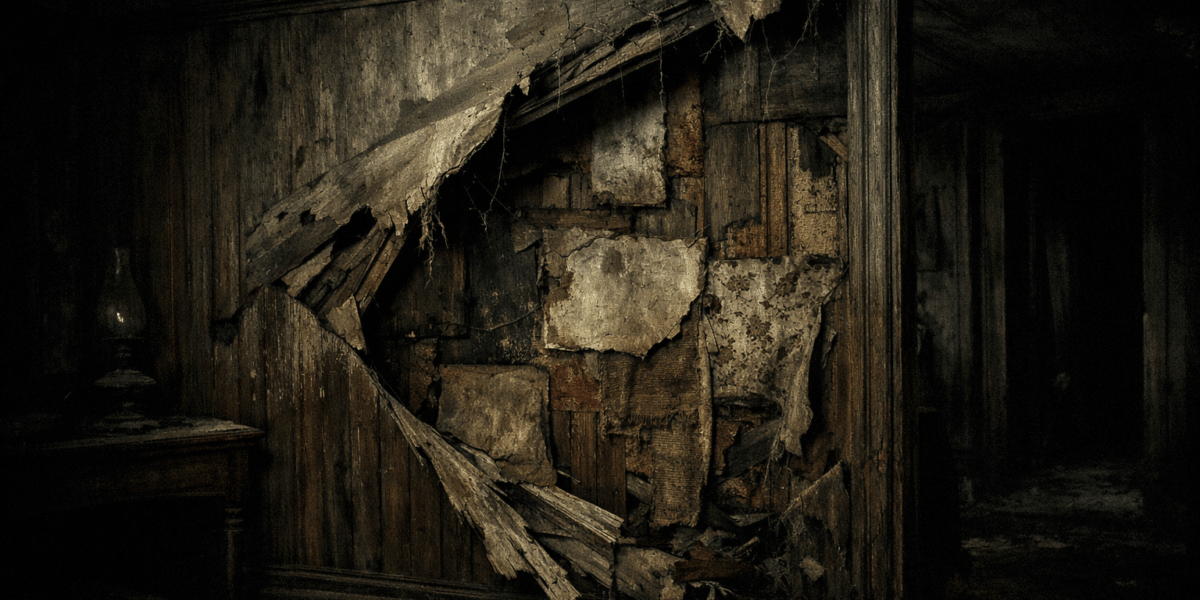
Overcast light is honest light. It flattens the rooms and makes the seams show. I spent the afternoon pulling quarter-round in the dining room, just to get ahead of the floor refinishing, and the scraper found a feather line in the paint that didn’t belong to any molding profile I know. Not a shrink crack. Too regular. The blade sank into a belt of smooth compound, soft as cake under the first crust. Someone had buttered a gap, sanded it to a shadow, painted, then painted again. The pry bar talked to the wood—low creaks, little sighs—and a board face came loose that had been laid against the original wainscot like a costume.
Behind it wasn’t damage. It was air. A shallow cavity, dust cool and resin-sour, that ran the length of the wall and narrowed to two inches at the corner. The old pine in there smelled green when I scored it. On the inner edge, pencil had left a tiny arrow and the letter B. Below the arrow, the heads of two finishing nails had been set at opposing angles, almost like staples—purpose not to hold, but to discourage a casual pull. This wasn’t a patch. It was a lid.
In the hall, where the baseboard returns under the stairs, there’s a heel scuff I’ve ignored for months. I cleaned it, found an oval plug, then the shadow of a keyhole beneath the paint. When I tapped, the tone went papery, not solid. The return came off in my hands with the paint stretching in silent threads, and there was a narrow access throat, ribbed with the backs of lath. A split length of broom handle had been screwed in as a brace to keep the panel from flexing. On the inside of the stair stringer, faint, the letters S.B. scratched with something blunt. I don’t know who that is. The mark is old. The stair wood has gone brown around it. The air in there was colder than the hall by a few degrees, like standing in front of a refrigerator door you don’t fully open.
Down in the kitchen, the back of the sink cabinet looked like beadboard until I pressed it. Veneer over plywood, and behind that a run of space not tall enough for a person, just enough for arms and a head. There were two magnetic catches painted over until the paint thinned itself—someone knew right where to press with fingers to break the tack. The footprint of repeated touch leaves a polish, even in flat paint. The magnets had left little crescents in the steel cups from being lifted and let go too many times. You don’t get that in a house that only breaks and gets fixed. You get that in a house that’s kept.
I keep seeing the same hand. Same spackle with mica flecks, same habit of setting brads at opposing angles and then bradding over the brads with filler. Same run of caulk smeared with a wet thumb and then wiped with a dry rag. Same color matched not to hide age, but to quiet it. There are hinge scars underneath paint in places that have no doors anymore. There are vents that pull no air, but open if you know where the putty is thinnest.
Anger came up and stayed. Not at a ghost or some grand design, but at the plain, domestic effort of it. The neatness. The way someone decided to keep the lines and then lie about them—wall by wall, room by room. I thought I was making a house work again. More and more, it feels like I am cutting through theater flats.
Some repairs are committed not in service of preservation, but of denial.
— Thomas Hale