
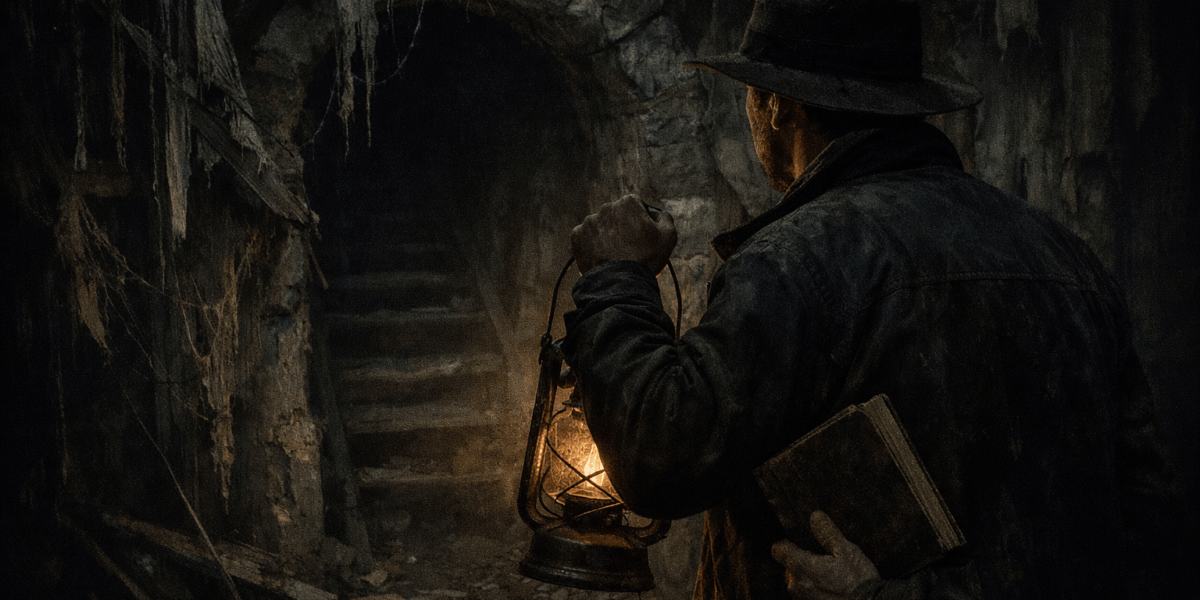
Entry #250
December 26, 2025 — 2:30 AM
I am done circling. What comes next isn’t another lesson in how the system works; it’s about the first thing that was done here. Cause, not mechanism. The original wrong.
I laid everything out on the drop table in the hall: pencil rubbings of the carved marks from joists and stair undersides; my sketch of the stations and their sightlines; the bag of old cut nails I’ve been pulling like teeth from trim that shouldn’t have been fastened twice; fragments of the predecessor notes—penciled arrows under paint, hash marks in closets, a fingertip’s worth of wax on the rail where a watcher stood too long. The copy of the deed is there too, dated June 14, 1891, Samuel and Eleanor Blackwood in that heavy hand they both seemed to share. Their names have been appearing in slivers under the house’s skin for weeks—S.B. on a sill, E— pressed into wet plaster, “Black—” scratched shallow on the back of a lath. I can’t find them in the county’s births or deaths. Either they were the first to try to document the house, or the first the house wrote down.
The stations make a ring, but all their attention runs inward. The observation logic has been bothering me—tiny holes at chair height behind wainscot, vents that line up not with air but with sight, a placed mirror’s ghost outline on the hall wall catching an angle you can only stand in comfortably for a few minutes at a time. There’s a scuff polished into the upstairs landing where a heel twisted regularly to look along a constant axis. The axis ends where it began: the core mass of the house, the wall that is not wall, the load that everything leans into because something decided it should.
I went down to the cellar with a work light. Cold enough to bite fingers through the gloves. The light made the suspended dust draw lines in the air. There’s a section of the chimney base that doesn’t belong to any plan I’ve found—brick over brick, a patch within a patch. The mortar there is different, fine sand and shell, the sort you use when you want a seam to disappear. Someone peened the heads of three iron straps flat and painted them to match fieldstone. I wouldn’t have noticed if I hadn’t been following the arrows—little triangles of ancient pencil on the underside of the first-floor subflooring, aimed neatly like compass points. One triangle has a nick across it, deliberate, and the nick lines with the left strap.
The air on that side smells older than cold. Not rot. Not damp. Ash without heat. There’s also a faint sweetness like paper left in a trunk. I ran a magnet along the brick and felt it catch on iron beneath where no iron should be. The floor above is quiet at this hour; the only sound is the click and settle of baseboards as they cool. From the table upstairs, the map says every watch arc crosses this place. If the house remembers anything, it is under that central weight.
I brought down tarps, a respirator, the small chisel, the long one I don’t like, a headlamp, a mirror on a telescoping rod, a carpenter’s level, a cheap borescope I haven’t trusted until now. I scored a rectangle around the patch and marked my cuts. I wrote down the order and the measurements because I don’t want to be in a hurry inside the house’s core. I am not interested in another mechanism. Only the reason.
I will start at first light. The deed on the table upstairs has two signatures that fix this house to a date and to two names no one seems to own. The rest of the signatures—the scrapes, the gouges, the stations—point to the same place. The oldest rooms are rarely the deepest parts of a house; that distinction belongs to whatever happened there first.
— Thomas Hale