
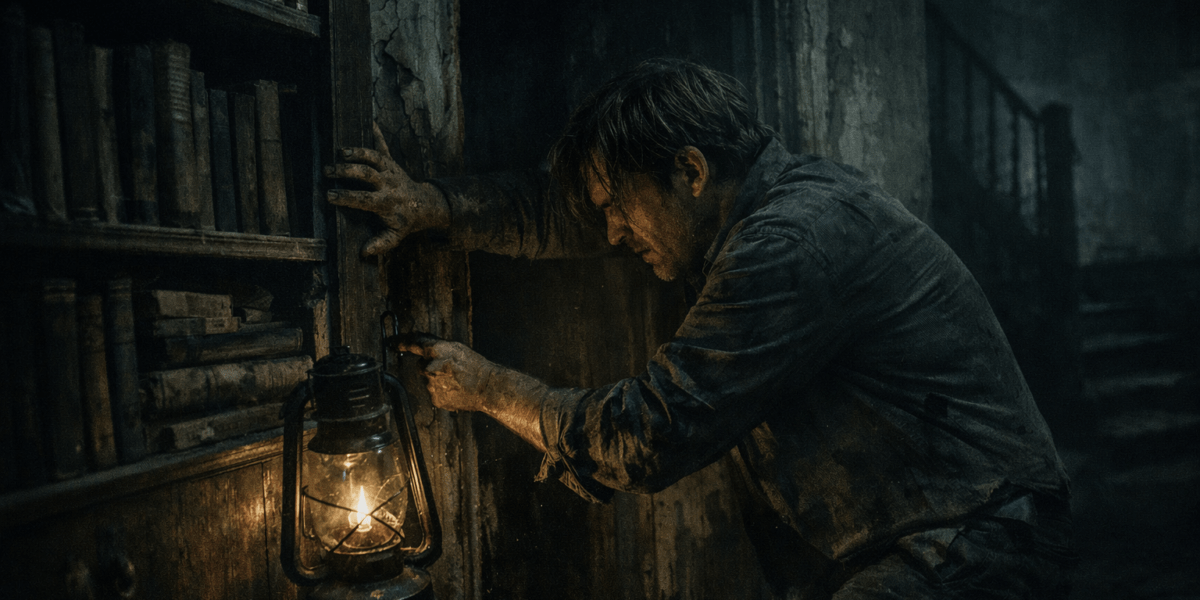
Entry #270
January 22, 2026 — 11:30 PM
Cold light at the landing this morning. I laid out the small kit: pry bar, tape, shims, level, square, the phone with the inclinometer app. Coffee on the stair, cooling faster than usual. I had sketched the circuit last night. Today was the first cut.
The continuity point I chose was the upstairs landing where the south window’s morning beam passes over the brass floor register, across the stair runner’s central stripe, and into the mirror on the east wall. When those lined up, there was that particular stillness (Entry 268). I decided to break it in three places.
I started with the mirror. The frame is screwed to the plaster, a little out of square from age. I backed the lower-right screw out, added a washer, and brought the bottom edge forward by 7.2°, marked it on blue tape at the corner. I cut a strip of black card and taped it to the glass to obscure a finger-width of its right margin, the section that usually catches the nooning light. The tape stuck cleanly. My hand left a fog print on the chilled glass that faded as I watched.
The newel cap was second. It sits on a peg, friction-fit, oak on oak. Someone had once pried it; the varnish was scarred in a crescent. I eased it up with the putty knife and found old pencil under it: S E B, each letter small and careful, and tick marks like notches on the rim. No date, just that. I rotated the cap until the long grain no longer lined with the runner, set two thin shims, and pinned it with a 23-gauge brad from the nailer—nothing visible, but enough to hold a change. I noted the rotation on tape: +6°.
Last, the register. Brass with louvers fixed in one direction. It had always sat flush with the boards, slots parallel to them. I lifted it, coughed dust. The duct smelled metallic, faintly sour, winter. On the underside of the grille, under the old paint, someone had scratched a line and an arrow, and the letter E. I turned it ninety degrees, wedged two matches in opposite corners so the frame couldn’t settle back, and set it down askew. The slots now cut the light into a different geometry.
I waited at the head of the stairs with my back to the wall clock. At 8:17 AM the square of light reached the register. It stumbled on the first angled slot, broke, and threw a new pattern against the riser. The mirror caught only a dull smear of white behind the card. The runner’s stripe no longer pointed true. The house did not fall silent. Air moved normally; the baseboard ticked.
Then the register breathed. Not a sound, a feel—warm air swelling from below. It flexed the brass once. The left match slid, a click like a cricket. The grille settled a hair, not back to perfect, but enough to rotate its light by half a slot. The card on the mirror lifted at one corner, adhesive giving under a slow draft, and re-seated higher. My 7.2° became 6.5° without my hand near it. The newel cap gave a tiny, patient creak, the sound wood makes aligning itself. I put my thumb against the grain. It was not moving under pressure, but when I looked at the tape mark, the line no longer sat on my scribed tick. +6° read +5.2°.
I photographed each change and re-measured. The beam found more of the glass. In the mirror’s edge I saw the runner’s stripe nearly central again, not quite. For a breath, the hallway lost its layered noises. Not gone; evened. I put the brad gun away and tightened the washer at the mirror’s corner to restore my angle. The screw turned harder than it had, as if the threads had seated deeper by themselves.
Later, in the deed folder, I looked again at June 14, 1891. Samuel and Eleanor Blackwood’s signatures are clear. The same hand as the careful S E B under the cap? I don’t know. But if they signed the paper, they also marked wood. The house holds both kinds of records: what we write of it, and what it writes back on us.
Today confirmed the thing I suspected: continuity can be challenged. But when I pushed, it pushed back. The first sign of resistance from the house was not violence, but correction.
— Thomas Hale