Entry #140
August 20, 2025 — 12:15 AM
I took the opening behind the pantry another four studs tonight. The plane of the old wall runs parallel to the kitchen, but the interior course isn’t honest about it. From outside, the line is straight. Inside, the studs set a quiet curve. I chalked arrows on faces as I went, white on dark pitch, because there’s no sense trusting only one sense.
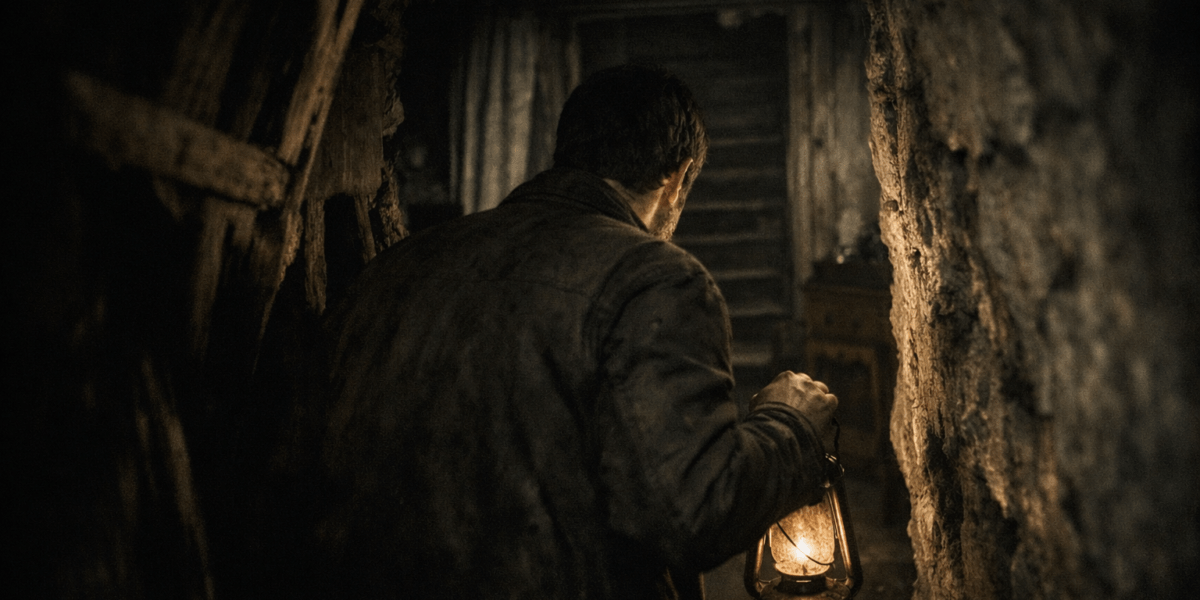
The air inside is cooler and smells like resin and mouse dust. My headlamp throws a tight cone that exaggerates everything: torn plaster keys like teeth, grain in the lath standing up where it got wet once and dried rough. I used a short pry bar for feel, poking ahead before committing my weight. Floors in there are not floors—just sleepers and cross-brace, and beyond them a fall to old subfloor scattered with mineral wool and the kind of nails that bite even when they lie flat.
At the third bay I found a brace with two letters notched shallow into the edge: E.B. The cuts were clean, not a child’s idle scratch, placed where you have to know to look to see them. A little sheen of sap still glassed the notch, though everything around had gone to gray. I touched it with a glove and felt the old oil rise as if I’d disturbed some varnish that never cured.
The corridor pinched there. I shifted sideways and eased in another body-length. Somewhere back at the opening, the work light I’d clipped to the pantry shelf buzzed and ticked, the cord rubbing on wood. Then a small movement, a dry brush noise not far from it—fabric against a nail head, or a sleeve crossing lath. I stopped and held my breath. The sound did not repeat. What carried forward was a fine settling as grit decided where to land.
It crossed my mind that the bit of panel I’d propped might let gravity win. I had it braced with a wood wedge and two drywall screws acting as a stop where the latch would have caught in 1900. The wedge sat on a piece of baseboard I’d laid as a shim. If any of that crept, the fit would change by the thickness of a coin, which is sometimes all this house asks.
On the way in I’d counted six studs to a crooked king, then a header. On the way out I met a run of three with the same knot like a dark eye. My chalk marks helped and then did not; one arrow had smeared into a cloud where my shoulder brushed it. The gap I’d slid through felt less generous. My tool bag caught and held on a wire. I backed my hips, breathed out to thin myself, and let the bag swing down to free. The lath scratched through my shirt in a clean vertical line.
Behind me—closer to the kitchen now—another small transfer of weight. Not a step. The kind of give a stair has when someone leans from it to look. The panel edge, when I found it with my knuckles, was not where I had measured it. The screws had walked a fraction, or else my hand was more certain than my eye. Either way, the opening had a new angle. The light from the kitchen seemed seated farther back than it had been, like a picture skied on a wall.
I eased the wedge with two fingers and did not let it fall, because I didn’t want one clean sound to announce anything. Cold air from the return vent lifted the hair on my wrists. I saw, just inside the jamb and only now that I was nearly through, another small cut on a beam—S.B., lower than my knee, right-handed, the B swelling as if the knife had met hard grain and insisted anyway.
I came out without hurry and pushed the panel to the exact place it had been. I will not swear the route inside is changing. It would be convenient to blame miscounts and poor light. But there is a kind of steering in there that isn’t mine. The passages are navigable. They aren’t safe. The route back felt found rather than remembered.
— Thomas Hale