
Entry #286
February 11, 2026 — 12:15 AM
I am writing this like a checklist because the work will be up high and my hands are not as steady by guess as they are by rule. Today’s wind mapped the seams for me. Tomorrow—the afternoon, when the sun has had time to thaw the skin of frost—the north gable.
Weather: forecast says high 38, wind NW 8–12, gusts to 18. Gusts fall toward late day. No rain, no new snow. Cloud cover thin. I wrote those numbers twice and underlined the gusts. I need a quiet hour where the air will not take the ladder and make the choices for me.
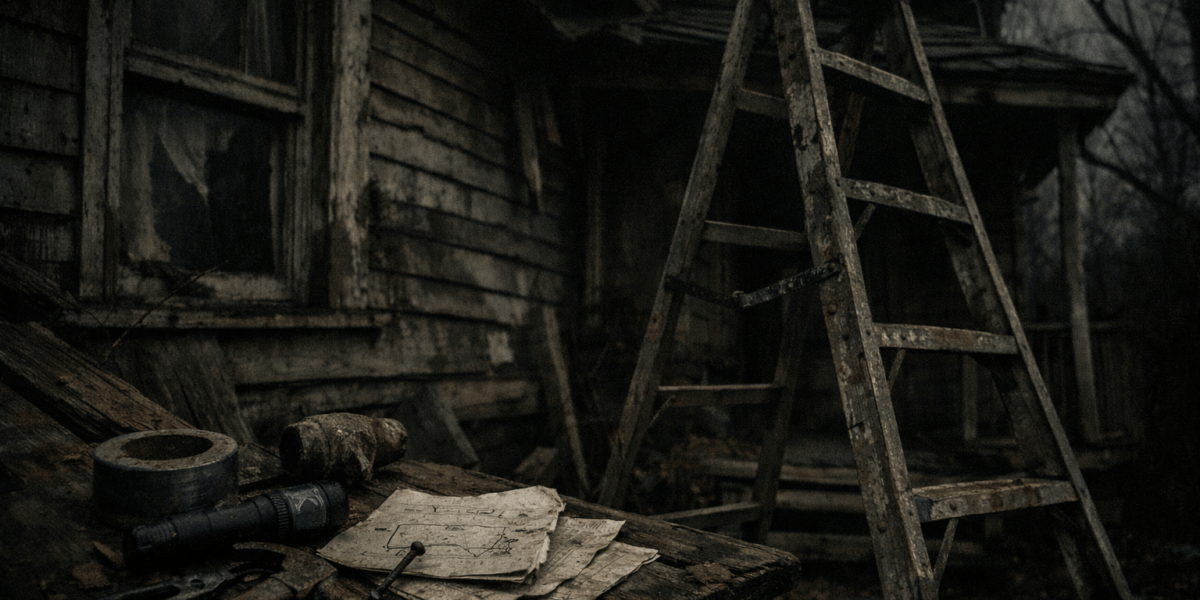
Ladder placement: 28-foot extension, rails inspected tonight in the cellar light. No checks in the wood, rungs solid. Cables clean. I will set the feet on the plank run I cut from the old pantry shelving—1x10s laid perpendicular across the frozen soil to spread load. Four-to-one angle: for every four feet up, one foot out. I measured the eave height earlier against the story pole—twenty-two feet to the fascia, so five and a half out from the wall. Standoff arms on the top to keep the ladder off the gutter; the gutter is loose. Tie-off: length of webbing pre-looped and carabinered, to go around the nearest rafter tail. I tested the tails from the attic last week—two are punky, one is firm. Use the firm.
Footing: boots dried near the radiator, tread brushed clean. I will sweep the plank free of grit. Ladder feet set to the spurred position for soil, not smooth pad. If the plank feels slick, I’ll sand it first. Gloves with rubberized palms. Harness and a roof rope with a figure-eight and prusik already tied. I’d prefer a proper anchor point; I don’t have one. The harness is more ritual than certainty up there, but ritual keeps sequence.
Route: exterior. Through the side door, across the brick walk—avoid the sunken third brick from the stoop—and along the north wall where the hydrangea canes are still low. Carry the ladder low along the rail so it doesn’t catch the wind. Stage the tool bag halfway on the porch to lighten the first trip. Do not go through the attic stair: the top three treads flex and one squeals like a pulled nail. If I must go inside for a tie-off, I’ll step only on the edges where I marked the joists in pencil. The pencil lines are faint in the low light; I refreshed two of them this evening. They pass through a scuff on the newel at the third-floor landing where someone once cut their initials—S & E—too small to brag about, too stubborn to sand out.
Materials: headlamp with fresh batteries, spare set in the left pocket. Chalk, small line reel to find the straight of the fascia. Pry bar, claw hammer, #8 screws, driver bits, two tubes of exterior sealant, butyl tape, short section of flashing, wood hardener and filler, utility knife with two spare blades. Drop cloth and small tarp to keep debris from the shrubs. The canvas shoulder bag is packed to hang from the ladder at hip height. First aid kit on the porch table within reach. Phone charged, belt clip, not in a pocket where it can fall when I look down.
Investigation now reads like repair. Same notebook, different columns: symptom, location, conditions, plan. The loose fascia at the north return where the daylight showed in the afternoon. The cold seam that sang through the bedroom casing in the wind. The nail heads that keep working proud, rowed like a small code across the siding. I have circled them on the elevation sketch, each circle a small admission that the house keeps its own ledger I am trying to copy line by line.
I am tired. The kind that makes the edges of the page look soft, but the numbers hold. I have done what I can to set the ground and the angles and to know, in advance, where my foot will land. There is a margin I can’t calculate—the way the boards dislike being moved, the way the upper rooms listen. That is the part I carry and can’t put in the bag.
Preparation is what remains when confidence does not.
— Thomas Hale