
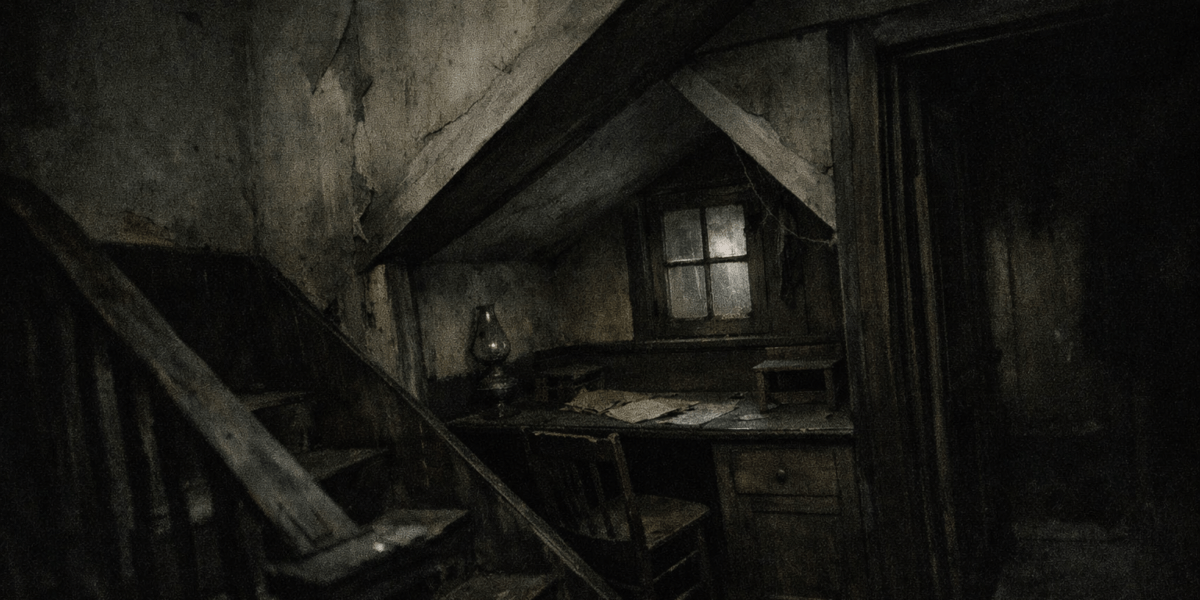
Entry #252
December 30, 2025 — 1:00 AM
I took up the baseboard along the inner chimney mass because the plaster there has a different sand in it, coarser, with dark flecks. Dust came away in granular sheets. When I backed the nails out, two snapped and sang back through the lath. The room held the sound too long. I pulled the last piece and found a bevel in the brickwork that didn’t belong to any flue—a chamfer cut to open a sightline around the corner of the built-in cupboard.
I put the lamp low. At knee height, a shallow lip in the masonry, smoothed by use, just wide enough for a ledger to rest without tipping. Directly above it, at eye level, a hole punched cleanly through a upright stud, not the ragged sort left by rodents, and not for wiring—no wax, no porcelain, no scorch. The hole faced the doorway to the small front room. I lined my eye and the frame made a narrow cone of the room beyond. Even the old paint edge inside the bore was burnished, as if by skin oils.
Further along, behind the jamb, I found a scored line like a cabinetmaker’s witness mark—two little ticks that align when the trim is seated. Behind that line, a pocket the size of a folded paper. Someone had packed it with wool at some point and then thought better of it; the wool was matted against the back. The plaster on the pocket’s interior had graphite on it, rubbed like thumb smudges. Notation, not nesting.
I followed the chimney up. On the landing, where the stair dog-legs, the newel post has a flat about two fingers’ width, polished smooth. I had written it off as a carpenter’s flourish. Tonight, with the floors quiet and the heater ticking in the kitchen, I stood there and looked down through another clean hole hidden in the turn of the rail. The same axis. The same room. Someone waited here. This is a waiting station.
Under the first course of brick—where last night’s ash smell is lodged, cold and mineral—I brushed the soot off a set of shallow cuts. Three points arranged in a line, separated by midpoints. Between them, faint letters, so old the strokes have widened. S ∙ E ∙ B. The center dot is eccentric, like a habit of a hand. I took the deed out again—the one dated June 14, 1891—and put the lamp on the signatures. Samuel Blackwood. Eleanor Blackwood. Their name isn’t in the county registers, but their hands are in this wall.
There are more. A slit made in the back of a closet panel, with a little batten to slide it shut; on the inside face, the same graphite bloom low and to the right, where a right-handed person would rest a note while crouched. A recess at the base of the chimney stack with a bevel cut to keep it dark yet dry. Every vantage paired with a place to record. Every concealment married to a surface meant to be written on.
I don’t think this was added after. The holes are bored before plaster, the trim cut to cover by design. The joints that hide them are original, square-cut nails still black in their beds. The stays I found last night were not improvisations. Even when the footprint was smaller, these angles were already laid in.
The house was built to hide and to preserve at once. The watching was not a later idea, and neither was the keeping of what was seen. My own notebook is beginning to feel like an object this place expected before I arrived—an echo of a ledger that once rested on that lip of brick. Samuel and Eleanor may have been the first to put pencil to these niches, or the first to have their movements notched by them. Either way, there’s a pairing here: eye to aperture, hand to page.
I pried up the tread above the landing. Under it, the oldest hidden room breathes cool, and when I lower the lamp, the air blurs with dust that does not drift until I move. Its walls have the same polished resting spots and the same marks. The oldest hidden room had not merely permitted observation; it had expected it.
— Thomas Hale