
Entry #290
February 16, 2026 — 11:30 PM
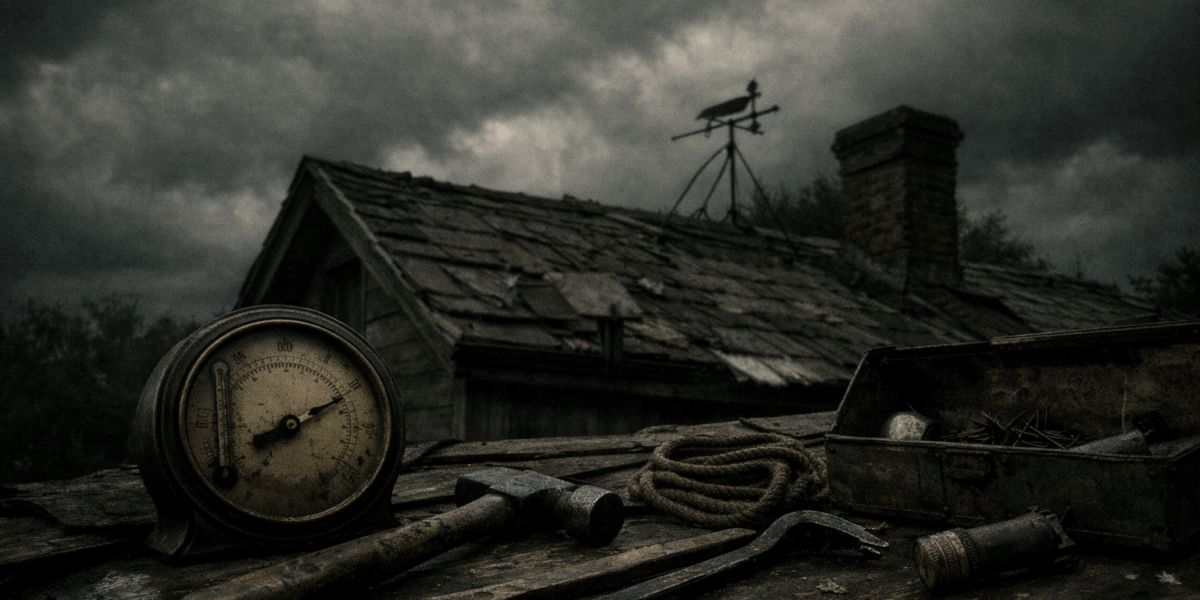
The light changed after lunch. Clouds stacked in a solid lid over the ridge and the yard went flat, like a photograph. The barometer on the kitchen shelf slid two marks without noise. By three, the air had that mineral taste it gets before wet weather. NOAA sent the first alert: rain starting as a cold front, then wind. Nothing novel in the wording. The timing is the problem.
The north eave is still a weakness. I said as much in Thinner at the Eaves. The fascia there pulls away in two places, and the top course of shingles along the dormer is proud by a finger’s breadth. In Half-Inch Slip I let myself get comfortable with small margins. That half inch matters with wind-driven rain. If I don’t pin it down before this system arrives, the water will run under the paper and I’ll be tearing out ceiling later.
I went up the ladder midafternoon to look at the ridge and the chimney saddle. The lead at the back of the stack has lifted on the right side. You can’t see it from the yard; you feel it under your hand, a soft give where there should be blunt resistance. The tar along the ridge cap has alligator cracks. I tugged at a blister and the paper came up easy, dry as a leaf. Under it the boards are silver and thin. Wind rolls in, finds that gap, and the rest of the plan follows.
It isn’t a question of courage. The adhesives need forty degrees to set. We’ll be below that soon. The hardware store closed at six and I bought exactly what I could carry up once: coil nails, a roll of ice membrane, two tubes of polyurethane, a short length of step flashing to replace what crumbled under my thumb. I was stingy with weight; gusts were already coming in from the west, irregular and hard enough to slip a boot edge. I marked a window on the radar where the band thinned around four. That was my time.
I roped the ridge the way I said I would in Before the Ladders Go Up. Threw a line over the gable, set the anchor in the oak round by the drive, and tensioned it to the hitch. Not perfect, but I don’t have a crew or a harness rated for this pitch. The plan was simple: get the membrane tucked under the ridge cap, bed the lead back down behind the chimney, set three rows of cap nails on the north face, and run new screws into the fascia where the gutter lagged.
The house helped make the case. Each gust found a new voice. The attic hatch trembled in its frame with a dry chatter. The cracked pane on the stairwell sang a tight note and held it as the pressure leaned in, then went quiet when it passed. From somewhere under the eaves came a slow tick, like a clock held under a pillow—nail points lifting and setting in the lath, maybe, the wind doing the counting for me. In the spare bedroom, the old stain in the corner lifted a smell of dust that’s only there when dampness is near. Nothing dramatic. Just a set of small facts, all pointing the same direction.
There isn’t room in the schedule for waiting it out. Either I’m on the roof when the lull hits or I mop a month’s worth of slow ruin. The house sags toward its weakest point and the weather presses in right there. Between the two, the decision is made. Old roofs do not care whether the rest of the house is ready.
— Thomas Hale