Entry #127
June 13, 2025 — 8:30 PM
I went back to the pantry wall at noon, when the house is easier. I had the twine from the stair newel, a carpenter’s pencil, and chalk. The access I cut last week was just wide enough for a shoulder and a steady breath. I set a work light on the floor to throw a flat wedge of light across the opening, left the rest of the kitchen in shade. It felt like working at the rim of a well.
The last known limit had been a diagonal brace. I’d told myself that brace was the end of it—a sensible end, a tidy void between studs and the old chimney. Today I took the brace out. The nails complained but came free. Behind it, not a dead stop: a run the width of my body, pinched, lined on one side with dusty brick and on the other by studs furred with lime and mouse hair.
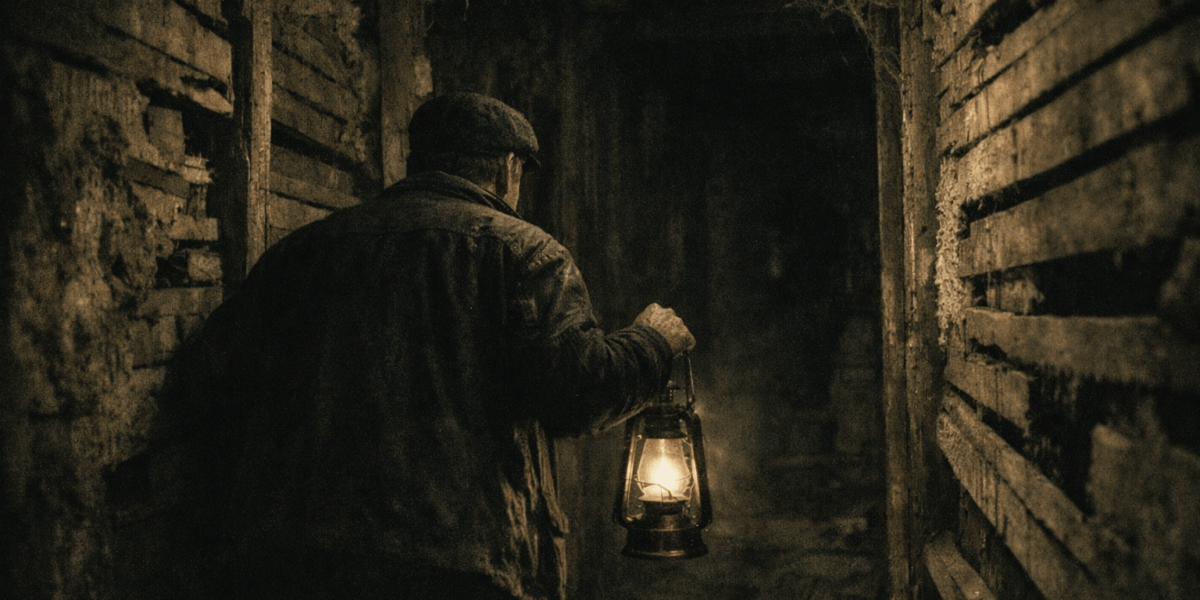
Footing was the first problem. There isn’t a floor there, not a real one—just the thin top of the sill and the rib of a lath here and there. My boots found edges by feel. The brick pressed the right side of my face if I turned my head. I could smell the chimney’s history: dry soot, old rain, something metallic like forgotten tools. Splinters lifted and caught in my sleeves. When I paused, the silence had a skin to it. No tick from the fridge made it through. My breathing sounded like a stranger’s.
The light was fixed behind me, so I worked in my own shadow and the tight beam of a headlamp. Dust hung and brightened when I moved, then settled. I chalked arrows on the studs where my hand could find them coming back, and I ran the twine from my belt into the dark. It slid over wood, hummed once on a nail head, then went slack again. The air was still enough that the lamp’s warmth felt like weather at my back, and ahead everything cooled by degrees.
Ten feet in—measured by knots in the twine and the count of my careful steps—the framing did something no ordinary chase should do. The studs didn’t continue. They pinched, then ended at a neat edge as if planed off. Past that, the space widened by an inch or two and dipped. Someone had fastened narrow cleats to the brick, each no deeper than my boot sole, like rungs made for sideways feet. I put weight on the first and it held. Grit shifted under the tread like powdered glass.
There was a turn I hadn’t accounted for. The run doglegged left, behind where the dining room should be, and the brick lost its soot and went damp-cool. On the stud to my right, at the cut edge, I found a scratch I didn’t make: a faint B gouged with a nail, and—either wishful thinking or real—what could have been the top of an E before the grain broke. I penciled a small mark of my own below it and kept going one more cleat.
Then it did something worse for any plan: it split. The left kept sloping down, the cleats continuing out of sight. A second slit opened tight to the right between doubled studs, no hardware, only the slight give of old wood. I flicked a washer down that right slit and counted. It didn’t ping metal; it made a soft, delayed sound, like cloth. The left gave back a different kind of silence, big enough to hear in.
I stopped there. I stood with both palms on cold brick and listened for a long minute. There’s service space in any old place, but this isn’t that. The alignments are all wrong for plumbing or flues. This was built to be passed through, if only by someone willing to turn sideways and move slow. I tied a final knot at my belt and backed out the way I’d come, chalking the last cleat as I left it.
When I straightened up in the kitchen, the work light made the dust in the pantry doorway look like rain. I wrote the distances on the joist. It’s a relief and an ache at once to know that the house seemed to continue inward after the visible rooms had already ended.
— Thomas Hale