Entry #190
July 4, 2025 — 8:30 PM
The town is making noise for itself. Bursts of color I can’t see push air against the panes. The house holds the day’s heat and gives back dust. Sulfur drifts in through the screens with the sweet, tired smell of old pine. A dog down the block hates all of it and says so on schedule.
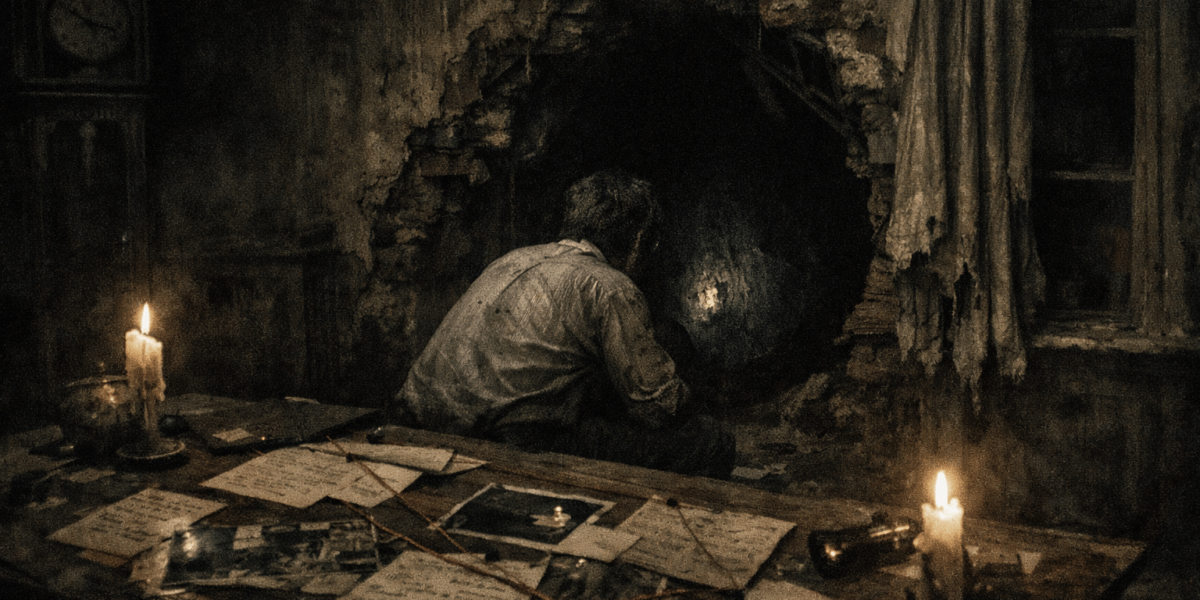
I laid out the notes from the last two weeks in a line across the trestle table: times, rooms, temperatures, sounds, small changes that repeat, mapped the way you map wiring when you don’t trust the walls. It is a serviceable picture, detailed enough to make me feel competent, and useless on its own. I have been collecting. I have not been changing anything. That used to feel like discipline. Tonight it feels like deference.
Discovery alone is not getting it done. Names, paths, hours — a neat inventory of the ways the house moves around me — and the same movements return exactly. The pattern keeps its time whether or not I am watching. That means there is a mechanism somewhere, if not gears then tolerances: gaps, lengths, pressures, timing. If there is a mechanism, a point exists where it can be made to slip.
Today, when I pulled the cap from the front stair newel to reglue a loose dowel, I found a word cut into the underside where a hand never would have seen it in use. Not initials. Not fragments. Blackwood. Each letter tight, stabbed more than carved, the grain lifted around them like small blisters. The cut was old — dark with dust and the kind of fine dirt that never blows in from outside. No date next to it, but inside the cap a grease pencil mark: S & E. The cap went back on. I photographed the underside first.
After that, I ran what records I could reach without leaving the house. County registrar, digitized. Deeds, yes; June 14, 1891; this parcel transferred into the names Samuel and Eleanor Blackwood. Births and deaths under that surname in this county: nothing. Newspaper archive search: nothing local beyond ads, none of them with that name. It is a placeholder that left marks and little else. I can pin the word to wood in my stair. I cannot pin it to a person in a book.
This was the last thing I needed to adjust my approach. I have been working as if knowing would be the force that turns a bolt. It isn’t. The house teaches by repetition. If I leave all the tolerances as found, I am only keeping pace.
I am thinking now in terms a carpenter or a plumber would respect. Baffles. Backflow. Starving a run, overfeeding another. A wedge where a door couples loose air to a frame. A strip of felt where a sash ticks. Packing the cavity behind the dining room vent, just enough to change the draw. Detuning the hour hand on the hall clock so it misses an alignment I have caught twice at 2:17 AM. Introducing delay — a timer on the basement light circuit, a second timer on the radio — to see if staggered signals break the echo I get between rooms. False closures. Dead ends.
I will not start jamming shims into the house tonight, not out of caution toward what it is but toward my data. If I break three tolerances at once, I learn nothing. One change at a time, observed cleanly. Quietly. Measured. It is not a fight yet. It is a test applied to a field of forces I can’t name, but can listen to.
I don’t mistake resolve for recklessness. I am writing it here so I don’t forget: I am moving from watching to interfering. The pattern is to be broken, eventually. There is patience left in me, but I am done treating repetition as an end in itself. Understanding a mechanism offers no mercy unless one can also find where it fails.
— Thomas Hale