Entry #263
January 13, 2026 — 2:30 AM
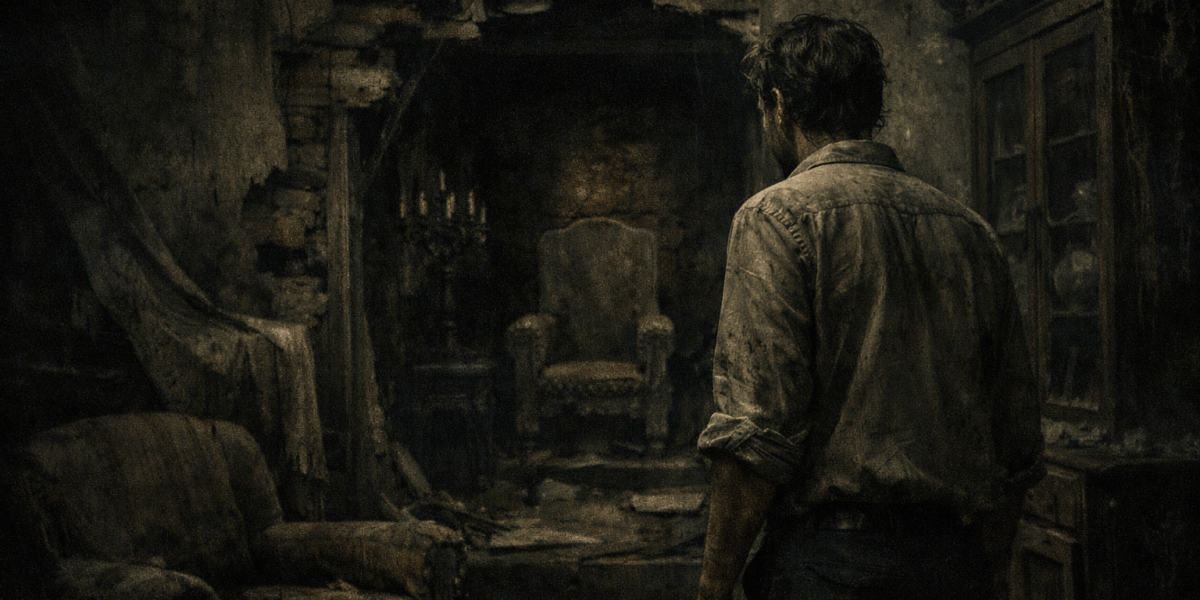
The work light throws a pale coin across the dining room floor. The rest of the house is unlit and crowded with its own cold. The boiler coughed twice around one, then quieted. The only steady sound now is the faint friction of the sash rope in the office window where I cracked it for air. The rope’s fray rubs like a small animal trying to get out.
On the table: my ledger, the nails sorted by gauge in shallow tins, the envelopes I’ve been using for found scraps. My pencil has a habit of drifting into my fingers whenever I sit down. Lately I reach for it before I know why.
After “The Necessary Witness,” I thought I’d claimed a neutral job: stand in one place and write down what I saw. Tonight I sorted another box from the binding niche. The paper sleeves inside were numbered in an old hand, pencil faded to smoke. Beneath a knot of twine I found a brittle folder, its clasp blackened and gummy. Inside: a thin copy of the deed, June 14, 1891, signed in two hands—Samuel and Eleanor Blackwood. Their names are straight as a rule. On the flap, someone had pressed a thumbnail so hard it left letters: S & E B.
I’ve seen those initials in here before without reading them. Inside the pantry door, scratched head-high into the paint. Under the stair, along the inner stringer where nobody bothers to look. On a joist end above the crawlspace trap, notched alongside tally marks. The house has a way of repeating its important words until you finally hear them.
There were other hands, later. A carpenter’s stub of blue pencil marked “plinth OK,” a tidy list of missing balusters with measurements to the eighth, a map someone made of the basement drains using bottle caps as tokens. The ones who stayed long enough to find were the ones who made these small inventories. I recognize them. I am them.
This is not only selection bias. I can feel the tug. When the breaker trips on the second floor, it does it at the hour when I’d most be up there measuring, so I end up back at the table with a candle, drawing diagrams. When the storm swells the thumb-latch and I can’t leave without planing it back, I stay through another dusk and fall into sorting, labeling, making sense. The house does not shove. It shapes the schedule. It keeps you in the kind of work that leaves traces.
I told myself I fell into documentation because I’m that sort of man. It’s true. I like rows, dates, screws nested in tins by length. I like a ledger that balances. I like to know where a thing came from and where it went. But it occurs to me now that those traits are not random shelter—they’re bait the place recognizes. It favors observers. It favors arrangers. It favors people who will remain because leaving without finishing is worse, to them, than any ache in the knee or draft under the sill.
If Samuel and Eleanor Blackwood signed the first paper, perhaps they were the first to write the house down. Or the first to be written by it. I don’t know which direction that transaction ran. I know only that the line continues. Discoverers become continuities. The lists get longer. The handwriting changes, not the habit.
This realization lands in the body first—a small stiffness in the throat, a pause at the back of the tongue. Future tense presses forward. I am not trapped. I can stop this page. I can shut the ledger and sleep in the truck. I can put these envelopes in the stove. I am alive and can still choose.
But I am writing. The pencil decided the route my hand would take before my head caught up. I had mistaken myself for a man uncovering the house when the house had also been preparing to use me.
— Thomas Hale