
Entry #197
July 25, 2025 — 3:45 AM
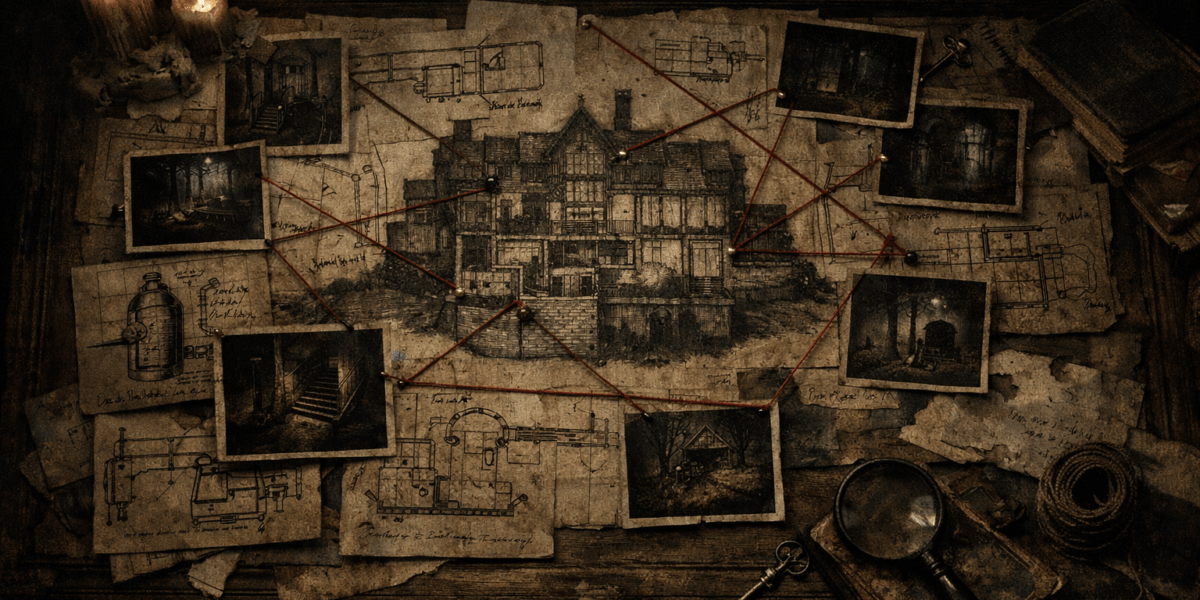
This afternoon I stopped treating each surprise as an isolated trick and started laying string. Chalk, tape, a plumb bob from the tool bag. I took the first floor plan I sketched weeks ago, spread it on the dining table, and began adding routes the way electricians mark runs. Once I traced the old core, the rest set itself.
The core is right where the house makes sense: the brick mass of the central chimney and the square of rooms around it, 1890s proportions, plaster that hangs onto its lath like wet bark. Old cut nails, hand-trimmed joists with plane chatter. Everything tight. That ring is honest work.
The later routes skirt it. Narrower cavities hugging the north wall, two-by stock with machine nails, and felt slipped between studs to damp sound. Panelling that isn’t quite the same species as the original—fir where there should be pine. A baseboard in the parlor that lifts with two hidden screws. Behind it, a horizontal run notched clean through three studs, edges too smooth to be casual. It connects the cold-air return beneath the stairs to a chute behind the built-in in the study. Pull a brass pin in the cabinet, the entire back swings on recessed hinges and you’re at an intersection: one path climbs in the thickness of the wall beside the stair, the other slides low, just above the basement ceiling joists, aiming for the kitchen.
Observation points are placed like deliberate commas. A pinhole behind the fretwork over the parlor transom catches exactly the cushion of the chaise. Two slots cut into the riser of the third stair, disguised by grain, with a sightline under the library table. The attic’s knee wall has a long slit painted black; from there, through the return and down the false back, I could see the edge of the dining room mantel mirror without seeing myself in it. I confirmed angles with a flashlight and a hand held up where a face might be. When I breathed in the knee space I felt the cooler pull from the return below. Air is part of the system too.
Visible rooms have been shaved and stuffed to accommodate all this. The crown in the hallway is prouder by a quarter inch where a tube rides above it; when I tapped it, the ring was dull. The base shoe in the guest room has a run of plugged brads that don’t match the rest. Someone retacked the picture rail on a different nail pattern to hide a channel just behind it. Everywhere a small compromise in symmetry, but each one agrees with the others. None of it reads like whim.
Upper to lower connections are continuous. The laundry chute I thought was a bad remodel is a decoy; the real drop is built into the wainscot, half-width, lined in tin, fed from the upstairs closet through a hinged shelf. The speaking tube in the study isn’t a toy. I blew and heard the faintest whistle answer from above the back bedroom, then a second one, further yet, somewhere under the rafters. The cold-air trunk in the basement, I now suspect, isn’t only for air. It knots everything together, returns and routes, a spine that the later work braided around the old brick.
In the attic, under loose tongue-and-groove near the east dormer, I found a slat used as a shim stamped BLACKWOOD in a serif so shallow you only see it on a low angle. I pulled it, brushed off the dust, and the letters held. Downstairs after dark I tried to coax anything about that name from the county indexes and scanned newspapers. The deed traces to Samuel and Eleanor Blackwood, June 14, 1891, but beyond that, silence. No births, no deaths. The registrar’s microfilm is a gap of gray where the year should be clear. The name returns inside the walls, and nowhere I can ask questions.
By dinnertime the plan on the table had become a net of red lines, arrows, and sight triangles that connect floor vents to closet voids, to knee walls, to mirrors. The old core sits at the heart and the later routes move around it with a logic that’s not mine but is consistent. Whatever the purpose, the whole house now reads as a single design, not an accident of decades.
It had become difficult to describe room by room because it no longer behaved as one.
— Thomas Hale