Entry #219
September 27, 2025 — 10:15 PM
Tonight I tried a different premise. Instead of treating the stray marks and placements as personal habits or accidents, I read them as forward speech—things arranged not for their maker, nor for anyone living beside them, but for a person who would meet them later. A relay carried across rooms and years.
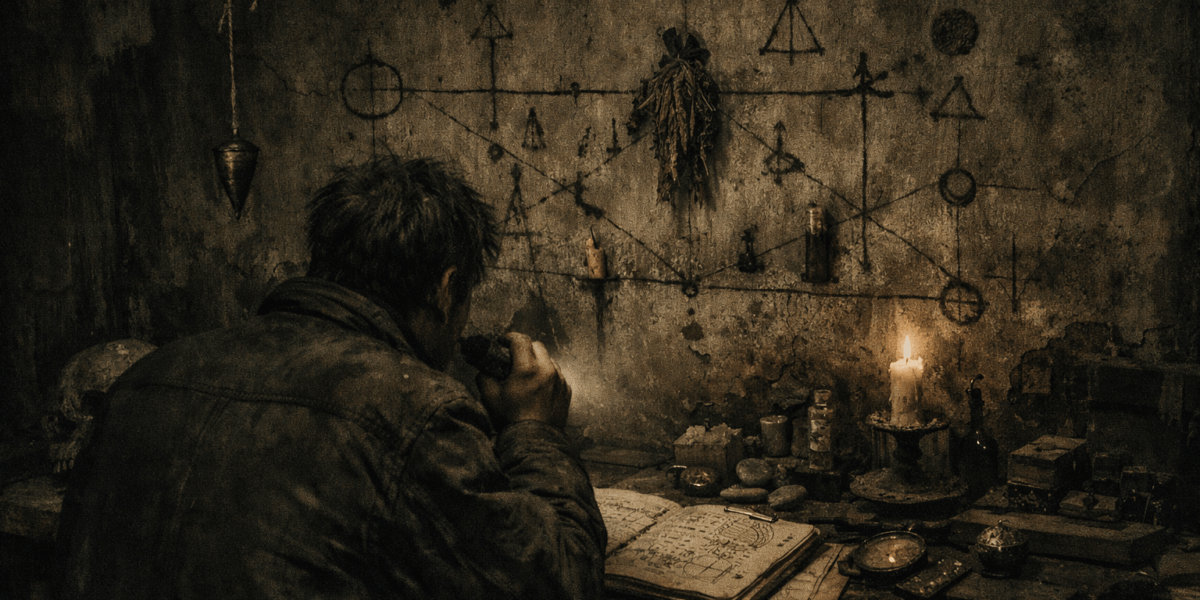
Under the yellow lamp the house shows its edits. Faint pencil pricks at baseboard height that don’t quite form a line until you lean; a cup ring on the dresser that refuses to sit round but tips into an ellipse, the long axis aimed at a chipped corner; soot dots above one pull-chain, as if someone touched the ceiling with a thumb each time the light went off; a run of nailheads along the stair skirting filed down flatter than their neighbors, their flat faces canted the same way. I have seen these since I started stripping the rooms. I had been cataloging them by zeal and sloppiness. Tonight I assumed intention, and then I tested it.
In the upstairs hall there is a brass carpet tack hammered too high, and opposite, a nick in the plaster that always caught the eye at night. When I crouched so the tack covered the nick, a knot in the banister rail slid under them both. Holding that alignment, the view through three doorways shifted into a single corridor of sight. My own lamp caught a set of old scrapes on the far bedroom’s paneling that usually look like cat damage. From that one angle they arranged themselves into strokes with a clear diagonal and tail. Not language in one place, but language by parallax: BLAC—then the angle failed. The draft took my sleeve and the strokes unstitched back into noise.
I struck one of the brittle matches I found taped under the sill last week. Sulfur and wood. I held the match where a pencil dot sits in the jamb. The smoke column bent right along a hairline where two boards meet—exactly where the next dot waits. The dots lead you by what the air does, not by what your eye prefers. Treated as a path, it keeps your weight off the boards that answer back. I walked the hall twice. My usual line woke the familiar complaint under the fourth plank; the dotted line skirted it and the floor stayed quiet. Not silence, but a quiet you can choose.
It isn’t only noise and drafts. The mirror in the southeast room lives on two nails set very slightly off level. If I swing it until the dark edge of the glass just grazes a scratch under the cornice, a nickel-sized bloom of old varnish on the opposite casement stops reflecting white and goes to amber. In that amber, someone’s light cuts appear on the painted stop: E. Bla—, and below it a short crossbar scribed with the care of someone trying not to slip. I compared the hand in the deed I found in the safe—the June 14, 1891 signatures of Samuel and Eleanor Blackwood, flourished and sure. The letters here are humbler, harder won. It reads less like a name declared than one being extracted.
Assuming a forward reader makes the system less arbitrary. The alignments stop being quirks and begin to make corridors, angles, timings. A manual written in corners and edges, by people who learned and could not keep it to themselves, and would not wish to.
Maybe the Blackwoods were the first to set it down. Or they were the first to be set down by it. Either way, the track does not feel new underfoot. It keeps choosing me back. There is inheritance here, but not the kind anyone applies for.
Some records are not made for contemporaries, but for successors no one would choose.
— Thomas Hale