Entry #220
September 30, 2025 — 11:30 PM
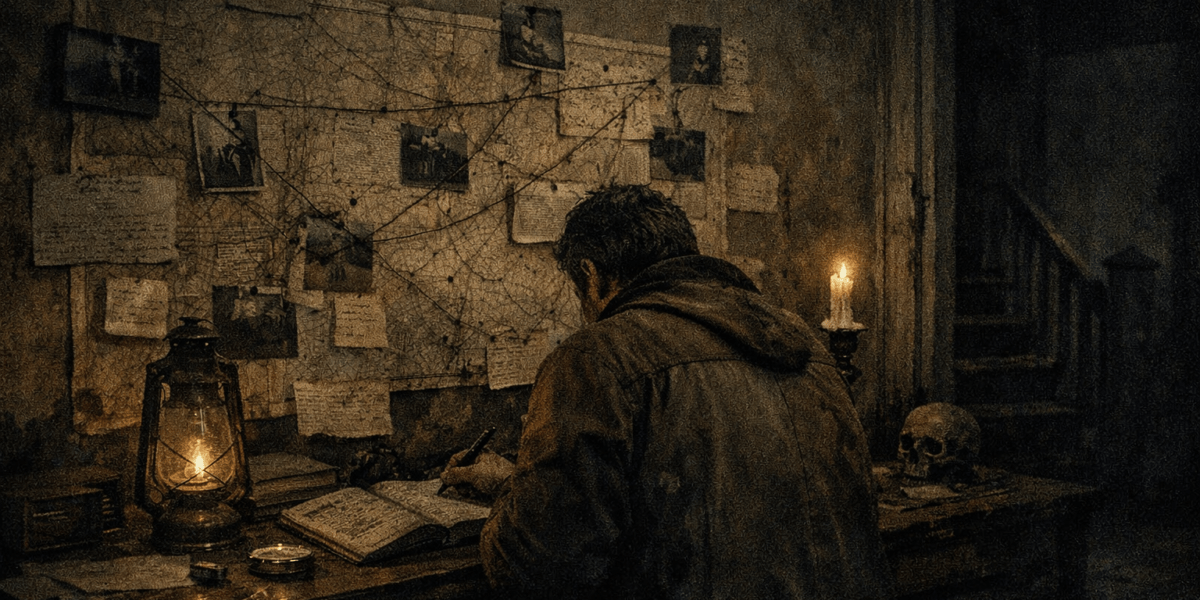
The shop light throws a hot circle over the card table. Everything past that circle is cooler, almost blue. The new plaster in the hall still smells faintly wet, chalky and sharp. Sawdust sits on my wrists like grit. The house is quiet in the way of midnight—refrigerator compressor off, water settled in the pipes, the small creaks spaced far apart like someone pacing themselves.
I took the folder from the cavity behind the stair stringer—the place where the hand rests—because I did not trust my earlier read of it. Tonight the paper felt more brittle, the adhesive stains browner. There are pages in at least three hands. Graphite, dip pen, ballpoint. The oldest paper has the onion-skin crackle I remember from ledgers, and it carries a light iron smell the others do not. The newest sheets are on lined notebook stock, corners dog-eared, a coffee ring gone to yellow.
The same headings repeat. Not the same words, but the same shape of thinking. “Turns taken,” “Distances,” “Openings that stay,” “The North Problem,” then underlined variants: “Rooms that reverse,” “Lengths that double,” “When the doors change mind.” Someone had used my word for it: “system,” written in the long, careful hand of a person trying not to blot. Next to it, a correction: “It isn’t a puzzle. It is a schedule.”
I laid one page over another and held them to the light. Pencil lines became rails that met. The measurements line up. Twelve feet three inches from the parlor threshold to the third riser, noted twice decades apart—only the pencil fades. Even the little arrows marking where to set a doorstop are in the same spots as the ones I’ve been using. Chalk ghosts on the baseboards I thought were mine alone show under a better angle of light. My marks sat directly over theirs. I did not discover anything new. I stepped into a groove worn almost invisible.
There is a deed in the folder. June 14, 1891. Samuel and Eleanor Blackwood in that black ink that looks wet no matter how old it is. A flourish under Samuel, a tight, patient E for Eleanor. In the margin—different hand, same ink—tiny numbers, fraction marks, a note: “hall ≈ stair three.” A later page in pencil refers to “S. B.’s first map,” and then a page after that says, in block letters, “HER CORRECTION WAS RIGHT.” I don’t know if they were the first to write the house down, or the first name the house wrote down. Either way, their names keep repeating. Scratched faint into the underside of a drawer I pulled tonight: “E. Black—” and then an old split through it.
I am not guessing anymore. At least one of the people before me saw the same alignments, called it a system, tracked it better than I have, and could not get out of its logic. Their pages break off mid-sequence. “At 2:17 the north—” and then nothing. The next hand starts again with the same headings, same arrows. That person tried to address me without knowing me. “For whoever came next,” they wrote, and then did the math I have been doing.
Knowing this makes the place less occult and more like weather. It changes, but on a pattern. The rooms do what they do on schedule whether I admire the craft or not. My part has already been drafted, down to the weight of a door and the number of steps I will count with a pencil between my teeth because I need my hands free.
I can say this plainly: I am in a sequence. The house repeats itself through whoever notices it, and I have noticed it. Acceptance feels like a kind of obedience, but it is only clarity. Pattern is cruelest where it admits precedent.
— Thomas Hale