
Entry #51
May 21, 2024 — 7:00 PM
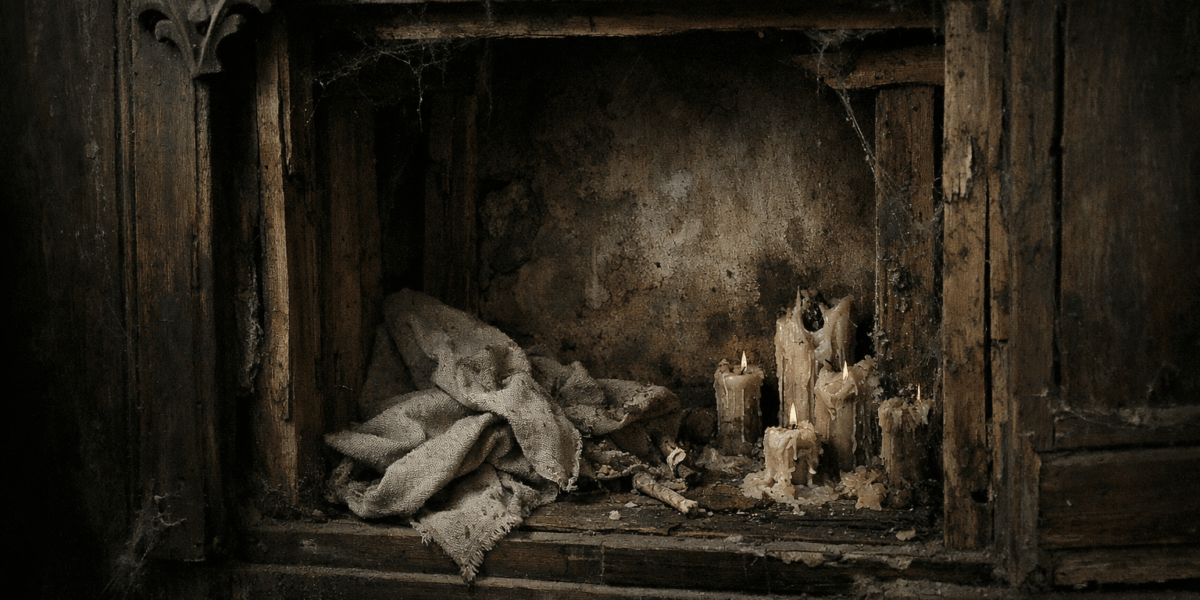
I went back to the opening with the sun on the east side and a kit I trust: nitrile gloves, painter’s tape, a soft brush, zip bags, pencil, steel rule, headlamp. The panel I pried free last night was leaning against the pantry wall like a door that forgot its hinges. In daylight the seam reads differently—no shadow tricks, just a straight, deliberate line in old paint. The air there has that mineral chill I associate with plaster kept dry too long. Pine, dust, a flat sweet note like wax rubbed thin.
The hollow is smaller than my camera makes it look. I measured and wrote it down: interior width 14 1/4 inches, height 23 inches, depth 8 1/2 at the center tapering a touch at the right stud. I labeled the inside faces A (back), B (left), C (right), D (sill), E (lintel) in pencil on painter’s tape so I could keep notes without writing on the wood itself.
Inventory, first pass:
Residue — a translucent film on D that takes a fingernail and curls like soap; a faint chalky bloom along the lower third of A that wipes to fine white on the glove (lime?); two narrow amber drips hardened on C, not sap, more like tallow or candle that cooled before it ran all the way.
Hardware — one square-cut nail 2 1/4 inches, bent at the last quarter, not driven; one shorter cut nail 1 7/8 inches with a burr at the head, both lying loose in the corner of D and B; a thin brass leaf from a small hinge (three countersunk holes in a row), edges rounded by use; three slotted brass screws of different lengths tucked behind a splinter on E; an iron staple sunk into A at mid-height, throat wide enough to take a small hasp.
Cloth — a rectangle of plain-weave linen, roughly 3 by 5 inches, one edge selvedged, stiffness at the selvedge consistent with wax or fat pressed in; a narrow strip of cotton twill tape, 9 inches, frayed; one mother-of-pearl button, split through the center, two holes intact.
Marks — shallow scribe lines on B at roughly four-inch intervals, the kind you set with a compass or dividers; a carpenter’s triangle faint on E, point toward C; three pencil tallies on A (“III”), dull gray under the oxidation; a small notch in D that fits the tip of a finger, notched from the inside; scratched letters on A at the lower right that could be an E over a rounded B or an 8 a hand didn’t finish. The scratch sits above the staple.
Stains — a thumb-sized oval on D, darker and smoother than the surrounding grain; rust halos around the screw heads where they’ve rested; a narrow gray vertical at the back left that looks like soot run thin.
Debris — two papery insect wings; grit that feels like sand and coal dust mixed; fine horsehair caught at the base of C where the plaster keys meet, nothing like a nest, no pellets.
I don’t think this void is an accident. The boards inside are planed, not rough. The edges of B and C have shallow chamfers you wouldn’t bother with unless you meant to put a hand in there. The fastener pattern on the cover I pulled last night is symmetrical, not the slap-on you see with later repairs. There are layout lines and a stop block at the lower right. Someone built a pocket and then hid it on purpose.
I found myself treating it like a box of papers instead of a wall. Bag 51.1: linen scrap, off-white, waxed edge. Bag 51.2: hinge leaf, brass, three-hole. Bag 51.3: button, pearl, fractured. Notes on odor, texture, location. A quick sketch on graph paper, arrow north, measurements on the margins. I brushed only where the brush wouldn’t rearrange things. Daylight doesn’t make it friendlier. It clarifies edges I missed last night and leaves the center the same flat uncertainty.
What sits under all that is simple: this was used. Not once and sealed, but used. The clearest proof waited until I pulled back and looked at the threshold. The interior boards are less grayed, less furred, than the cavity beyond the studs. The web strung across the lath outside stops clean at the opening. Inside, the corners are bare wood. It is cleaner in there than the wall around it, as if someone kept it that way.
— Thomas Hale