
Entry #103
February 6, 2025 — 11:30 PM
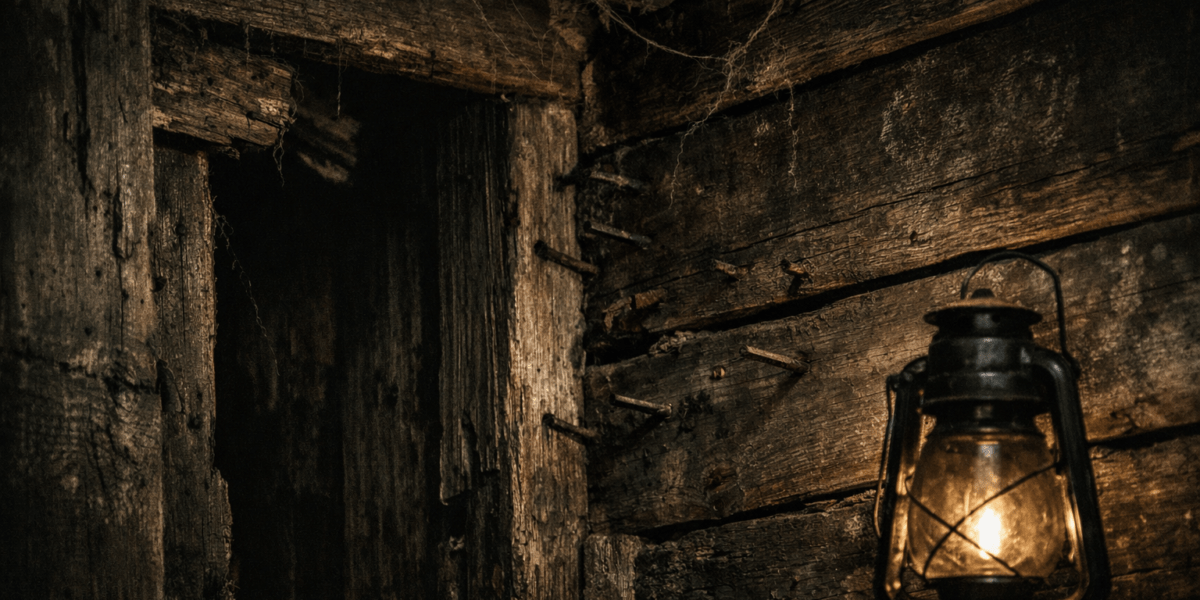
I spent the afternoon back inside the run between the true hallway and the unadmitted space. Headlamp, mask, knee pads. The air inside is colder than the rooms it borders by a few degrees; you feel it first in the fingers. Dust holds the light in a fixed column, and everything else seems to wait for it to move.
What I missed before: it isn’t all one job. The studs along the first stretch are rough, faces scalloped by an adze or a similar edge—shallow, overlapping cups you can feel with your glove. The next stretch, after the elbow where they tucked the wiring, switches to smooth, milled stock with shallow arcs from a circular saw visible on the narrow edges. The older pieces are browned unevenly; the newer are a flatter gray. One post near the bend shows plane chatter marks, faint ridges left when someone pushed too quickly. Another carries a pencil line scribed and then ignored: the cut landed an inch off.
The nails argue with each other. In one ledger, hand-cut squares driven at opposing angles and clenched. Their heads are black and sit proud under a century of paint flakes. Eight feet on, I found bright wire nails sunk too deep, their rings still visible, driven by a light hand that didn’t bother to set them flush. A handful have been pulled and re-driven in the same holes, loosened by time; you can wobble that board with two fingers. One shim is fixed with brads too short for the load they’re pretending to carry.
Plaster tells its own story. In the oldest portion, wood lath sits irregular, gaps wide, keys of lime and hair mushrooming through, now brittle enough to snap if you breathe on them. There’s a line of soot across one backing, like smoke stopped at a seam—candle or lamp run too close for too long. Past that, the lath becomes tighter, more even, and there’s a skim of white that chips in plates instead of powder. In one patch behind a closet, someone used a small panel of metal lath and a hard, fast-setting mix. The seam telegraphs as a hairline ridge under the wallpaper.
I backed into the chimney chase and scraped a sample of mortar that sifted down like dry sand with a sharp grit under my nail. The joint above it is coarse and tan; below, the bed is darker, almost oily to the touch, like it drank soot. Tiny shell flecks in one, none in the other. The brick faces bear two sets of trowel swirls that cross at different angles.
The concealed surface of the passage carries finishing that should not exist if this were made once and sealed. The backs of wallpapers meet the void like pages of a closed book: a rose-and-stripe layer, then a geometric, then a washed-out field of dots, each cut back around openings that are no longer there. Flour paste still smells faintly sweet when you moisten it; the newer adhesive has no scent at all. I found a run of small holes filled with whittled pegs stained to match the older wood. A mortise for a hinge has been plugged with a fitted block, planed smooth, then dusted over with the same gray as everything else. The block is a different species—tight-grained, a darker heart. A knot above it has bled a glob of amber that hardened mid-drip years ago.
It reads as a route kept up in secret, not a single conceit nailed shut and forgotten. Different hands, different tools, different kinds of care. Concealment maintained as if it had to answer to new circumstances now and then. The hidden route appears repaired in the same way a lie is revised.
— Thomas Hale