
Entry #71
August 29, 2024 — 3:00 PM
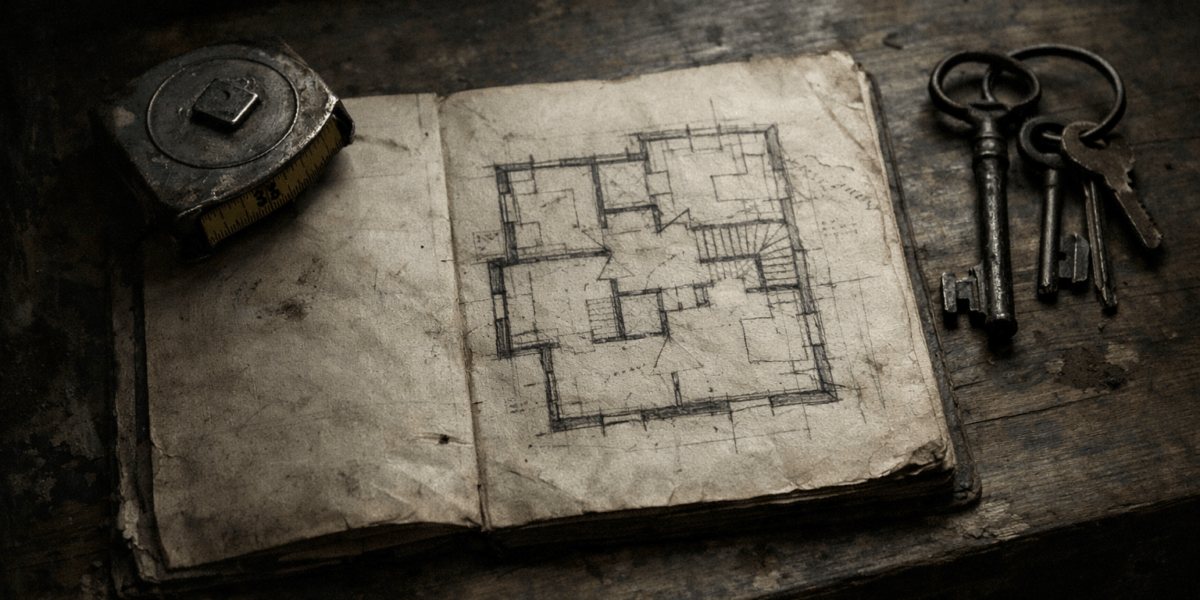
This morning I set the house down on paper. Graph sheets taped together on the dining table, scale marked in the corner, a legend for door swings and windows. Steel tape, pencil, a small square, blue painter’s tape to tag datum lines so I don’t grind graphite into the trim. I started at the front door, because that felt like a neutral zero.
Living room interior span, east to west: 14′ 9 1/2″. Door casing to window jamb, to opposite casing, add the plaster returns. The adjacent hall on the west adds 3′ 1″. At a typical interior wall thickness of roughly 5″, the total should land comfortably against the line of the stair wall. On paper it does. In the room, it leaves me short by nearly an inch and a half. I re-shot it three times. The tape kissed the baseboard; I kept the blade flat. The number stayed put.
Upstairs, I worked the east side where the runs are straight. Hall length from the top newel to the north bedroom wall: 23′ 3/4″. The north bedroom depth, baseboard to baseboard: 12′ 5″. South bedroom depth: 10′ 2 1/4″. Subtract wall thicknesses and the landing nudge. Paper says I should be over by a half inch. The tape says I’m missing seventeen. Seventeen isn’t a plaster swell. Seventeen is a board face.
I stepped outside for a control. The east clapboard run between corner boards measures true at 27′ 4″ to the inside faces, if you account for siding and sheathing. Sun was on that wall, warm to the hand. Inside, in the south bedroom, it was ten degrees cooler and carried the chalky smell that lingers when you unsettle old dust. I marked the measured span across that wall with blue tape flags and laid the plan over it. The flags didn’t meet the penciled line.
I tried to blame the chimney mass, but the worst of the discrepancy falls south of the flue, where there’s only a long, painted wall with a radiator niche. The niche is 7 1/2″ deep. If the wall is balloon-framed—this era—it buys some space, but not that much. I rapped it with my knuckles in a slow grid. The sound changes in a band two studs wide, three feet off the corner. Not hollow exactly. Muted. As if layered.
In the linen closet, behind the lower shelf, I peeled back a sliver of brittle paper lining to run the tape into the corner. The plaster under it had two short scratches like someone testing a nail, and a third line crossing them. Not letters, I told myself, but my pencil copied them before I moved on. E and B fit too easily after you think them.
The plan grew heavier as I added rooms. Overlaps of tracing paper where the first floor ought to sit neatly under the second refused to lie flat. I redrew the stair twice, because the run upstairs arrives three inches north of where the downstairs risers insist it should be. The square says my corners are square. The walls disagree by degrees you don’t see until the math tugs on them.
There’s a space that isn’t yielding its inches. It can be explained—thicker plaster keys at corners, sistered studs, a stuffed chase—until explanations start to feel like furniture I’m moving around to keep a bare spot out of sight. I’ll keep measuring. Numbers are trustworthy until the walls begin participating.
— Thomas Hale