
Entry #156
November 6, 2025 — 10:15 PM
I spent the morning inside the thickened section by the front hall, the one I opened last week. Cold air in there, dryer than the rooms, with a chalky sweetness from old plaster. I went in with a light, tape, and a carpenter’s pencil. No chasing impressions. Just inventory.
On the inner sill, two things first: a shallow crescent of soot printed on the plaster where a lamp base sat, and below it a line of wax runs hardened like stalactites. The soot is not a flare; it’s a halo. Same diameter, laid in the same place, enough times to stain. The wax falls repeat, a little ladder. When I pressed my palm where a person would steady himself to set a lamp, my hand covered a bead of wood polished brighter than the grain around it. That spot is oily, darker from skin. Small things, but consistent.
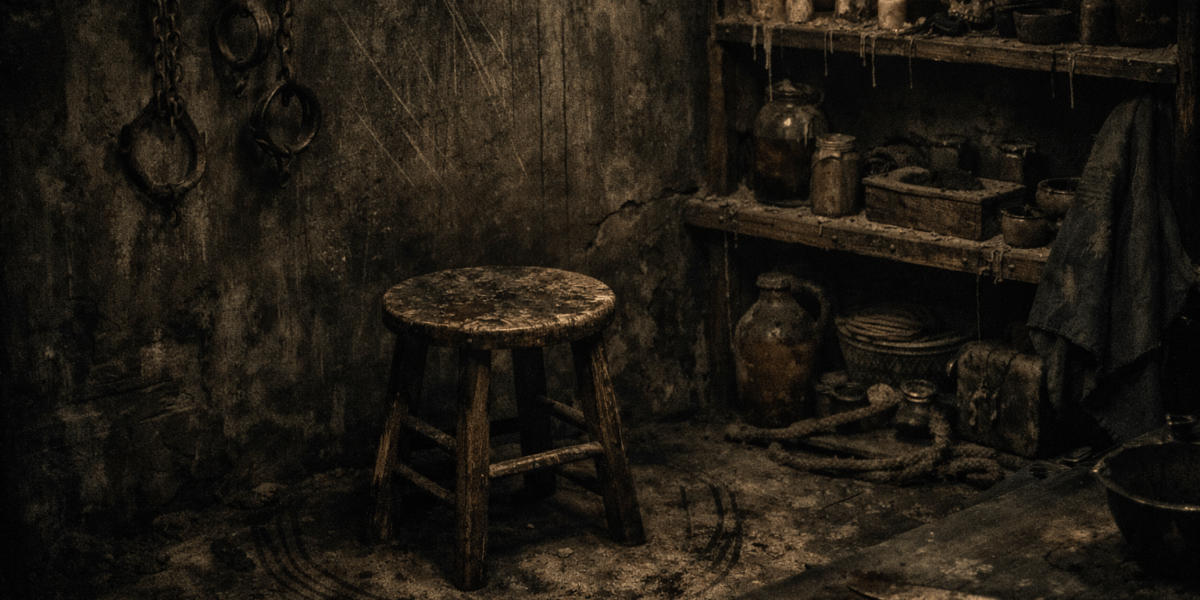
The cross-brace at knee height has a shallow notch dead center, not a break—cut smooth, then softened by use. Above it, the head of one nail shines, the others don’t. A kneeling posture fits. My knee found the worn spot without looking. Someone used that brace as a rest to hold still, to look. They would have leaned left: the left edge is cleaner, rubbed free of dust. My own shoulder marked it again when I mirrored the position.
There are apertures. A peephole bored through lathe and plaster at a downward angle opens to the stair landing. Another, thin as a knife slot, faces the front door. Their heights make sense if you take that kneel, lift with an elbow, bring one eye to the wall. The edges are burnished. The wood around the stair hole carries three tiny pencil ticks, evenly spaced, like sighting marks. On the joist beside the slot, someone scratched S.B. with a pin or nail. On the far beam, deeper in, I found E.B. cut more carefully. I don’t know them.
This is not one hide and then abandon. It’s laid out like a station. There’s even a small iron hook set low—its arc eaten with rust, but still solid. The hook is directly under the soot halo, and four inches below that the wax begins. A habit stacks evidence vertically. When I backed out and checked the wall behind the dining room, I found a twin: smaller, but the same soot crescent and the same knee-sheen on the brace. A notch low in the wainscot lines with a hairline crack. From there you can see the pantry door hinge.
Between the two, along the joists, dust is disturbed on a measure. Not a path cleared once by panic, but a series of footfalls that always chose the same boards. The gaps that are quiet have a fur of dust. The ones used shine and print a repeating arc of shoe edge at sixteen to eighteen inches apart. In that short run, another hook. Another faint halo. My tape found the same distances repeating between brace, hook, and hole. Same build, same reach, same routine.
The structure starts to read like work. Not legend, not accident. A procedure someone kept for long enough that the house learned it, surface by surface. I can follow it without anyone here to explain because repetition writes in simple grammar.
Routine leaves a different kind of evidence than panic.
— Thomas Hale