
Entry #106
February 22, 2025 — 2:30 AM
Midday light made a rectangle on the upstairs hall, thin and precise. I was working the back of the linen cabinet—prying the nailed panel I noted in Entry #104—because the measurements for the new return duct didn’t add up with the wall depth. The blade slid, the brads let go one by one, and cool air breathed out from the cavity. It smelled like dried paste and mouse dust, a little metallic, old varnish heated and cooled for a century.
Inside is the run I’ve been mapping: narrow, ribbed with lath ends, the plaster keys broken and fossil-like. A person can move here sideways if they commit to it. I took the lamp and edged along to where the wall meets the sitting room. At the turn my sleeve brushed a surface that wasn’t raw framing. Smooth. Worked.
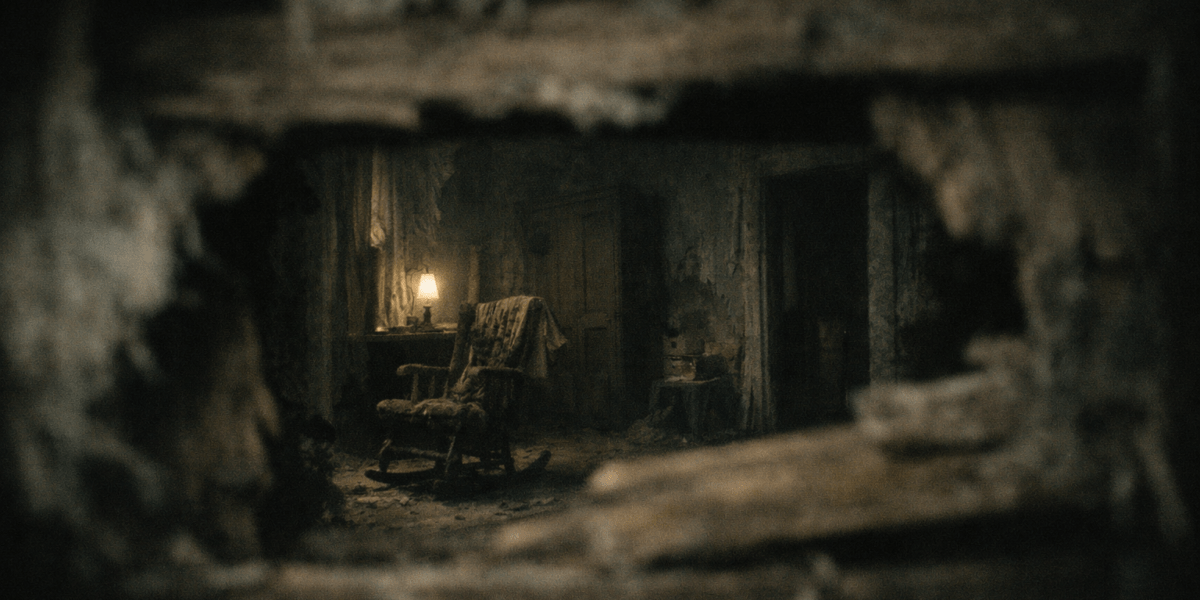
There was a seam of daylight, hair-thin, at eye height. Not a crack from settling. A slit, finished. The edges had been planed and blackened, and someone had fitted a small tin baffle, flared like a thimble cut open. I put my ear to it first. The sitting room clock came through louder than it should, fat and hollow, with a faint whistle at the end of each tick. When I spoke, my voice came back to me a second later from the room side, as if I had thrown it against a shell.
I put my eye to the slit. The sightline was narrow, but deliberate. I could see the lower corner of the room’s south window, the blue runner by the settee, the strip of baseboard where the varnish never quite took. If a chair was placed four feet out, you’d catch a straight view of knees and hands.
I tried to find it from the room. Out of the run, down the hall, in through the sitting room door. The wallpaper’s pattern swallowed everything. There’s a short panel of wainscot just under the chair rail with a carved rosette no one would think about. Under its lip, there’s a dark oval the size of a fingernail. Not a hole so much as a shadow that doesn’t change with the hour. If I hadn’t known where to look, I would have missed it. I placed my palm on that section and felt a thin cold draw along my skin.
Back in the run, I checked the wood around the slit. The finish is worn in a crescent where a cheek would rest. There are shallow half-moons like someone idled their thumbnail there for years. Not letters exactly, but the ghost of an E scratched beside the tin. The baffle isn’t haphazard—its flare collects sound. You could listen without pressing close. You could wait.
This changes the map. I had read these voids as convenience—service chases, access for repairs, a way to keep pipes out of sight. That is still true, but not complete. The runs have stops where the rooms have focal points. The slits sit at seated eye level, not where a plumber would need them. The bends conceal turnouts that favor watching over reaching. Doors I thought were awkward are positioned to make someone cross a certain spot of floor.
The ordinary rooms feel less central now. They are bright islands pressed up against a second, thinner house where steps and breath were measured. The surfaces out here are for occupants. The quiet behind is for the unadmitted, and for the ones who would keep account of them.
Privacy in this house may have been architectural theater.
— Thomas Hale