Entry #360
June 25, 2026 — 11:30 PM
I traced the loop again without deciding to. The back hall, three steps down to the service landing, hand on the rail turned smooth by more than my years. The bulb over the sink hummed with that faint dental-drill pitch. I checked the latch on the cellar door twice. On my way back I paused at the window on the landing, the one I have come to call the watchpane. There was no plan to it. My feet, or what I have of them, found the same squares, the same boards.
At the desk, the pen waited where I left it, aligned with the edge. The blotter shows a long dark oval where my wrist has rested night after night. I don’t remember starting that habit. I recognize it now as a shape of me that will outlast the heat of my hand.
Station, then. I have more than one. The watchpane. The stair bend at the third riser where sound climbs before it shows itself. The front parlor threshold where I tilt the frame so the portrait hangs plumb. Roles grew under my hands the way callus does. Straighten. Listen. Hold. If the window stutters, press the latch. If the cellar yawns, make it mouthless. If the house lists by a thin degree, correct the picture so the room believes itself level.
I thought I was preventing something. Tonight I saw it from the other side. The repeated act is not a hedge. It is a hook. The motion keeps me here as surely as a nail keeps a plank.
The warning I took for advice was not kind. Under the stair’s lowest tread (I would not have looked if I hadn’t already known to pry for messages), in faint graphite: Keep your station. The handwriting is disciplined, the pressure even, the tail of the y clipped. Close by, on the riser where scuffs collect, an E worked into the grain in shallow strokes, and farther along, an S like a snake arrested mid-curve. I have seen those letters before, cut into the attic beam, pressed in the varnish on the banister finial. They were not signatures so much as proofs. Someone before me wrote down the instruction and then obeyed it until the instruction owned them.
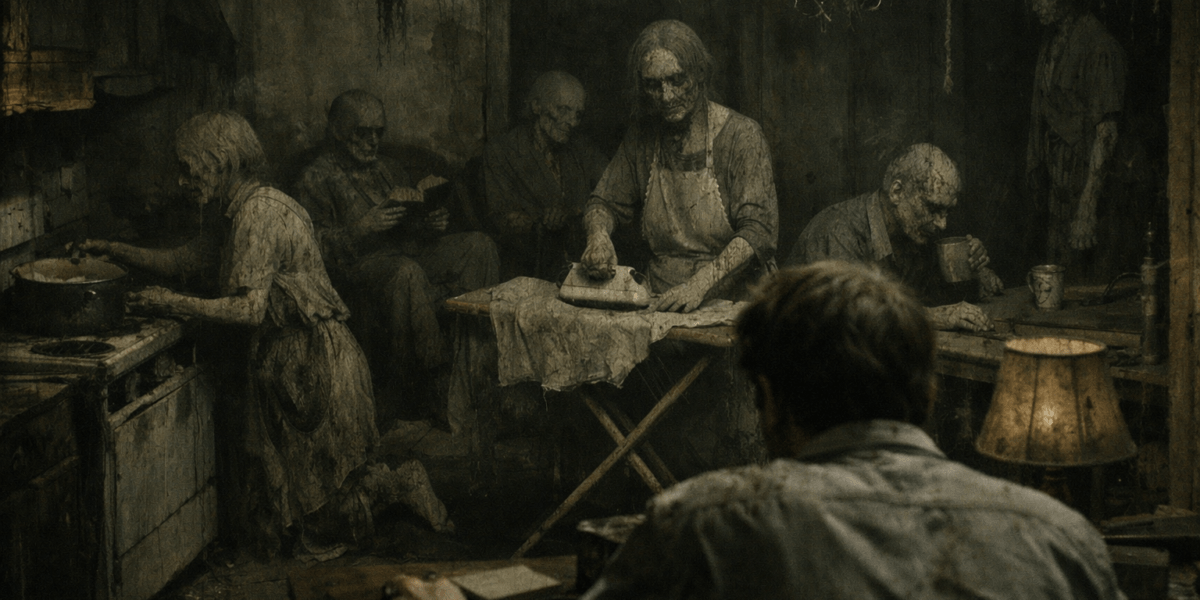
I stood at the watchpane and counted breaths in the glass and saw, just once, another count overlaid—careful, measured, keeping pace. The smell of soap—lye, sharp, old—came and thinned. A skirt hissed where no cloth moved. I did not see their faces and I don’t need to. Samuel, Eleanor—names the deed gave me and the house keeps giving back in slivers. They did not haunt in the way stories promise. They worked. They worked their stations, held their roles, and in that working they stayed.
The mechanism is not spellwork so much as practice. Retention is habitual. The house preserves through reenactment. It makes the dead useful and then makes the usefulness us. If there is a mercy in that, I don’t find it tonight. I feel the grain of myself taking the set of these tasks. I have begun to reach for the frame before the tilt shows. I have begun to pause at the stair bend even when nothing rises.
I can refuse a turn or two. I can walk past the cellar without laying a palm flat to feel for breath. Tomorrow I will not straighten the portrait. I will leave the watchpane to its own reflection. I don’t mistake that for deliverance. It is only resistance to training.
The house did not merely keep the dead; it trained them toward repetition.
— Thomas Hale