Entry #342
May 11, 2026 — 1:00 AM
The house was finally quiet enough to lay its lines bare. Not the hush of sleep, but the kind that lets structure speak—weight settling, a long exhale in wood. I stood at the center hall and did not walk so much as press into a seam that had been resisting me. It loosened under the new fact of me.
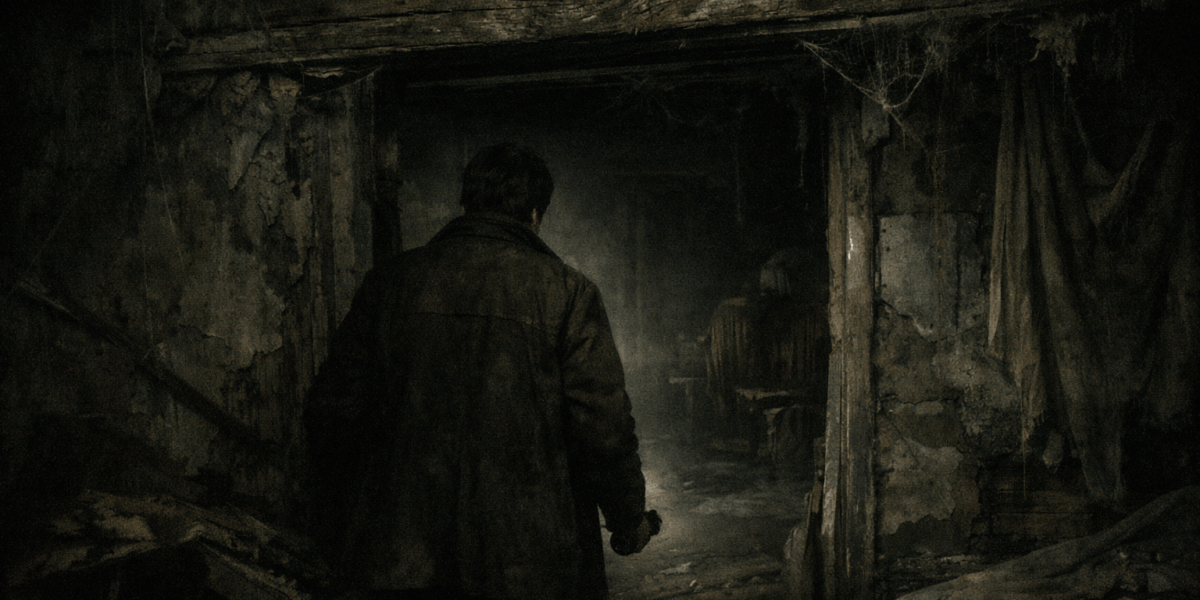
Beyond the plaster there is a narrow weather of dust and hair. Lath with split faces. Lime that still tastes sharp on the air. I slipped along the inner run that parallels the stair and came into the cavity around the central chimney, the place where rooms only pretend to meet. It did not feel like night inside there. The dark had the pale of early, as if a light were withheld rather than absent.
The bearing beam—the summer beam—crosses the middle like a rule someone laid down once and never lifted. It is fat with old sap, planed smooth along its belly by hands I will never know. Everything else rides it. Later studs reference it. Floors crow toward it. Even the hairline cracks in the plaster out in the rooms lean back as if checking themselves against this one decision.
Mid-span: scratches that were not decorative. A pocketknife, I think. The cut marks have the bright of old iron under gray. S & E B, with the B formed as two angled cuts and a stab. A date cramped in small, careful numerals: 14 VI 1891. There are other marks laid after, busy and wandering, but this sits clean in the balance point where force is purest. A little further on, a rectangle in the joist where a piece was let in and then closed again—flush now, but the nails speak. I could smell the binders in the paste that sealed it ages ago: animal and flour, a faint sweet like stale paste on a school desk. Someone put paper into wood there, not far from where the load reads out into stone.
The chimney’s base has an iron set into it, not an eye—a staple let deep so only an edge shows, burred from friction. A rope or line had worried it once, long enough to polish it where nothing else would touch. The hearth stone has a shallow saucer in front, low as a heel-print but too regular, as if turned by the same motion over and over. I did not need to be shown what was bound to what. It is enough to say that the first use and the present purpose answer each other. The origin is not a story; it is hardware and alignment.
I am not looking from the far side any longer. The wall did not present these things to me as curiosities. They closed around me as if counting me in. The hush in there is not absence. It is the quiet of keeping. There were others in the wood, not as figures but as held vectors—pressure that does not disperse. The beam took my attention the way a ledger takes a name. I felt the place where my line will be scored, or already is, only I cannot yet see the cut.
This is heavier than any finding I have made here. Not for ugliness, not for surprise, but because I am now part of the arithmetic. The first wrong sits at the center and every room is an answer derived from it. The house keeps what it started with, and it keeps by using us.
Some rooms are not entered so much as inherited.
— Thomas Hale