Entry #114
April 6, 2025 — 1:00 AM
This afternoon I took up the dining room baseboard where the plaster had already given me a line. The void I’d mapped last week ran longer than I thought. I cut another two bays and found a narrow run wide enough to slip a shoulder through. The studs face one another like ribs. Air in there was cooler, carrying a chalk smell and a sweetness I couldn’t place at first—later I decided on old soap.
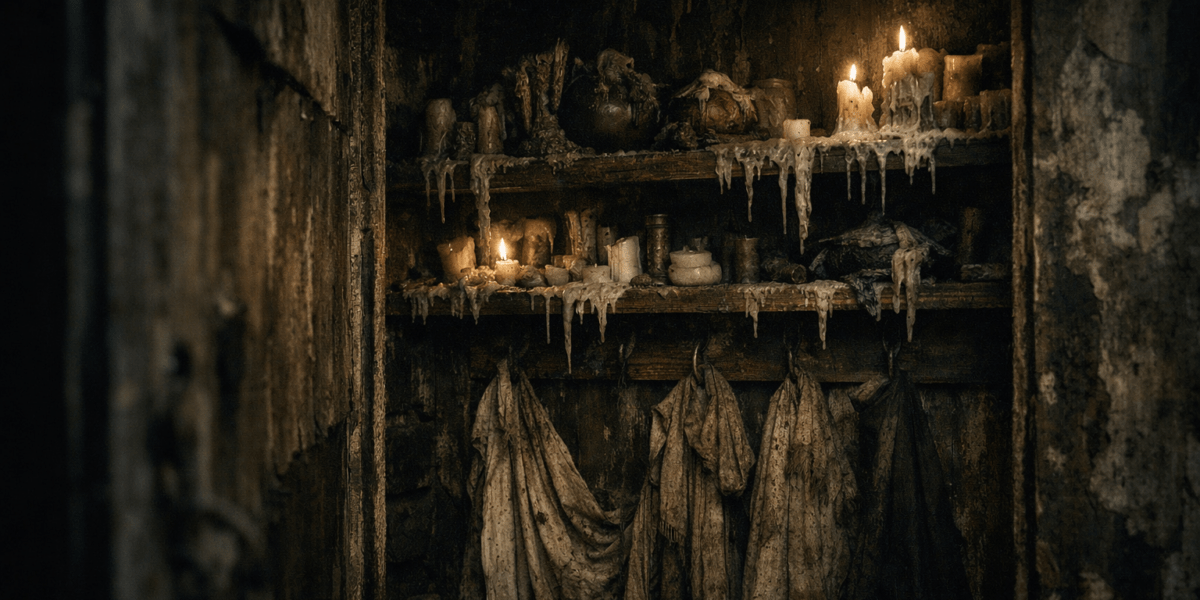
The first thing that told me it wasn’t just a dead space was the edge of a plank shelf let into two studs, planed so the lip was smooth under my fingers. It wasn’t improvised. The braces were cut to match, same angle on each, same nail heads lined up like buttons. There were hooks too, black iron, driven at even intervals—every fourteen inches by my tape, consistent the whole length I could crouch through. The wood beneath each hook showed that dark, glossy dent you get when the same weight hangs in the same place for years.
On the shelf: not an inventory, but enough to say there had been one. A glass jar clouded to milk with age, its cork capped with dark wax, a paper scrap adhered to the curve with only “—wood” left visible. A shallow box with finger joints at the corners, empty but carrying a trace of graphite where a number had been written and rubbed away. A bundle of rags tied with twine, the outer cloth cleaned smooth at the knot from being handled. A paper tag on a nail, brittle, with P-3 faint and slanted.
The floorboards inside the run are narrow, not the wide ones in the rooms. I’d call them service boards. They give a scuffed sound when you move, not hollow, not spongy. Dust lies to the sides, pushed there in a shallow scallop, as if a broom had been run along the center often enough to leave a habit. Even now, after a century of settling, that lane is thinner than the rest. Cobwebs were there, yes, but snapped across at shoulder height, not the undisturbed curtains I find in true voids. On one stud, a faint soot thumbprint near head height. I found a little tin cap the size of a thimble caught behind a brace. It smelled of oil.
Under the shelf lip, someone cut a notch and then, beside it, scratched two initials so tight they almost disappear: S & E. Farther along, a row of pencil marks in sets of five, repeated at three bays. Counting, failing, counting again. The measured kind of failing. Chalk lines still ghost the studs where someone once laid out where to nail, but over that there are marks that don’t belong to construction—small arrows, a circle around a knot, a lightly penciled “north” written the wrong way round for the room it sits behind.
I don’t want to name it a corridor, but it’s not a crawlspace, either. Not the kind you forget. It reads as a working interior. A place to go to do something, then go back out and pretend it wasn’t there. The hooks free of corrosion where something shielded them for a long time. The way the rags were folded, edges aligned, not just stuffed. Repetition reveals itself in dents and shine, in the rhythm of nails, in distances that match each other when measured blind.
It’s one thing to find what the walls take. Another to find what the walls keep ready.
Disorder can look accidental, but arrangement always asks by whom.
— Thomas Hale