
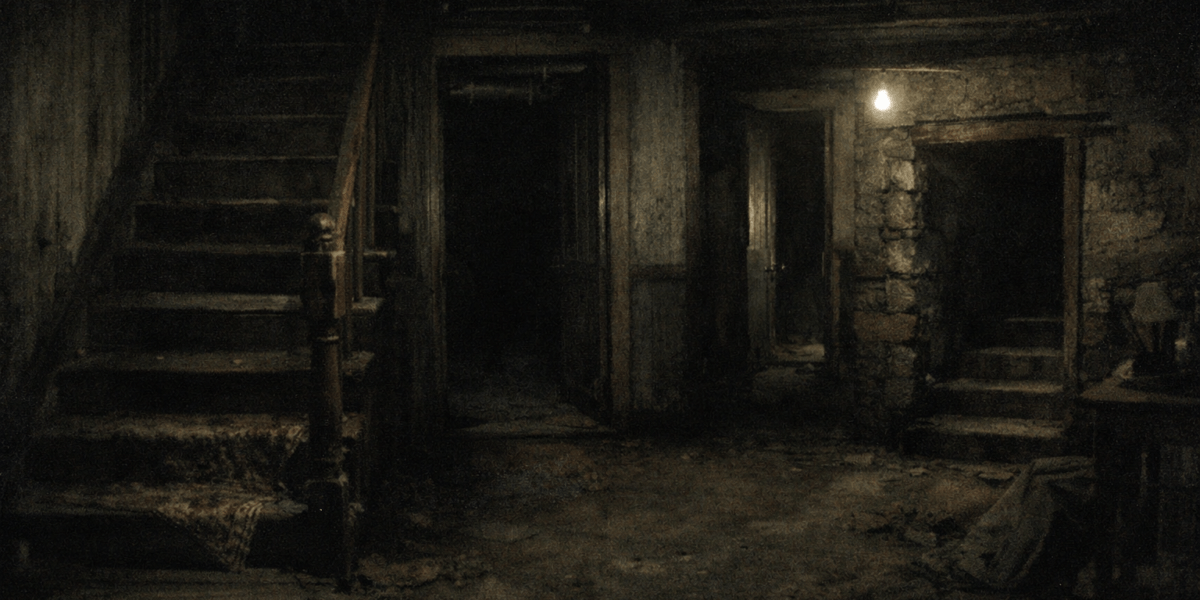
Entry #174
January 21, 2026 — 10:15 PM
I shut the furnace down at nine to hear what the framing and plaster do without forced air. The house cooled fast, a film of cold on the floors and a drier sort of quiet. I set the phone recorder on the stair and took the graph paper from last week’s Observation Run. Tonight wasn’t a line like #171. I wanted a route.
The first sound was ordinary: a chair leg rasp in the dining room, back left — except I was standing there. The rasp came from above me as much as beside me, as if the floor itself was a mouth. Six seconds later, three dull taps from the east parlor wall, same cadence I’ve heard before, followed almost immediately by that identical three-tap from the second-floor landing, but offset toward the rear, where there is no continuous wall to carry it. I marked times and arrows. The sequence produced a curve that, on paper, ran through a corner that doesn’t exist.
I tried to force it to make sense. I opened the return grilles and put my ear to the cold metal lips. Air smelled like dust and old linen. In the pantry I rapped a wrench against the stud bay and listened upstairs. The return pinged back from somewhere that should be the chimney mass, then slid to the right as if drawn by a longer void. In the basement, a water hammer in the south run answered a tap in the upstairs bath within a beat, then a full beat later the same click arrived from the attic knee wall — too fast for vertical travel if it were one continuous pipe, too regular if it was random.
I mapped it as a circuit: parlor east, landing rear, back stair, pantry chase, basement south, attic knee. A neat oval on paper. When I laid the oval over the measured plan, it leaked past the exterior line by a foot in two places and tucked inside the chimney stack by three. I redrew, tightened everything. The marks still wouldn’t live inside the envelope. Either I was hearing through hidden chases and voids that cut diagonally, or the air in here carries sound along paths that don’t match stud and joist.
The house did something I can’t do: it coordinated itself. When I stood at the bottom of the main stair and scraped a drywall knife twice along the tread, the second scrape answered from the short hall between the innocent room and the bath before the first had fully faded. The hall is not visible from the stair. There’s no open door to make it a straight shot. And yet the reply had the same brightness, as if the same blade were traveling a longer step somewhere invisible, keeping tempo.
While I had the return in the dining room off, I found a thin wooden strip wedged behind the grille screws, probably a shim. On the back, in a careful hand, the word BLACKWOOD cut all the way through the veneer. Not initials. The full name. I searched county registries again, broader terms this time. No births, no deaths. The deed is still the only firm thing. A name without a person it belongs to.
I worked another hour. Chalk on thresholds, pencil ticks at baseboards where a click seemed to pass. I strung a plumb line from the landing and took measure down to the parlor line, tried to set proportional distances to match the timing I was hearing. The times suggested lengths that would make sense in a larger structure. The sketch that made the sounds fit did not fit the house I can measure with a tape.
The plan is to build a new map that assumes the sound routes are the true boundaries and see where that takes me. For tonight, one conclusion only: the house seemed largest when measured by sound.
— Thomas Hale