
Entry #120
May 7, 2025 — 10:15 PM
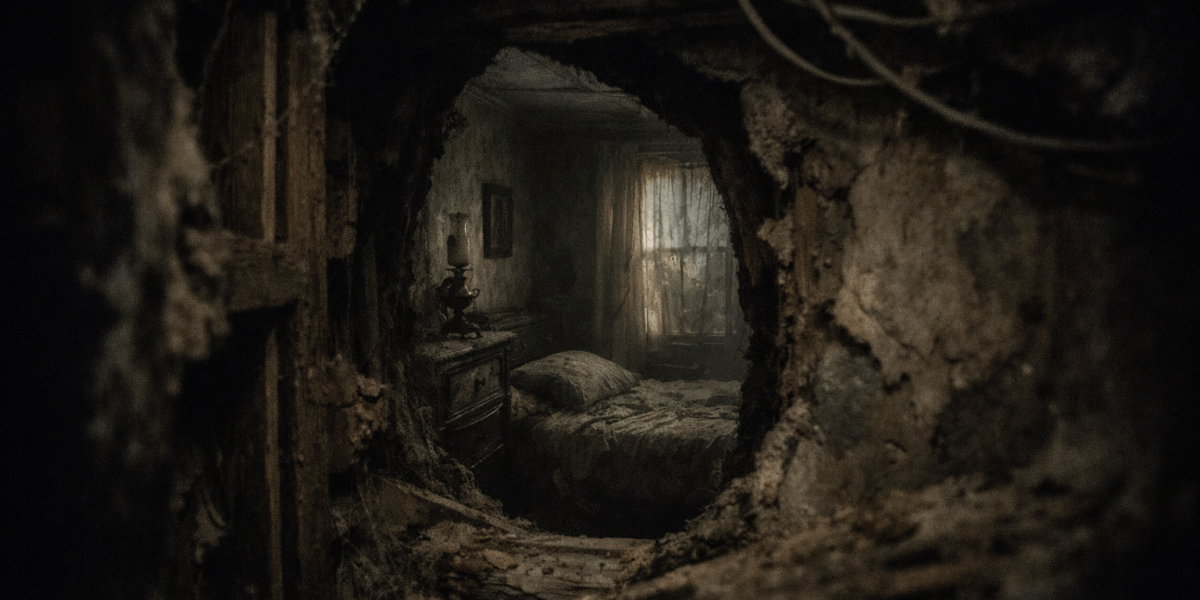
This morning, chasing the same thin draft I mapped last week, I pulled the beadboard in the upstairs east hall. The nails came out with that soft, reluctant groan, heads shined from a hundred coats of paint. Behind it the studs were scarred and pale. Dust fell in a drift that smelled like dry wheat and mouse. The air changed—colder, less room in it. A void about a foot wide ran between the chimney chase and the outer wall, tidy as a hallway built for the narrow idea of a person.
I went in sideways with the headlamp. Splinters combed my shirt. The tongue-and-groove back there had a polish where no one should have touched it—at knee height, a strip smoothed satin-dark by cloth or skin. Directly opposite, at face height, the stud edges were inscribed by a motion that repeated: elbows braced here, then slid there. The headlamp showed a shallow wooden block fixed at an odd angle, a rest that fit too well under my cheekbone when I tested it. The block gave slightly. It remembered the pressure.
The draft had a path. It came through the lath itself. Someone had cut a slit as precise as a cabinet maker’s mortise, a bevel from within to widen the field. From the hall side it looked like nothing—plaster and paper. From here, pressed into the cold, I could set my eye and see the parlor beyond, framed narrow: the white of the mantel, the north window, the edge of the long table, the place where a person stands to pour from the decanter. The angle was deliberate. It took in the chairs but not the door. It missed ceilings and floors and committed to faces.
On the parlor side, what shows is only a cast-iron return with a prim pattern of diamonds. It’s older than the furnace. I checked: the screws had been painted over and repainted. From in here, the diamonds line with nothing. Only that one gap is true. The rest are blind. I put out my light and let the room compose itself in grays. The feeling wasn’t being seen. It was the opposite—this narrow intake of sight, the house taking in.
Sound found the opening too. When I breathed, the room held it. When the kitchen clock downstairs nicked the minute, I heard it sharpened, carried up and along this thin tract of air. In the afternoon, standing in the parlor and speaking toward the grate, my voice bent and answered itself a shade late from my own shoulder in the wall. The edges of speech I noted days ago weren’t a trick of plaster. They were a function.
There were marks above the cheek-rest, small notches in the stud, irregular, not quite counting. A fingernail had tested the resin there, over and over, until the gum bled and turned black. On the sill of the slit, a single initial shallow as breath—an E, or maybe only a stroke begun and lost to the soft grain. The wood around it is dark from oil. You don’t get that without time.
I backed out slow, felt the chill leave at my shoulders. In the parlor I looked again at the register and understood its job. Storage is generous. This isn’t generous. This is exact. It puts an eye where an eye was meant to be.
Being watched is unpleasant, but learning the room was built to permit it is worse.
— Thomas Hale