Entry #172
January 12, 2026 — 8:30 PM
The seam I kept losing by daylight finally gave. South parlor wainscot, east wall. The beadboard nails weren’t right—two brads sunk at a slant where others had old square heads. I worked the putty line with a thin blade, then a cat’s paw under the cap rail. No creak from the room side. Inside the wall: a small iron catch, filed smooth. A lever you have to know to touch. I slid it. The panel breathed cold at me.
Behind it, not a void but a run: shoulder-width, plank floor raw and gritty, the kind of dust that keeps its own scent—dry plaster, mouse, singed oil from a long-ago lamp. Enough height to stoop, not stand. I clicked the headlamp and went in sideways. The house breathed a little different in there, a slow cool draft that went past my ear like a hand.
The run carried behind the parlor and under the stair, boards scabbed with old graphite marks: arrows, room names in shorthand (P, S, H). At chair-rail height, between studs, beveled slots blackened with lampblack. From the room side they read as shadows where boards meet; from the run you can see through at an angle into the bright. I put my eye to one for the test—parlor molding sharp as a ruler, the far chair upright and empty. Corridors like this don’t build themselves by accident.
The system isn’t only sight. At intervals the wall thickens and there are short tubes let into the lath, thumb-thick, lined in felt, each ending in a cup of turned wood. I put one to my ear and heard the kitchen clock through three walls, not loud but exact—the stop, the lift, the drop. When I touched the tube’s damper, the tone changed. Frequencies favored, others killed. Tuned.
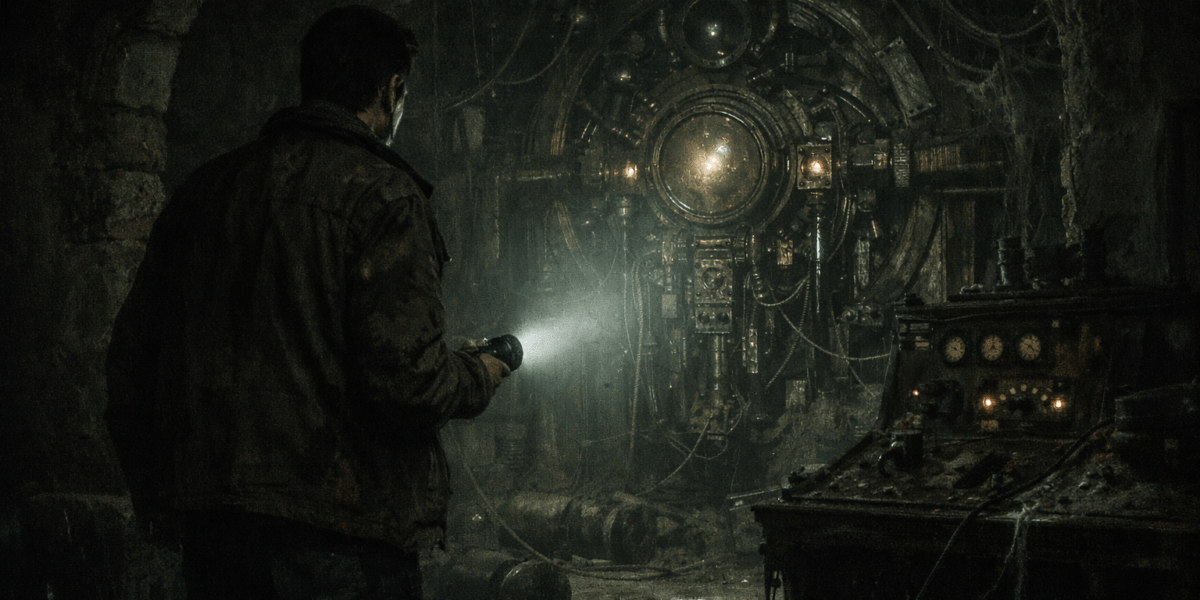
Ten feet in, the run swelled into a pocket, a little station under the stair angle. A fold-down seat was still hinged there, its leather strap dried to a twist. Opposite, a narrow board set with four brass toggles, hand-made, each tied to a wire disappearing both ways. The toggles weren’t electrical—they traveled. I flipped one a hair and heard in the parlor a hush I could feel in my teeth, a louver or baffle seating somewhere. I flipped it back. On the board, scratched with something sharp: DON’T SET FOR NIGHT. Below that, in a steadier hand, BLACKWOOD. No initials. The whole name.
There was also a paper tag under a tack, edges feathered to nothing. The ink had fled except for a line of numbers and a month I had to guess at twice until the light hit it right. 14 June. 1891 would fit the way the numerals were curled, but I won’t swear to it. I took photos anyway, then my gloves off to feel the heat of the brass. All of it was the same temperature as the room: cold.
I backed out and shut the panel. The catch seated the way a jaw sets. At the desk I pulled the county site again. The deed—my deed—cites Samuel and Eleanor Blackwood, witnessed that same June. No births. No deaths. No tax rolls under that name other than the parcel itself. Searching further got me a mill ledger from the 1890s with a blotted entry, and a church list with a blank where a family might have been. The name turns up around the house in fragments I’ve been seeing for weeks—S.E., a B burned into a joist—but this was the first full BLACKWOOD, in the hand of someone who sat on that little seat and worked those levers.
I could spend pages on how the slots are beveled, how the tubes turn ninety without losing the kitchen clock, but the point is simpler. The house wasn’t built to be haunted. It was built to watch and listen, to adjust its rooms the way you tune a radio until the signal stands up. The warnings aren’t poetry. They’re operation notes.
The house had finally admitted not a ghost story, but a method.
— Thomas Hale