Entry #231
November 1, 2025 — 1:00 AM
I opened the narrowed throat the rest of the way with a pry bar and the short hammer, working from the ribs outward so I wouldn’t drop weight where I couldn’t see. The last board let go like an old tooth. Cold air came up, not damp, not cellar rank—dry, a little mineral, with that high chalk smell of old lime. I put the headlamp in, then my shoulder, then both knees.
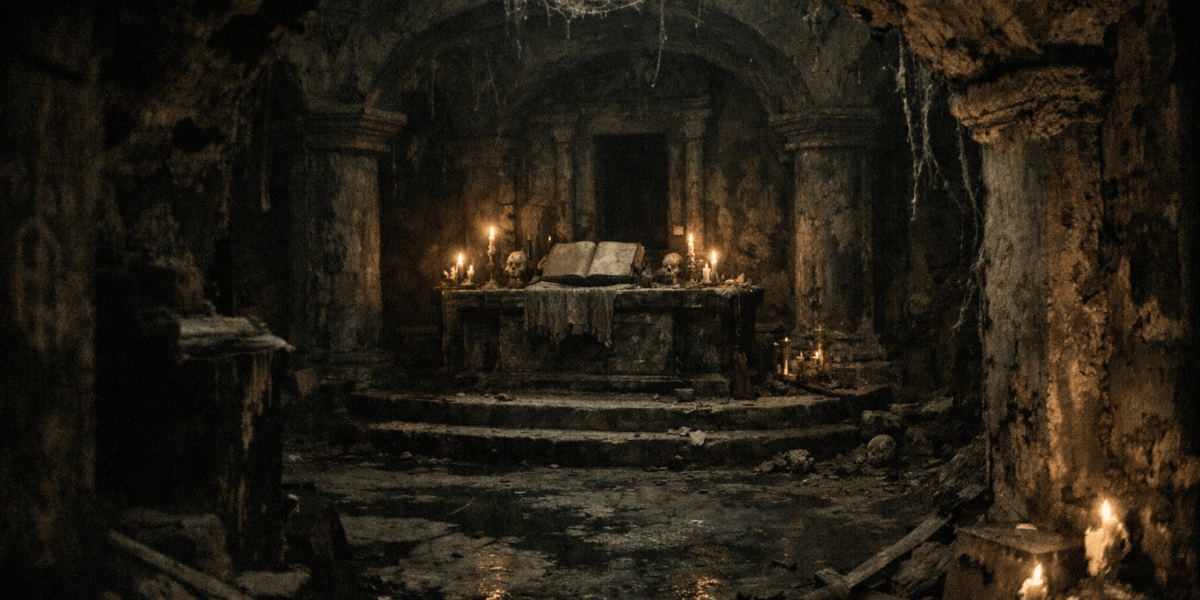
The space beyond isn’t like the copied pockets I’ve found under stairs and behind cabinets. This sits before those, in every sense. The timbers are older: adze-flattened oak, grey and black where smoke must have gotten in once, edges worn to a softness under fingers that found the same path a long time ago. No nails in the primary joints. Pegged mortise and tenon, cheeks tight. The pins are riven, not turned. When I lit across them, there were scribe lines still visible, shallow knife ticks that never saw the planed-off day because no one bothered to pretty this for anyone’s eye.
It is a square, almost exact—eight feet and a handful by eight and the same, low at the crown by my head and a half. The ceiling is a lid of planks with a single cross-beam, and in the center of the floor there’s a scar, a circle cut into the boards and later packed with a different mix—lighter dust, hair in the lime, flecks of charcoal like pepper. The walls each have a shallow recess halfway up, not deep enough to serve as a shelf, just a relieved panel the size of a book turned sideways. They correspond from face to face. I checked with the tape: the spacing from corner to recess repeats at each wall with less than a quarter inch of drift. I have seen that interval mass-produced in the later additions, but there it was an echo riffed around pipes and ductwork. Here it is the first sentence.
The light picked mica in the plaster, a slow sparkle like frost under dull paint. My breath came back to me flattened and close. If I held still, I could hear nothing mechanical, just a slight dry tick where powder sifted somewhere else in the frame. The corners are cut clean, and each corner post bears a circle scratched around a peg at knee height—four circles at four points, no decoration, just a mark to say: here, here, here, here.
On the underside of the beam, near the west side (the compass at my belt read it so), there is handwriting in graphite, soft and fainted by decades of temperature and mice and air: S & E B—. Then, a space, and what could be 6 14 91, the ones squared like a person taught before the century turned. The surname tails off into the knot. I held the lamp low and read it three times until the bevel of the grain stopped tricking me. Back in my folder upstairs, the deed from June 14, 1891 sits with their full names in iron gall ink. Down here the house has their abbreviated hand instead, in a place no closing agent would ever see.
There are other marks. Very light pencil grids on the east wall, one-inch checks, and tiny numbers in a steady script counting studs that are not present. A drawing of the same square I was standing in, drawn smaller, with the recesses shown by four darker ticks, and an arrow notated N. It is not a charm. It reads like measurement done in place. I don’t know if they were recording it, or if the room pressed their hand to the wood and took their measure down itself.
The hidden rooms I’ve pulled apart upstairs and in the addition—behind the kitchen chimney, along the laundry—suddenly made more sense kneeling here. Their odd dimensions weren’t accidents or cheap fixes; they were adaptations of this older logic, bent to later walls and newer lay-ins. What’s here is the source pattern. The later hidden rooms seemed to speak a dialect of this older one.
— Thomas Hale