Entry #129
June 24, 2025 — 10:15 PM
I spent the evening in the space I opened last night, the cavity beyond the lath that turned out to be more than a void. Knees on an old plank bridging studs, work light clipped to a nail, bulb hot against the stale cool. The air in there has its own weather—cold at the floor, warmer where the chimney shaft warms one wall. It smelled of old paste and camphor, with the sharp iron scent of old nail heads every time I brushed a beam and woke the rust.
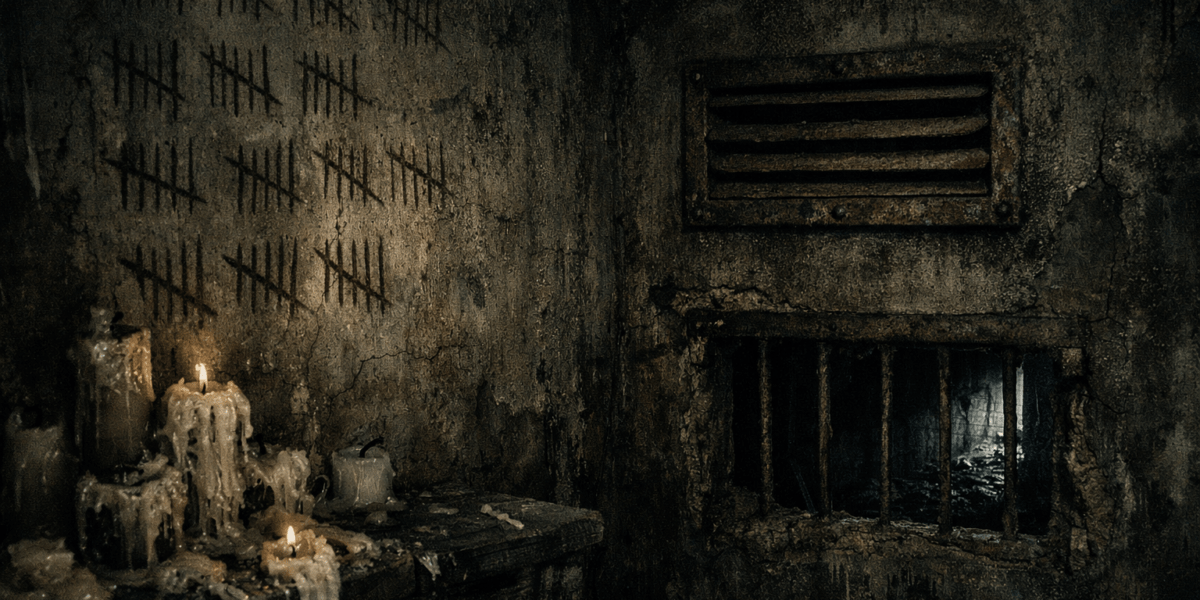
The first thing that felt familiar were the chalk marks. On the inside faces of the studs, not builder’s plumb lines, but small arrows and ticks like the ones I’ve been finding under paint on baseboards. The same waxy drag. A circle with a notch, repeated at two corners. One of the crossbraces carried a little ladder of lines—five and a slash, five and a slash—like the tallies under the parlor sill that didn’t make sense at the time.
Twine, too. Several cords, thin as kite string and waxed, ran along the studs and slipped through bored holes into adjoining walls. One frayed end was knotted the way I found behind the dining room baseboard in March. The same pale fibers, same bit of grit worked into the twist. I gave it a slow pull. Somewhere to my left and a floor up, a tiny metal click answered, then the soft give of a latch. I didn’t see anything move, but I knew that sound. The hallway linen door that opens itself by an inch and waits. So it isn’t a trick of airflow, or at least not only that.
There are apertures. Not crude peepholes—narrow slots and round bores at differing heights, each leading out through some decorative element. One at my shoulder looked through the space behind a return grille on the upstairs landing; the vanes out front disguise the cut. Through it I could see the banister post I’ve patched twice, and the slice of the runner where the boards always complain at night. Another tiny circle stared into the parlor between two panels of wainscot; it caught only the chair backs and a corner of the mantel mirror, tilted to take a reflection. When I breathed toward that one, the draft returned on my cheek from a different angle, as if the house breathed back through a different mouth.
I scraped at a strip of soot near the chimney. Under it, faint knife scratches: an E, then a B very close by, and below that 14 VI 91. The first two could be anyone’s initials. The numerals match nothing I’ve dated in the framing so far. On a different stud there was only a long cursive tail that might have been the start of a name ending in a hard line, as if the knife slipped or someone stopped.
All the earlier strays are in here somewhere. The cold patch along the east bedroom baseboard sits directly opposite a narrow gap that pulls air from this room when the attic window is open. The odd acoustics in the front hall map to a void branching off the slot behind the return grille; a whisper travels there with almost no loss. The small nail I kept finding in the floor register matches the gauge of brads used here to fix a shutter over one of the slots. Even the pattern of dust on the dining room floor—the same soft gray that sits on the plank in front of me, disturbed in the same crescent shape where a hand would brace to peer.
I don’t have meaning, only function. Standing inside it felt like standing in the center of a device. Heat here, draft there, sightline carried by a mirror edge, a cord laid to tug a tongue of metal on a latch sixty feet away. It isn’t ornamental. It isn’t even secret for its own sake. It reads like part of the house’s operating logic—one of the ways it moves and sees and makes its noises.
Tonight the room seemed less like a discovery than a key that had been waiting for the right lock.
— Thomas Hale