
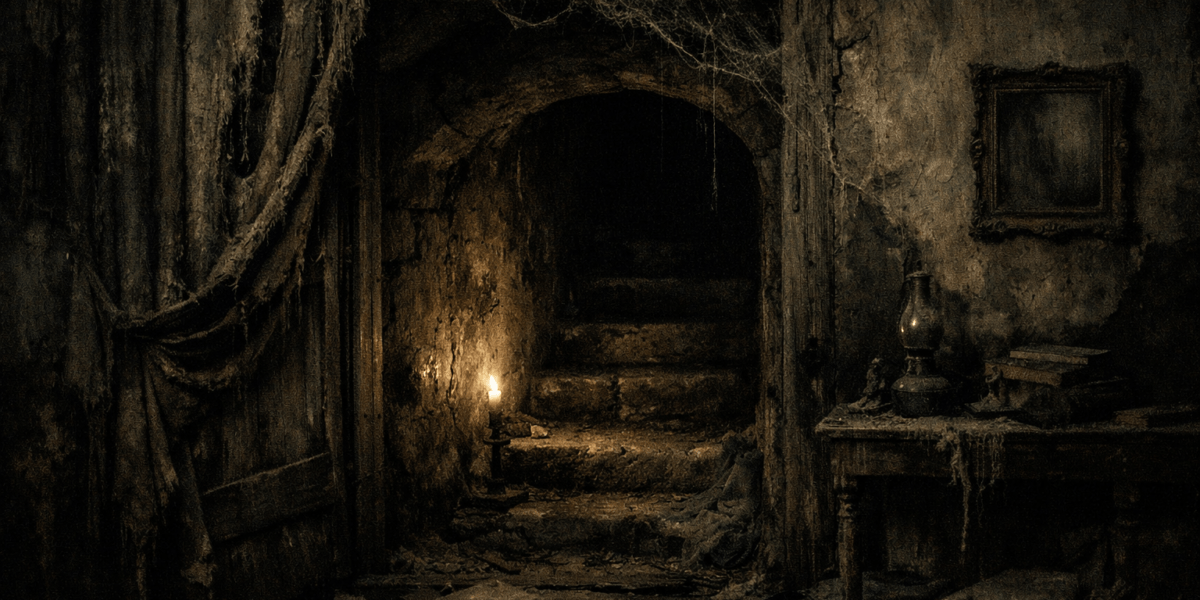
Entry #307
March 11, 2026 — 1:00 AM
This afternoon I went back to the narrow run behind the pantry, the one with the panel that used to pretend it was part of the wall. I wasn’t sure what I expected. Habit took me there, I think, the way your feet will find stairs in the dark because they remember.
The seam showed itself before I touched it. No more than a dull brightness, a line where dust did not settle as thickly as on the rest of the paint. The light in the pantry was poor—clouded March sun washed through a small window and filled the air with the smell of soap and onions—but the line had a steadiness I could read. I set my fingertips to the molding. There was no need to wedge a knife or lend weight with a shoulder. The panel yielded the way a held breath lets out. No hinge screeched. No vibration came back into my bones. It was more like the space past the board decided to include me.
Inside, the temperature held even and close, not cold the way a cellar is, not warm with pipe heat. The air was dry. It had the starch-sharp smell of folded linen and an old mineral tang, something like lamp oil long since gone. I put my hand along the rail to keep balance, out of old reflex. The wood felt smooth where many hands learned to turn in the dark, but my palm left no print in the dust. On the underside, where I wouldn’t have seen before, two letters had been scratched shallow into the beading. E and B, the vertical of the B not quite straight, as if whoever cut it rode a nail along the grain. I had run this way more than once. I would have noticed that. I am not sure if the letters were new or if the rail had turned itself to show them.
The stairs took me up in a count that matched the dining room paneling: twelve to the landing, four more to the elbow, then seven. The geometry behind the walls finally admitted its logic without hurry or explanation. Every turn squared to a corner I knew from the other side; each riser met my foot without asking for pressure I no longer carry. I didn’t have to brace, or angle my body to take the tight parts. The wood made room and forgot to complain. I could hear the house’s regular sounds in small, unbothered portions—the slow tick of cooling pipes, a far cupboard settling, a loose shutter tapping in the west bedroom—but none of it pressed into the passage the way it used to when I pushed from the wrong side.
At the second landing there’s a slatted door that never did more than rattle at me. Today the slats opened as if they recognized the touch. The latch came up, quiet as a pull of thread, and the closet beyond gave off the husk-smell of old cloth and iron. On the back of the lowest shelf a mark showed under the gray—a single S, then a long stop where the stroke met a knot, and beside it the beginning of a rounded letter that could be the start of a B or just the curve of someone’s hand catching. Dust lay even, but the cut edges looked lighter than they should have. I listened for a footfall on the landing outside the closet, for any sign I’d made noise. Nothing came. Not even my own breath to answer me.
Coming back down, I put the panel almost to, then left it a thumb’s width. From the pantry side that gap was nothing, the line swallowed by the paint’s flat sheen. From the passage I could see daylight chasing along the baseboard like a thread being pulled through. The concealment worked both ways, but I was on the side that no longer had to pretend ignorance. The passage no longer felt concealed from me, only from the rest of the house.
— Thomas Hale